The Best Temperature for Sleep Isn't the Number You Think
You keep nudging the thermostat and still wake up too hot at 2 a.m. Here is the part the sleep tips skip: the number on the wall is not really the point — your body has to lose heat to fall and stay asleep, and the room's only job is to let it. Set the room up for that and the number mostly takes care of itself.
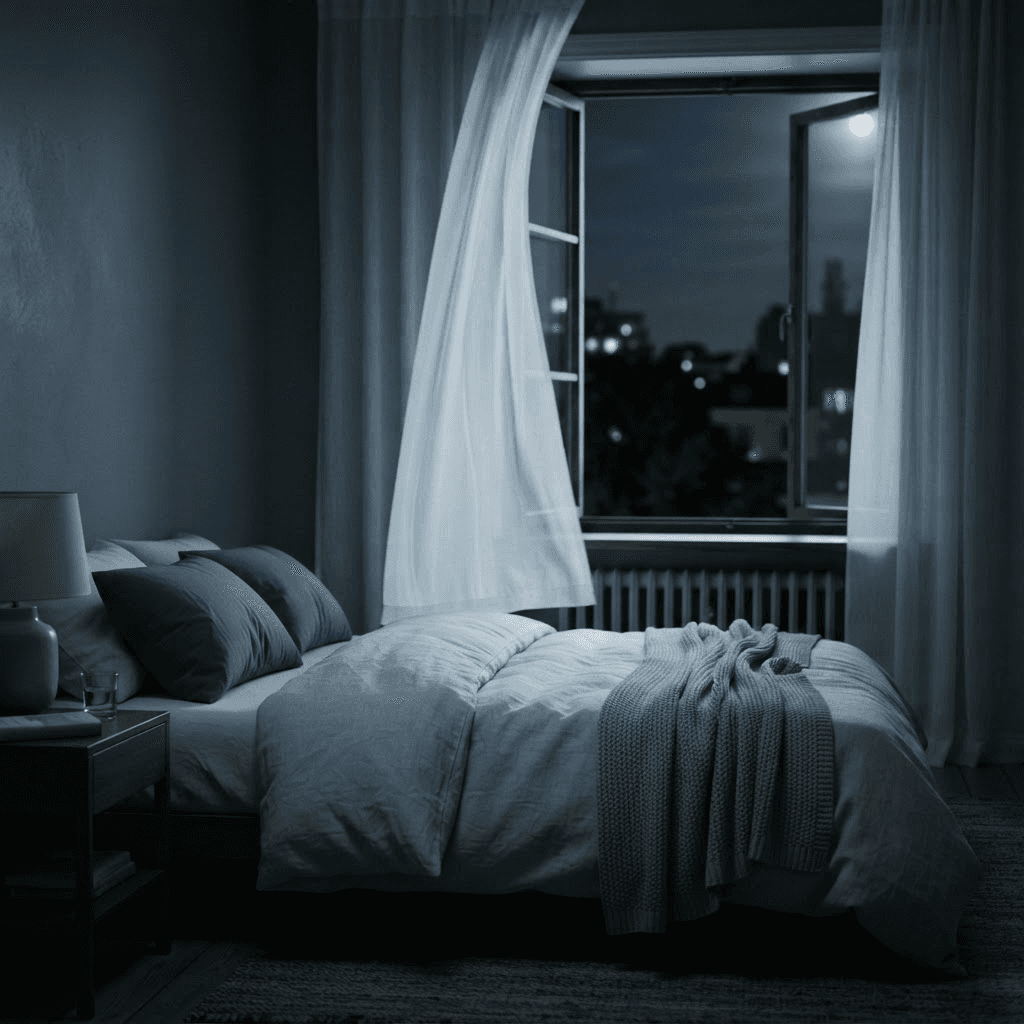
The reading, in five lines
- 01A common recommendation is a bedroom around 60–67°F (roughly 16–19°C), but the right number varies from person to person.
- 02The reason a cool room helps is that your body has to release heat and let its core temperature dip to fall and stay asleep.
- 03Warming your hands and feet — warm socks or a warm bath before bed — can actually help you cool down faster and drift off sooner for some people.
- 04Too cold can be as disruptive as too hot; the goal is a room that lets you shed heat, not one that leaves you shivering.
- 05A room set up well but still leaving you hot, sweat-soaked or wide awake most nights is worth raising with a clinician rather than solving with the thermostat alone.
It is 2 a.m. and you have kicked one leg out from under the duvet — the ancient, unconscious move everyone makes without ever being taught it. You nudged the thermostat down before bed, and you are still too warm. So you do the obvious thing and hunt for the perfect number, as if there is a single setting that unlocks the night. There isn't, quite. The number matters, but not the way most sleep tips imply — and once you understand what the room is actually for, the question stops being "what temperature" and becomes something you can actually act on.
This guide gives you the range most experts land on, then spends the rest of its time on the thing that makes that range work: your own body temperature has to fall for sleep to arrive, and the room's whole job is to let that happen. Get that relationship right and you can stop fiddling with the dial every night.
Why temperature runs your night more than you realise
Of all the things people fuss over before bed — the screens, the last coffee, the racing thoughts — temperature is the one that quietly overrides the rest. You can do everything else right and still spend the night flipping the pillow to the cool side because the room will not let your body do what it is trying to do. And what it is trying to do is cool down.
Your body runs on a roughly 24-hour internal clock that governs far more than when you feel sleepy. One of the things it controls is your core temperature, which is not fixed — it drifts up and down across the day and night in a predictable rhythm. In the evening, as bedtime approaches, your core temperature begins to fall, and that decline is closely tied to the release of melatonin and the onset of sleep. A room that traps heat works directly against this nightly cool-down.
This is why a hot room does not just make you uncomfortable — it can fragment the night. Research on the thermal environment and sleep suggests that heat exposure, especially without the ability to adjust bedding or clothing, is associated with more time awake and less of the deeper, more restorative sleep, with the effect often more pronounced in the second half of the night. If you already tend to surface in the small hours, warmth can be one of the reasons it turns into a proper waking; our guide to waking at 3 a.m. walks through the other common causes.
So what is the "best" temperature — really?
Here is the number you came for, with the honesty it deserves. Many sleep organisations and clinicians suggest a bedroom somewhere around 60–67°F, which is roughly 16–19°C, as a starting point for a lot of adults. It is a sensible range and a good place to begin experimenting. What it is not is a law of nature that applies identically to every body in every bed.
Treat that range as the middle of a target, not a single bullseye. Plenty of people sleep perfectly well slightly above or below it, and the figure you actually want is the one that lets you drift off without either sweating or shivering. Your bedding does a lot of the work here too: the same room feels very different under a thin summer sheet than under a heavy winter duvet, which is why the temperature that suits you in July is rarely the one that suits you in January.
| Setting | Approximate range | Notes |
|---|---|---|
| Common adult recommendation | 60–67°F / 16–19°C | A widely cited starting range; find your own spot within or near it |
| Too warm signs | Above your comfort point | Kicking off covers, sweating, restless second half of the night |
| Too cold signs | Below your comfort point | Cold hands and feet, tensing up, waking to pull covers back on |
If you prefer to skip the numbers entirely, use your body as the thermometer. A room is about right when you can settle under your usual bedding without peeling layers off within the hour or curling up to get warm. That felt sense of "cool but not cold" is more useful than any single reading on a wall.
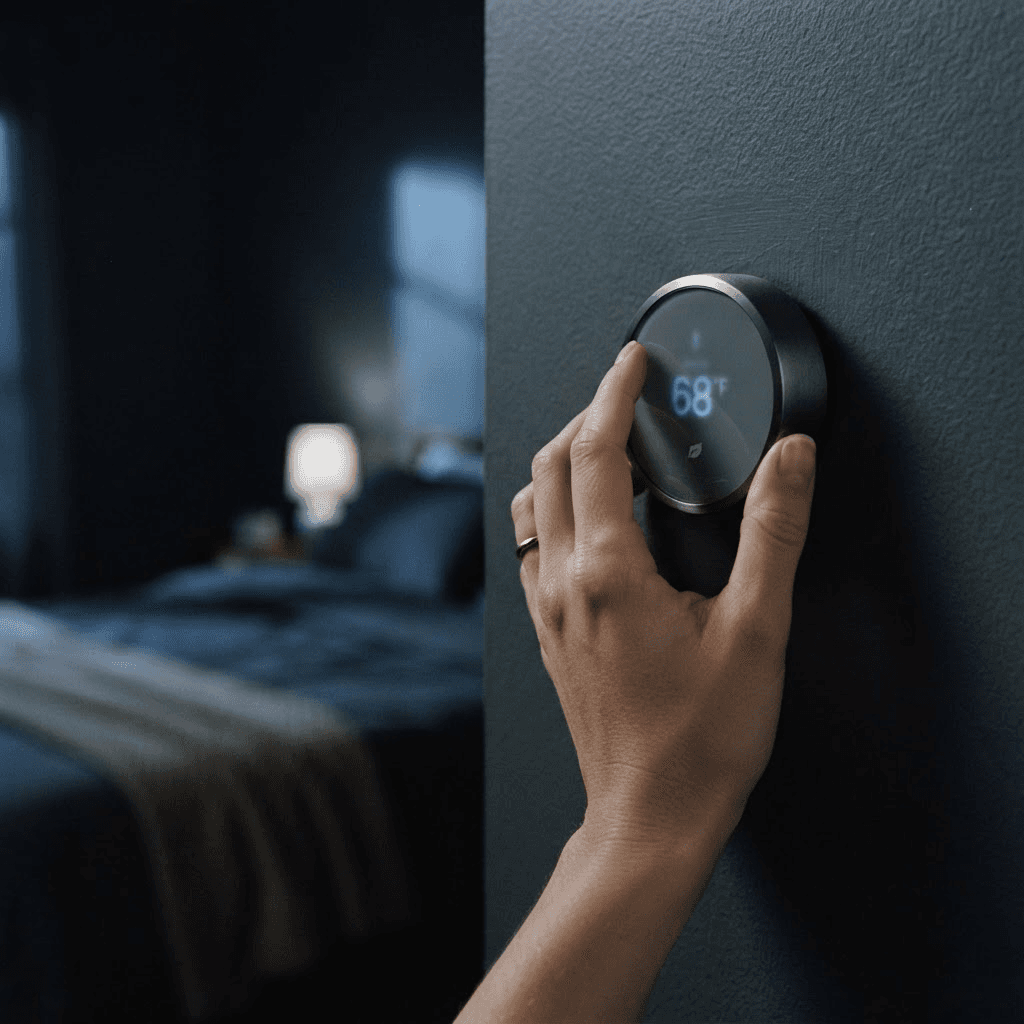
The real mechanism: you fall asleep by cooling down
This is the part that reframes everything. Falling asleep is not just your brain switching off — it is accompanied by a measurable drop in your core body temperature, on the order of about one degree Fahrenheit (roughly half a degree Celsius) as the evening progresses. That dip is one of the physiological signals that helps sleep begin and deepen. The cool room matters precisely because it makes that dip easier to achieve.
Your body sheds that heat mainly through your skin, and especially through the parts furthest from your core — your hands and feet. As bedtime nears, the blood vessels near the surface of your extremities widen, blood flow to the skin increases, and heat radiates away. If the room is too warm, there is nowhere for that heat to go, so the core stays stubbornly high and sleep is harder to reach and harder to hold.
You do not fall asleep in a cool room despite the cold. You fall asleep partly because the cool room lets your body do the cooling it was already trying to do.
Understanding this one fact changes how you read a bad night. The 2 a.m. overheating, the tangled duvet, the strange relief of a cold pillow — none of it is random. It is your body fighting to offload heat against a room that will not cooperate. Fix the room's ability to let heat escape and most of those symptoms ease on their own.
Why warming your feet can help you cool down faster
This sounds like a contradiction and is one of the more counterintuitive findings in sleep. If cooling the core is the goal, why would warming your feet help? Because warming the skin of your hands and feet widens those surface blood vessels, and wider vessels let your body release core heat more efficiently. Warm extremities are, in effect, better radiators.
That is the logic behind two old bits of folk wisdom that happen to have some support. A warm bath or shower one to two hours before bed has been studied as a way to nudge sleep along: reviews of the research suggest that passive body heating in that window is associated with falling asleep somewhat faster for some people, likely because it draws blood to the skin and helps the subsequent core-temperature drop. And a pair of warm socks can help people who get into bed with cold feet, because cold extremities constrict those vessels and make heat loss harder.
- A warm bath or shower roughly 1–2 hours before bed, not right before, so the timing lines up with your natural cool-down.
- Warm socks if your feet are habitually cold at bedtime — they can help some people settle faster, and are easy to kick off if you overheat.
- A cool core with warm edges is the pattern to aim for: light over the body, warmth at the feet if needed.
Two honest caveats. These effects are modest and vary a lot between people — they are gentle nudges, not switches, and they will not override a room that is simply too hot. And if warm feet are your problem in reverse — you are the person who overheats and throws the socks across the room by midnight — then skip them. The whole approach is about helping heat escape, so anything that traps it in is working against you.
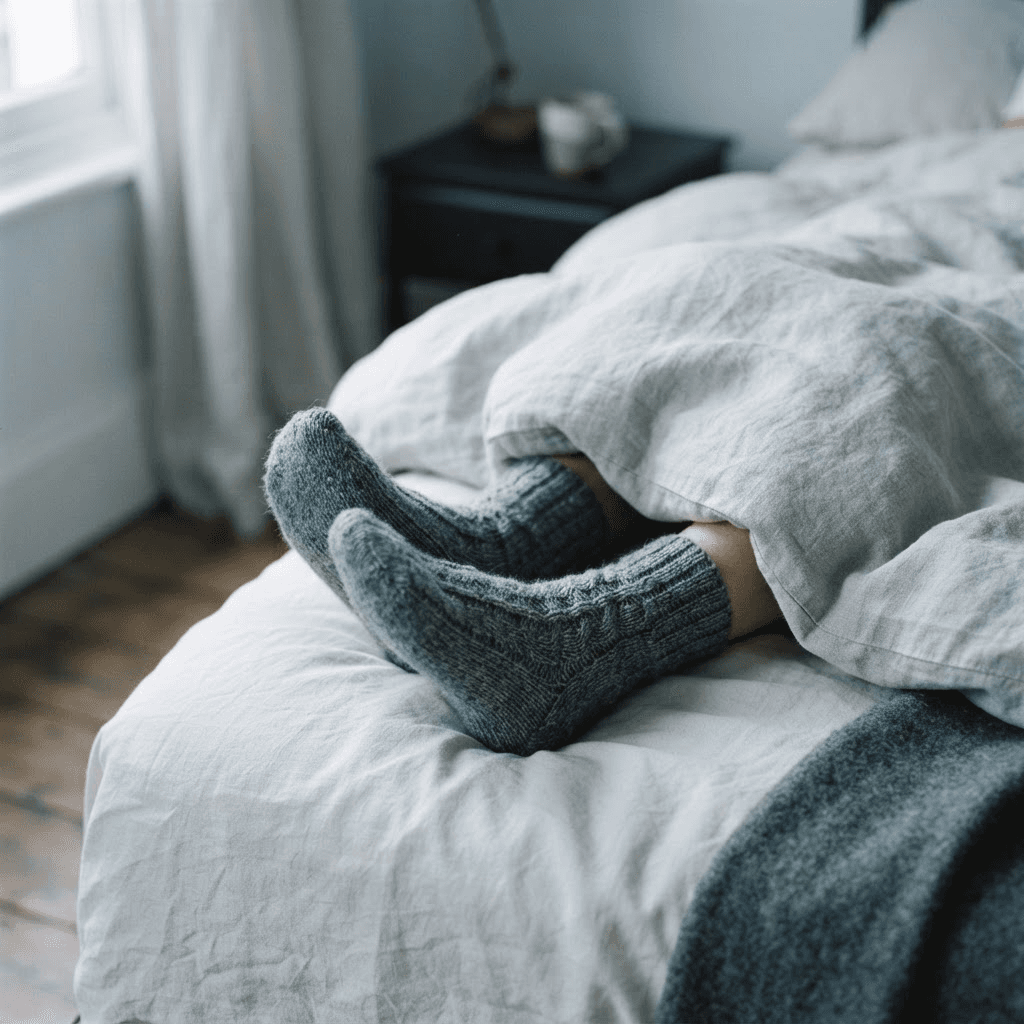
When the room is too warm — and when too cold backfires
Most people who look this up are too hot, so start there. If you are waking sweaty, kicking off covers, or feeling that second-half-of-the-night restlessness, the fixes are mostly about giving heat somewhere to go rather than blasting cold air.
- Switch to lighter, more breathable bedding and nightwear — natural fibres like cotton or linen tend to move heat and moisture better than heavy synthetics.
- Move air, not just cool it. A fan helps sweat evaporate and carries warm air away, which can feel far cooler than the thermostat number alone suggests.
- Cool the room before bed rather than only during it — open a window in the evening, or air the room out, so you climb into an already-cooling space.
- Keep daytime heat out: closing blinds against afternoon sun stops the room banking heat it will radiate back at you all night.
Now the mistake people make in the other direction: assuming colder is always better and cranking the room down until they are shivering. It is not. If you are cold enough that your muscles tense, your hands and feet go icy, or you keep surfacing to drag the covers back up, you are working against sleep just as surely as if you were too hot. Shivering is your body generating heat — the opposite of the calm cool-down you want. The target is a cool room your bedding makes comfortable, not a cold one you have to brace against.
Setting up your own room, step by step
You do not need a smart mattress or a cooling gadget to get this right. A handful of low-cost changes, made in the correct order, cover most of what matters. Treat the list below as a sequence: start at the top and only move down if you still are not comfortable.
- Aim the thermostat near the common range — around 60–67°F (16–19°C) — as a starting point, then adjust by a degree or two based on how you actually sleep over a few nights.
- Match your bedding to the season. The right layers change what any given room temperature feels like far more than most people expect.
- Add airflow with a fan or a cracked window. Moving air improves comfort at the same temperature and helps sweat evaporate.
- Pre-cool the room in the evening so you are getting into an already-cool space rather than waiting for it to catch up after you are in bed.
- Keep it dark and quiet too. Temperature is one lever; a genuinely restful room also blocks light and noise, which is where a proper wind-down routine comes in.
If the underlying problem is that your whole schedule is drifting — late nights, moving wake-up times, a body clock that no longer knows when night is — then temperature alone will not fix it. The room setup gives your body the conditions to cool down; a steady schedule gives it a consistent time to do so. Our guide to fixing a broken sleep schedule pairs naturally with this one.
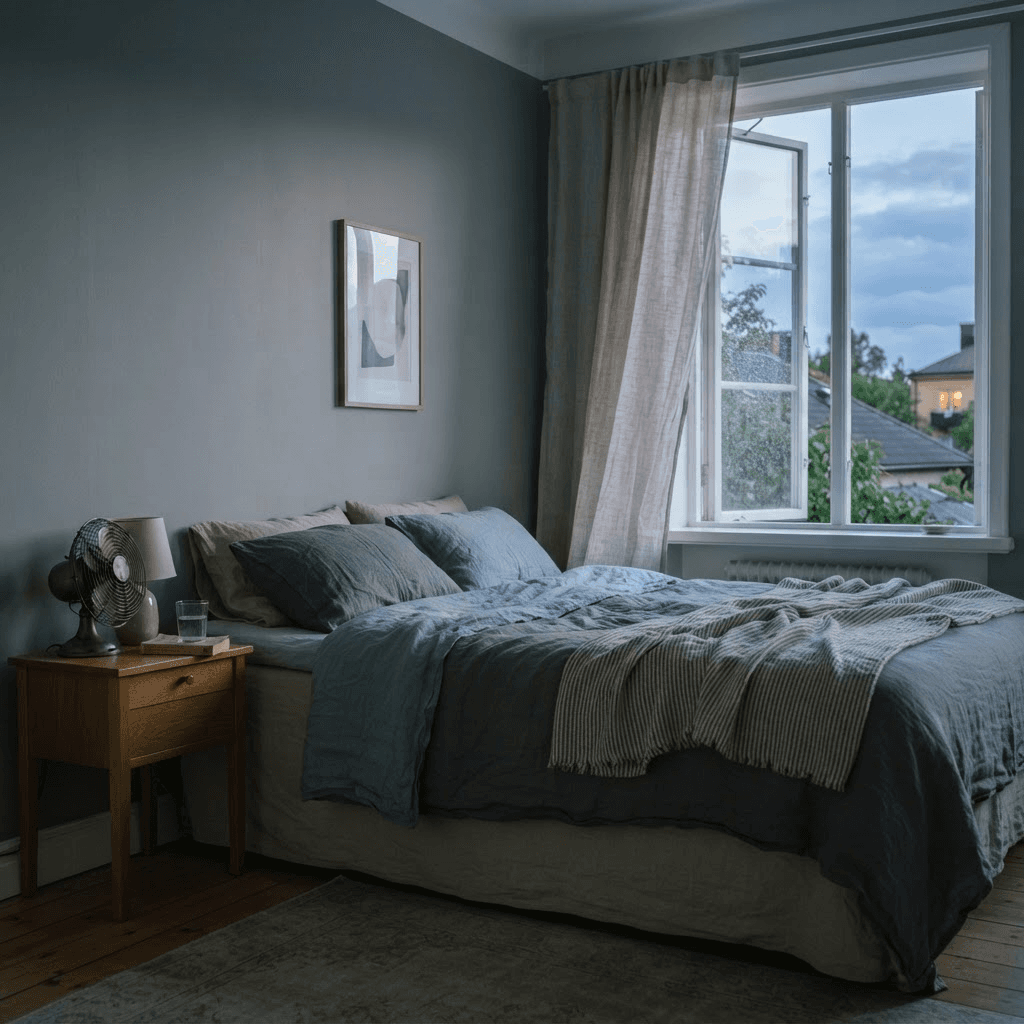
When 'just lower the thermostat' isn't the whole answer
The advice above suits most healthy adults sharing a fairly ordinary bedroom. Real life is messier than that, and a few situations deserve their own note rather than a blanket number.
Hot flashes and night sweats
If you are going through menopause, temperature control at night can feel like a losing battle, because hot flashes and night sweats are driven by shifts in how the body regulates its own temperature — not by the room. A cool room, breathable bedding, moisture-wicking nightwear and layers you can shed quickly can all help you cope, but they treat the symptom. If night sweats are wrecking your sleep regularly, it is worth discussing with a clinician, because there are approaches beyond bedroom tweaks.
Babies, older adults and shared beds
Infants are not small adults when it comes to temperature, and safe-sleep guidance for babies is specific — follow advice from your pediatrician or national child-health service rather than applying an adult range to a nursery. Older adults can be more sensitive to cold and may need the room a little warmer. And if you share a bed with someone whose ideal temperature is nothing like yours, separate bedding — two duvets instead of one shared layer — is an underrated fix that lets each person set their own warmth without a nightly negotiation.
When it might not be the temperature at all
Sometimes a hot, broken night is a symptom rather than a thermostat problem. Persistent night sweats that soak the sheets, waking gasping or being told you stop breathing in your sleep, or feeling exhausted no matter how well you set the room up can all point to something that needs proper assessment — from sleep apnoea to thyroid issues to other medical causes of night sweats. This is general information, not a diagnosis. If a well-set-up room does not fix a stubbornly bad, sweaty or unrefreshing night over a few weeks, that is a reason to see a doctor, and our guide to waking up tired even after a full night covers the overlap.
For most people, though, the fix is refreshingly ordinary. Set the room near the common range, let your body and your bedding fine-tune it, give the heat somewhere to go, and stop chasing a single magic number. The best temperature for sleep is not really a number at all — it is whatever lets your body do the cooling it was always going to try to do.
Sources and further reading
The guidance above draws on public-health and clinical sources on sleep, body-temperature regulation and the bedroom environment. Follow the links to read the original material, and note where the evidence is still developing or varies between people.
- The best temperature for sleep and how to set up your bedroomNational Sleep Foundation
- Effects of the thermal environment on sleep and circadian rhythmJournal of Physiological Anthropology (Okamoto-Mizuno & Mizuno)
- Before-bedtime passive body heating (warm bath) and sleep — systematic reviewSleep Medicine Reviews (via PubMed)
- Healthy sleep habits and the sleep environmentNational Heart, Lung, and Blood Institute (NIH)
- About sleep: how much adults need and what affects itCDC — Sleep
- Menopause, hot flashes and night sweatsMayo Clinic
The temperature questions that keep coming up
What is the best temperature for sleep?
Many sleep organisations suggest a bedroom around 60–67°F (about 16–19°C) as a starting point for adults, but there is no single perfect setting. The right number depends on your age, your bedding, what you wear and your own physiology. A useful rule of thumb is that the room is about right when you can settle under your usual covers without sweating or shivering.
Why do I sleep better in a cold room?
Falling asleep is accompanied by a drop in your core body temperature, and your body sheds that heat mainly through your skin. A cooler room makes it easier for your body to release heat and reach that dip, which is why many people fall asleep faster and sleep more soundly when the room is cool rather than warm.
Is it better to sleep in a cold or warm room?
Cool tends to beat warm for most people, because your body needs to lose heat to fall and stay asleep. But cold is not automatically better — if you are shivering or your hands and feet are icy, that also disrupts sleep. The goal is a cool room made comfortable by your bedding, not one so cold you have to brace against it.
Why do warm socks help you fall asleep?
Warming your feet widens the blood vessels near the skin of your extremities, which helps your body release core heat more efficiently — and that heat loss is part of how sleep begins. For people who get into bed with cold feet, warm socks can help them settle faster. If you tend to overheat instead, skip them, because trapping heat works against the same cool-down.
What temperature should my room be during menopause?
A cool room, breathable bedding and moisture-wicking nightwear can help you cope with hot flashes and night sweats, but these are driven by changes in how the body regulates temperature, not by the room itself. If night sweats are regularly disrupting your sleep, it is worth discussing with a clinician, since there are options beyond bedroom adjustments.
How can I sleep in a hot room without air conditioning?
Give heat somewhere to go rather than trying to blast it away. Use lighter, breathable bedding, run a fan to move air and help sweat evaporate, open a window in the evening to pre-cool the room, and close blinds during the day so the room does not bank heat. Warm, humid nights are genuinely harder, so focus on airflow and lighter layers.
Keep reading
More from the sleep desk for the habits and hours that decide the rest of the night.
 13 min readWhy You Wake Up at 3 A.M. — and How to Fall Back AsleepYou did not wake up because something is wrong with you. You woke up because every human wakes several times a night — the question is why yours turns into ninety minutes of ceiling-staring. Here is how to find your cause and what to do before 4 a.m.
 12 min readWhy You Wake Up Tired Even After 8 Hours of Sleep — and How to Fix ItYou were in bed for eight hours. The tracker says you slept. So why do you wake up feeling like you barely closed your eyes? Morning tiredness is rarely about how long you slept — it is about what happened to those hours. Here is how to find the actual reason, in order of likelihood.
 12 min readHow to Fix Your Sleep Schedule: A Realistic Reset When Your Body Clock Is StuckYou keep promising yourself an early night, then blink and it is 2 a.m. again. A drifted sleep schedule is not a willpower problem — it is a timing problem, and timing is something you can nudge. Here is how to move your body clock back to the hours you actually need, one small step at a time.