Why You Wake Up at 3 A.M. — and How to Fall Back Asleep
The gap — where most people lose the second half of the night
You did not wake up because something is wrong with you. You woke up because every human wakes several times a night — the question is why yours turns into ninety minutes of ceiling-staring. Here is how to find your cause and what to do before 4 a.m.

The short version
- Brief waking between sleep cycles is normal and universal — staying awake for 30+ minutes is the actual problem.
- Six causes explain most cases: hyperarousal, alcohol, a too-early bedtime, temperature, bladder, and untreated apnoea.
- After roughly 20 minutes awake, leave the bed. Lying there teaches your brain the bed is a place for thinking.
- Never check the time. The arithmetic of "only three hours left" is itself a stimulant.
- Fix the daytime, not the night: consistent wake time, morning light, and an honest look at alcohol.
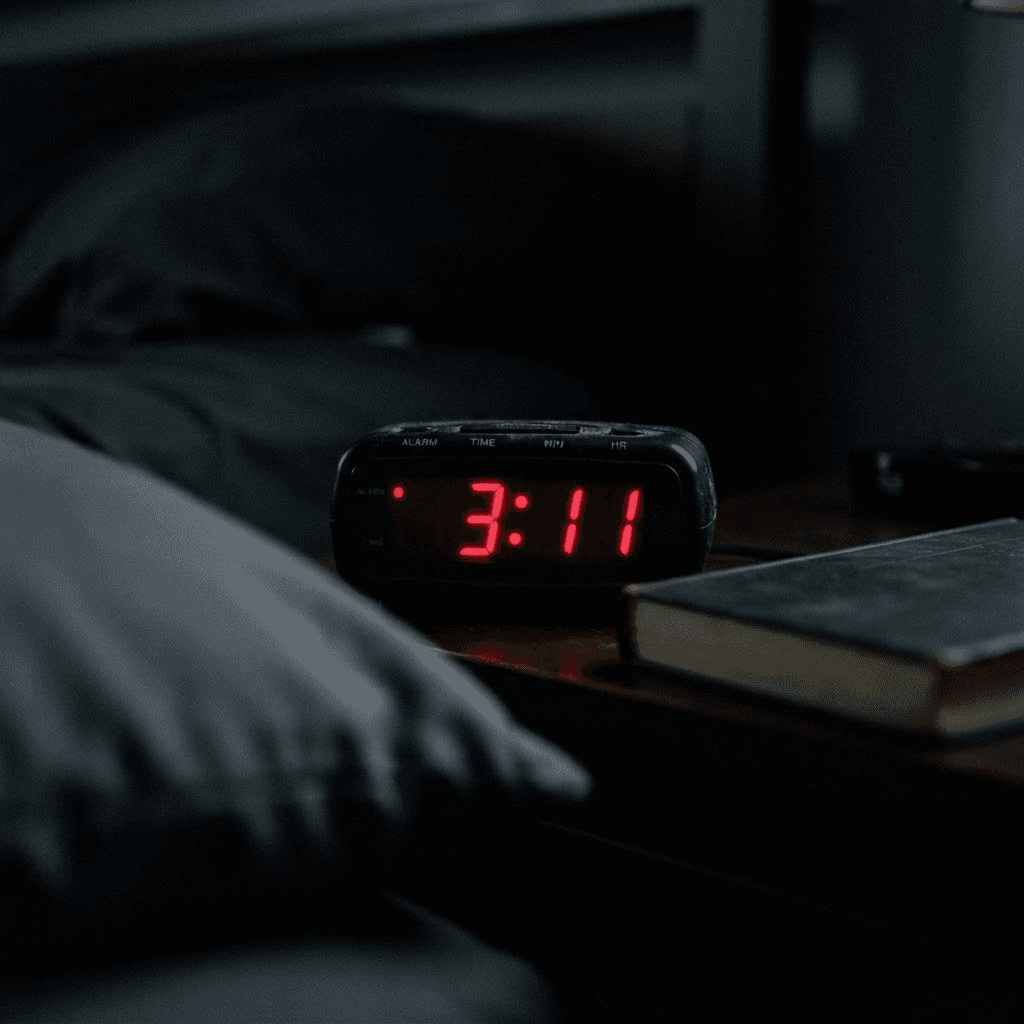
It is 3:11 a.m. Nothing woke you — no noise, no bad dream, no alarm. You are simply, completely awake, and within about forty seconds your brain has already queued up the email you should have sent on Thursday, a comment someone made in a meeting, and the running total of how many hours are left before you have to get up. By 4:30 you are negotiating. If I fall asleep right now, that is still two and a half hours.
This is the most common sleep complaint that never gets talked about, because it does not look like insomnia. You fell asleep fine. You are not tossing for hours at bedtime. You just cannot stay asleep through the second half of the night — and it happens at almost the same time, which is the part that unsettles people most. This guide is about that specific gap between 2 and 4 a.m.: what is actually happening in your body, which of six causes is likely yours, and what to do with the twenty minutes after you open your eyes.
Everybody wakes up. You are just remembering it
Sleep is not a single block that you sink into and climb out of eight hours later. It is a stack of cycles, each running roughly 90 to 110 minutes, and each ending in a light, easily-interrupted stage. Healthy sleepers surface briefly between these cycles somewhere between six and fifteen times a night. They shift position, half-register a sound, and drop straight back under without ever forming a memory of it.
So the awakening itself is not the malfunction — it was always scheduled. What separates a good sleeper from someone reading this at 3 a.m. is what happens in the ninety seconds afterwards. A good sleeper does not become alert. You do. And because you were awake long enough to think, you remember it, which builds the belief that you "wake up every single night" while the other fourteen awakenings go unrecorded.
The second half of the night also has a different texture, which is why the 3 a.m. version feels worse than an 11 p.m. one. Deep, physically restorative sleep is heavily front-loaded into your first few hours. By 3 a.m. you have banked most of it, so the remaining sleep is lighter and more dream-heavy — easier to fall out of, and emotionally louder when you do.
- 11:15 p.m.
Cycle one — the deep bank
Body temperature falling, the heaviest slow-wave sleep of the night. Wake someone here and they are groggy and confused, not alert.
- 12:45 a.m.
Cycle two — first surfacing
A brief awakening you almost certainly will not remember. Still plenty of deep sleep pressure left to pull you back down.
- 2:20 a.m.
Cycle three — deep sleep runs low
Sleep pressure has largely been spent. Sleep becomes lighter and REM-dominant. Awakenings start to feel like being switched on.
- 3:10 a.m.
The gap
The classic wake point. Low sleep pressure, rising physiological arousal, and a quiet dark room with nothing to occupy your attention.
- 4:30 a.m.
Cortisol begins its climb
Your natural pre-waking hormonal ramp starts hours before your alarm. If you are already awake and anxious, it lands on an alert brain.
- 6:40 a.m.
The cruel nap
Many people finally fall hard asleep here — twenty minutes before the alarm, which is why the morning feels like being dragged out of a well.
Six reasons, and how to tell which one is yours
Middle-of-the-night waking is a symptom, not a diagnosis, and the fix depends entirely on the cause. Read these six honestly rather than picking the most flattering one. Most people find their pattern in the first three.
1. Hyperarousal — the engine idling too high
This is one of the leading explanations in current sleep research, and it is the least intuitive. In chronic middle-of-the-night waking, the nervous system does not fully downshift for the night. Heart rate, core temperature and stress signalling all stay a notch above where they should be, so the normal between-cycle awakening tips you into full alertness rather than back into sleep. The tell is mental: your mind arrives already busy, and it is often busy with problem-solving rather than dread. If your waking comes with a racing, planning, list-making quality, this is probably you — and our guide to regulating your nervous system is the daytime half of the answer.
2. Alcohol — a sedative that expires at 2 a.m.
A drink or two in the evening genuinely helps you fall asleep and then reliably wrecks the back half of the night. As your body metabolises it, the sedative effect drops away and produces a rebound in alertness, roughly four to five hours after the last glass. Do the arithmetic: last drink at 10 p.m., rebound at about 3 a.m. This is the single easiest cause to test — three consecutive alcohol-free nights will tell you more than any supplement.
3. Too much time in bed
This one surprises people. If you need seven hours of sleep and you spend nine and a half hours in bed — going up early because you are exhausted, lying in late at weekends — the sleep you have gets spread thin across that window and fragments in the middle. It is the same volume of water in a wider glass. Counterintuitively, going to bed later and shortening your time in bed consolidates sleep into one solid block. This is the core mechanism behind sleep restriction therapy, and it works.
4. Temperature
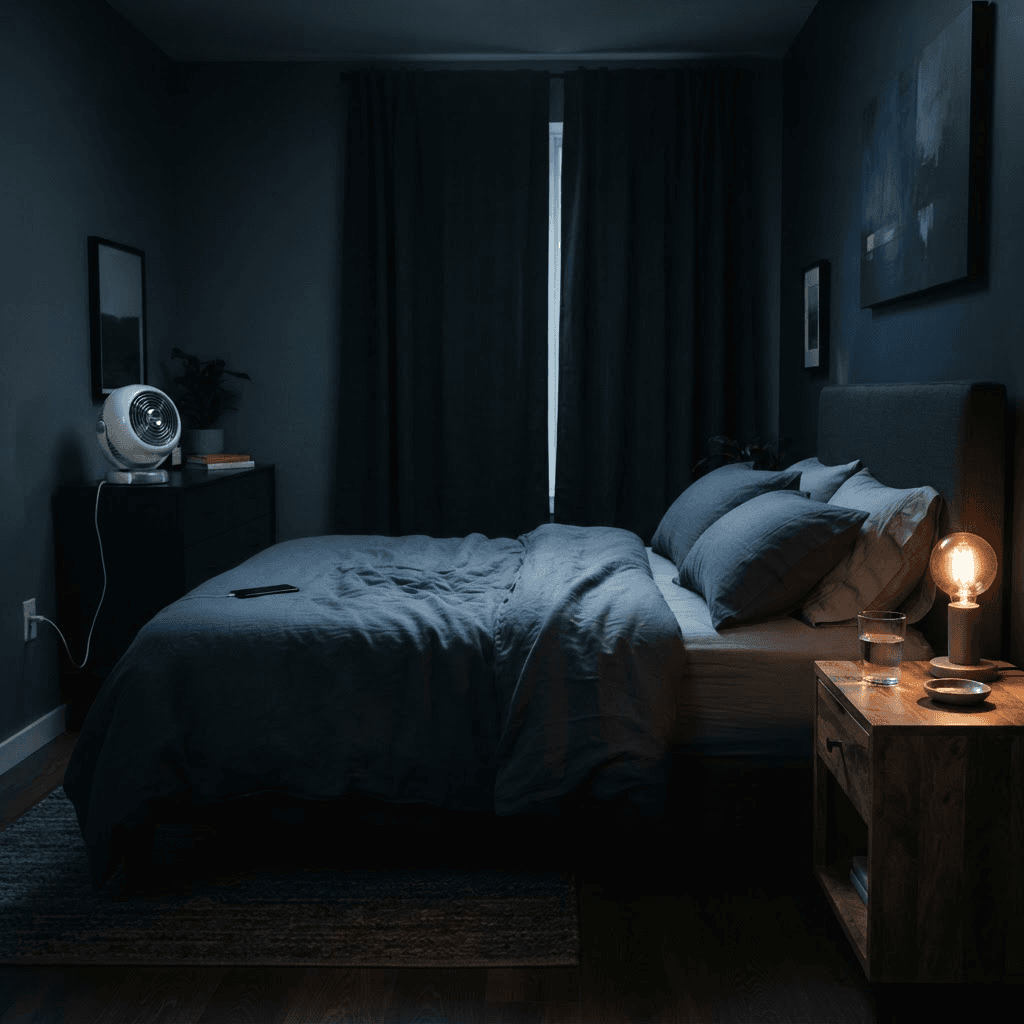
Falling asleep requires your core temperature to drop, and staying asleep requires it to stay down until early morning. An over-warm room, a heavy duvet, or a partner who runs hot will interrupt sleep in the second half of the night specifically, because that is when your body is closest to its temperature floor and most sensitive to being pushed off it. If you wake slightly damp, or throw a leg out from under the covers, start here — it is a cheap fix.
5. Your bladder (but read this carefully)
Plenty of people report that they wake because they need the toilet. Sometimes that is true. Often the order is reversed: the awakening was already scheduled, and once awake you notice a bladder signal you would otherwise have slept straight through. The distinction matters, because if you assume the bladder is the cause you will start restricting fluids all evening and treating the wrong problem. A genuinely useful version of that change is front-loading your fluids earlier in the day rather than cutting them — our daily hydration guide covers the timing.
6. Sleep apnoea — the one you cannot fix yourself
If your awakenings come with a gasp, a dry mouth, a headache on waking, or your partner reports snoring and pauses in breathing, stop troubleshooting habits and get assessed. Untreated obstructive sleep apnoea fragments sleep repeatedly through the night, is strongly associated with cardiovascular risk, and does not respond to blackout curtains or magnesium. It responds to diagnosis and treatment.
The 20-minute rule: what to do when you are already awake
Here is the trap. You wake at 3, and because you are tired and it is cold, you stay in bed and try hard to fall back asleep. Trying is the problem. Sleep is not a task you can perform under effort, and every night you spend an hour awake in bed thinking, you strengthen an association between that mattress and mental activity. Do it for enough weeks and your brain begins to treat lying down as a cue to start thinking. That association is the difference between a rough week and chronic insomnia.
So the rule is: roughly twenty minutes of lying awake, then get up. Twenty minutes estimated, never timed — no clock-watching. If it feels like you have been awake a while and you are not drifting, you have your answer.
- Get out of bed and leave the bedroom if you can. Yes, even in winter. Keep a cardigan or blanket within reach so the cold is not a reason to stay put.
- Use the dimmest light that lets you function. One lamp, not the ceiling light, and nothing overhead in the bathroom if you can avoid it.
- Do something quiet, analogue and genuinely boring but not unpleasant. A paperback you have read before is close to ideal. Folding laundry works. Podcasts at low volume work for some people.
- Avoid anything with a feed, a score, a plot cliffhanger, or unread messages in it. Your phone is not neutral — it is engineered to hold your attention, which is the exact opposite of what you need.
- Do not eat a proper meal or make coffee. A glass of water is fine. Regular 3 a.m. snacks train genuine 3 a.m. hunger within about a week.
- Go back to bed only when you feel physically sleepy — heavy eyes, losing the thread of the page — not when you feel bored, and not when you decide you have served enough time.
- If you are awake for a second stretch, repeat the whole thing without judgement. Two trips out of bed is a normal night in the middle of retraining this.
This feels wrong the first few nights, because it looks like giving up on sleep. It is closer to the opposite: you are protecting the bed as a place where only sleep happens. It is one of the oldest and best-supported behavioural techniques in insomnia treatment, and it is part of why cognitive behavioural therapy for insomnia — not medication — is the recommended first-line treatment for chronic sleep problems.

You cannot force sleep. You can only stop doing the things that hold it off, then get out of its way.
When the problem is not sleep, it is the thinking
For a lot of people the awakening is trivial and the mental spiral that follows is the whole disorder. Two spirals in particular show up again and again.
The first is sleep arithmetic — the compulsive calculation of hours remaining, which converts a neutral awakening into a performance you are failing. The second is the 3 a.m. distortion, where ordinary daytime problems arrive stripped of all context and proportion. Your brain at 3 a.m. is running on low deep-sleep reserves with an emotional processing system that is temporarily louder than the part of you that keeps perspective. Genuinely: you are not thinking clearly, and that is physiological, not a character flaw. Whatever seemed catastrophic at 3:20 is usually a task on a list by 9 a.m.
A useful move is to give the thoughts somewhere to go before bed rather than at 3 a.m. Ten minutes in the early evening, on paper, listing what is unresolved and the single next action for each. It is not journalling and it is not therapy; it is closing open loops so they stop surfacing when the room goes quiet. If the waking arrives with real dread rather than busyness, our night anxiety troubleshooting guide goes deeper than this article can.
Troubleshooting your specific pattern
Match the shape of your night to the change most likely to help. Give each one at least a week before you judge it — sleep is noisy data, and a single good or bad night tells you almost nothing.
| What your night looks like | Most likely cause | What to change first |
|---|---|---|
| Awake at nearly the same time, mind busy and planning | Hyperarousal | Get out of bed at ~20 minutes; add a 10-minute evening brain-dump on paper |
| Fine on weeknights, wrecked after social evenings | Alcohol rebound | Three alcohol-free nights as a test, then last drink 4+ hours before bed |
| In bed 9+ hours, sleep broken into two chunks | Too much time in bed | Push bedtime 45 minutes later, keep the same wake time for a week |
| Wake slightly sweaty, kicking off the duvet | Room or bedding too warm | Drop the room a few degrees, switch to lighter layers you can shed |
| Wake needing the toilet, fall back asleep easily after | Bladder, or a normal awakening you now notice | Front-load fluids earlier in the day rather than restricting them |
| Gasping, dry mouth, snoring, morning headaches | Possible sleep apnoea | Stop self-treating and book a clinical assessment |
| Wide awake at 3 a.m., desperately sleepy at 3 p.m. | Irregular wake times shifting your body clock | Fix the wake time first — same time daily, including weekends |
The fixes that actually work happen while you are awake
Almost nothing you do at 3 a.m. improves tonight. What you do between 7 a.m. and 10 p.m. changes next week. Three levers matter far more than the rest, and none of them involve buying anything.
Anchor your wake time, not your bedtime. Your body clock takes its strongest cue from when you get up and see light, so a fixed wake time — every day, weekends included — is what stabilises the whole system. Bedtime can drift by half an hour without much cost. A weekend lie-in until 10:30 is a small dose of jet lag you then spend Monday and Tuesday recovering from.
Get real daylight into your eyes early. Ten to twenty minutes outdoors within an hour or so of waking does more for your night than any evening ritual. Outdoor light on an overcast day is still many times brighter than a well-lit room, so this is genuinely about going outside rather than sitting near a window. Pair it with a short walk and you have handled light exposure and movement in one go — walking is quietly one of the better sleep interventions as well as everything else it does.
Then be honest about the last four hours of your day. Alcohol, a heavy late meal, an intense workout close to bedtime, and doing your hardest thinking at 11 p.m. all raise arousal into the night. You do not have to eliminate them permanently — you have to notice which of them precedes your worst nights. A one-line note each morning (bed time, wake time, drinks, how the night went) will show you the pattern in about ten days, faster than any wearable will.

On supplements, briefly, because everyone asks: magnesium has modest evidence and is more likely to help if your intake is genuinely low, in which case getting it from food is the sensible route. Melatonin is a body-clock signal rather than a sedative and is most useful for jet lag or a delayed sleep schedule — it is generally poorly suited to 3 a.m. waking, and taking more of it does not make it work better. Neither belongs at the top of your list while your wake time is still irregular and there is wine on four nights a week.
What if it is 4 a.m., 5 a.m., or a different hour?
Three in the morning gets all the attention, but the clock reading matters far less than the shape of the waking. What your body is telling you is in the pattern, not the exact number on a screen you should not be looking at anyway. Three broad patterns are worth telling apart.
The first is the classic middle-of-the-night waking this guide is about: you fall asleep normally, then surface somewhere in the 2–4 a.m. trough and struggle to get back down. The hour drifts a little from night to night, and it responds to everything above — the 20-minute rule, a steadier wake time, an honest look at alcohol and arousal.
The second is consistent early-morning waking — up at 4:30 or 5, hours before you need to be, with no route back to sleep. When this runs for weeks it is worth paying attention to, because persistent early waking is one of the more recognised sleep signatures of depression, and it also becomes more common with age as the body clock shifts earlier. If it arrives with low mood, loss of interest, or a change in appetite, treat the sleep and the mood as one problem and raise both with a clinician rather than chasing the waking alone.
The third is not a maintenance problem at all: if the hard part is getting to sleep in the first place — lying awake for an hour at the start of the night rather than waking later — that is sleep-onset difficulty, and the levers are different. There the priority is a later, more consistent bedtime, dimmer evenings, and getting out of bed if you are still wired after twenty minutes, exactly as you would in the small hours.
One caveat worth stating plainly: the tidy folklore that a given hour maps to a given organ or emotion has no basis in sleep medicine. A 3 a.m. waking is not a message about your liver, and a 4 a.m. one is not your body flagging grief. The useful signal is the pattern and what travels with it — a racing mind, a rebound from alcohol, a gasp for breath, a flat and heavy mood — not the digits themselves.
When this needs more than an article
A run of broken nights during a stressful month is ordinary and usually resolves once the stressor does. Some patterns are worth taking to a clinician rather than managing alone.
- Three or more disrupted nights a week for three months or longer, with daytime consequences — this meets the usual threshold for chronic insomnia, which is treatable.
- Snoring with gasping, choking or witnessed pauses in breathing, or waking with headaches and a dry mouth.
- Falling asleep unintentionally during the day, especially while driving.
- Waking with chest pain, breathlessness, night sweats, or needing to sit upright to breathe.
- Persistent early-morning waking alongside low mood, loss of interest or appetite change — sleep and depression run in both directions.
- You have been relying on alcohol or over-the-counter sleep aids to get through the night for more than a couple of weeks.
One last reframe, for tonight. The goal is not an unbroken eight hours — that was never how human sleep worked. The goal is that when you surface at 3 a.m., nothing much happens: you turn over, you do not reach for your phone, you do not start counting, and the next thing you notice is morning. That is a learnable skill, and most people who get there did it by changing their mornings rather than their nights.
Sources and further reading
Guidance here reflects clinical treatment recommendations and public-health sleep resources. Links go to the original publishers so you can read past our summary.
- Insomnia: symptoms, causes and treatmentNHS
- What are sleep deprivation and deficiency?National Heart, Lung, and Blood Institute (NIH)
- Insomnia treatment: cognitive behavioural therapy instead of sleeping pillsMayo Clinic
- Obstructive sleep apnoea: diagnosis and treatmentNHLBI (NIH)
- Alcohol and sleep architecture disruptionNational Library of Medicine (PubMed)
- Circadian rhythms and light exposureCDC — Sleep and Sleep Disorders
- Sleep problems and depression, including early-morning wakingNHS — Depression symptoms
What people ask at 3:47 a.m.
Why do I wake up at 3am every night at almost exactly the same time?
Because your sleep cycles run on a fairly fixed schedule, so the light stage between cycles lands at roughly the same clock time each night — and by 2 to 4 a.m. you have used up most of your deep sleep, so there is less pressure pulling you back under. The consistency feels eerie but it is a sign of a regular body clock, not of illness. What needs fixing is not the awakening itself but how alert you become afterwards.
Is waking up in the middle of the night normal?
Yes. Everyone surfaces briefly between sleep cycles, often six to fifteen times a night, and normally does not remember it. Clinically, the concern is not the awakening but staying awake — being unable to fall back asleep for 30 minutes or more, several nights a week, with knock-on effects during the day.
Should I get out of bed if I cannot fall back asleep?
Yes, after roughly 20 minutes — estimated, not timed. Staying in bed awake teaches your brain to associate the bed with thinking rather than sleeping, which is how a few bad nights turn into chronic insomnia. Go somewhere dimly lit, do something quiet and analogue, and return only when you feel physically sleepy.
Does waking at 3am mean my cortisol is too high?
Not necessarily. Cortisol does begin rising in the hours before you wake, which is entirely normal, and it is not proof of a hormonal disorder. Sustained physiological arousal — a nervous system that never fully downshifts overnight — is the better explanation for most chronic middle-of-the-night waking, and it responds to behavioural change rather than to cortisol testing.
Why does alcohol wake me up at 3am?
Alcohol sedates you early and then rebounds as your body clears it, usually four to five hours after your last drink, which lands squarely in the early hours. It also suppresses REM sleep in the first half of the night, so the second half becomes unusually light and dream-heavy. Three alcohol-free nights is the cleanest way to test whether this is your cause.
Will melatonin stop me waking up at 3am?
Usually not. Melatonin is a timing signal for your body clock rather than a sedative, so it is most useful for jet lag or a shifted sleep schedule — not for maintaining sleep through the night. Fixing a consistent wake time and getting early daylight generally does more, and higher doses do not improve results.
How long should it take to fall back asleep?
Most people drift back within a few minutes without ever fully waking. If you are routinely awake for 30 minutes or more, several times a week, for three months or longer, that pattern meets the usual definition of chronic insomnia and is worth raising with a clinician — cognitive behavioural therapy for insomnia is the recommended first-line treatment.
Keep reading
More from the sleep and nervous-system desks, for tomorrow.
 Mental HealthNight Anxiety: Why Your Brain Switches On at Bedtime (and 5 Fixes That Actually Work)
 Mental HealthRevenge Bedtime Procrastination: Why You Stay Up Late When You Are Exhausted (and How to Stop)
 Mental HealthHow to Regulate Your Nervous System: A Beginner’s Guide to Calming Anxiety in Your Body