How to Regulate Your Nervous System: A Beginner’s Guide to Calming Anxiety in Your Body
You cannot think your way out of a body that feels unsafe. This beginner’s guide skips the theory and shows you how to read your nervous system, tell which state you are in, and use short physical resets that calm anxiety from the body up.
Which state are you in?
Revved upFight or flightRacing heart, tight chest, urgencySettledThe state we return toCalm, focused, able to restShut downFreeze and collapseNumb, heavy, foggy, flatName the state first. The right tool depends on it.
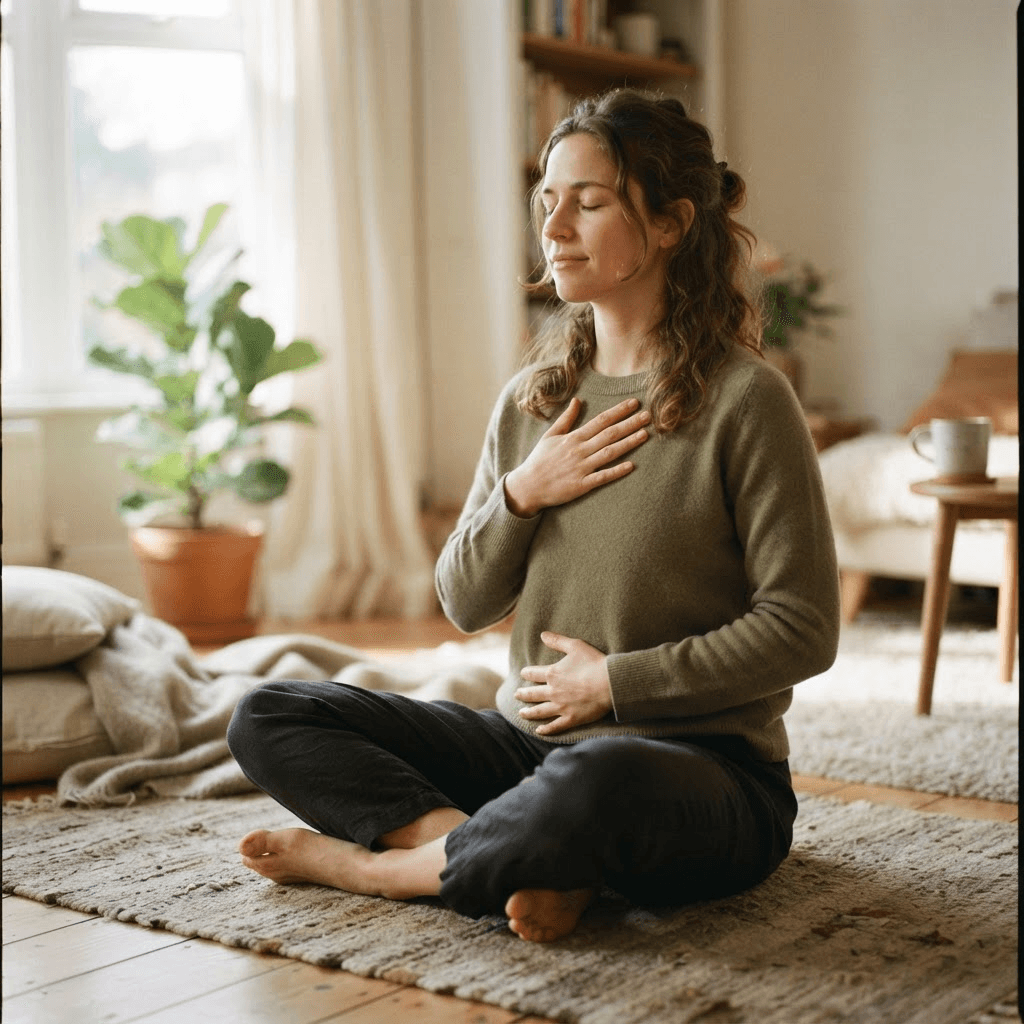
Five things to remember before you start
- Regulation is not the same as relaxation. It means your body can shift into a state that fits the moment — alert when needed, calm when it is safe.
- Most anxiety advice fails because it talks to your thoughts. Your nervous system responds faster to signals from the body: breath, temperature, movement and pressure.
- You have three broad states — settled, revved up, and shut down. Knowing which one you are in tells you which tool to reach for.
- A long, slow exhale is the single most reliable off-switch you carry with you everywhere, for free.
- Regulation is a skill, not a personality trait. Small daily reps matter far more than one perfect session.
Picture this. You are sitting in a meeting, or reading a text, or just standing in the kitchen — and your chest tightens, your thoughts speed up, and your body braces as if something is about to go wrong. Nothing has actually happened. You tell yourself to calm down. It does not work. That gap, between what your mind knows and what your body is doing, is the whole reason this guide exists.
Learning how to regulate your nervous system is not about becoming permanently calm or never feeling anxious again. It is about giving your body a way to come back down after it revs up — and doing it through the body itself, not through arguing with your thoughts. This is a beginner’s guide, so we will skip the dense neuroscience and stay with what you can actually feel and use today.
What “regulating your nervous system” actually means
Your autonomic nervous system is the part of you that runs in the background: heart rate, breathing, digestion, the sense of whether you are safe or under threat. It is always scanning, and it makes decisions long before your conscious mind catches up. When people say their nervous system is "dysregulated," they usually mean it is getting stuck — staying switched on when the danger has passed, or shutting down when there is nothing to escape from.
Regulation is the ability to move between states appropriately. A regulated nervous system can gear up for a hard conversation and then settle again afterwards. A dysregulated one gears up and stays there, sometimes for hours, sometimes for days. Notice that the goal is flexibility, not flatness. You are not trying to feel nothing — you are trying to recover.
You cannot talk a frightened body into feeling safe. You have to show it, with signals it already understands.
That last idea is the hinge this whole guide turns on. Thoughts are slow and easily argued with. But a long exhale, cold water on the face, or the weight of your own hand on your chest speaks in the body’s native language. That is why breathwork and morning breathing routines for anxiety tend to work when pep talks do not.

The three states your body moves through
Forget the clinical charts for a moment. In everyday terms, your nervous system spends most of its time in one of three broad states. Learning to spot which one you are in is the single most useful skill in this article, because the right tool depends entirely on the state you are trying to leave.
1. Settled — the "I’ve got this" state
Breathing is easy. You can focus, feel curious, connect with people, and handle a problem without spiralling. This is the state we are trying to return to — not to live in permanently, but to reach reliably. When you are settled, you can plan, reflect and rest.
2. Revved up — fight or flight
Heart pounding, thoughts racing, jaw tight, a restless urge to do something. This is mobilisation: your body has decided there is a threat and is pouring fuel into escaping or fighting it. Useful when a car swerves toward you. Exhausting when it fires because of an unread email or a memory.
3. Shut down — freeze and collapse
Numb, foggy, heavy, disconnected, flat. When revving up does not resolve the threat, the body can drop into a low-energy shutdown to conserve itself. People often mistake this for laziness or depression. It is neither — it is a protective brake, and it needs gentle re-activation rather than force.
| State | What it feels like | What your body needs | Reach for |
|---|---|---|---|
| Settled | Calm, focused, open, able to rest | Maintenance — small daily reps | Breath, daylight, movement, connection |
| Revved up | Racing heart, tight chest, urgency | To discharge and slow down | Long exhales, cold water, shaking it out |
| Shut down | Numb, heavy, foggy, flat | Gentle, safe re-activation | Orienting, humming, light movement, warmth |
How to tell if your nervous system is dysregulated
Dysregulation rarely announces itself as "anxiety." It hides in ordinary complaints. Run through this list honestly — you are looking for a pattern over weeks, not a single bad day.
- You feel wired but tired: exhausted, yet unable to switch off.
- Small things trigger big reactions — a tone of voice, a delay, a change of plan.
- You swing between overdrive and total shutdown with little in between.
- Your body carries it: clenched jaw, tight shoulders, shallow breathing, a churning stomach.
- You struggle to feel rested even after sleep, or you cannot fall asleep because your body will not settle.
- You go numb or "check out" when things get intense, then feel foggy for hours.
- Relaxing feels unsafe or boring — stillness makes you more anxious, not less.
If several of those feel familiar, you are not broken and you are not weak. You have a nervous system that has learned to stay on guard, often for very good historical reasons. The good news is that the same system that learned to brace can learn to settle. That is what the rest of this guide teaches.
The reset menu: exercises by state
Here is your toolkit. Do not try to do all of these. Pick one from the state you are actually in, and give it 60 to 90 seconds before deciding whether it worked. Regulation is quiet — you are looking for a small drop, not a dramatic switch-off.
When you are revved up (fight or flight)
- The extended exhale. Breathe in for a count of four, then out for a count of six to eight. The out-breath is the brake. Do six rounds. This is the most portable vagus nerve exercise for anxiety there is.
- The physiological sigh. Take a normal breath in through the nose, sip a second small breath on top, then let a long slow breath out through the mouth. Two or three is often enough to take the edge off.
- Cold water. Splash cold water on your face, or hold the sides of your neck under a cold tap for 20 to 30 seconds. The cold triggers a reflex that slows the heart.
- Shake it out. Literally shake your hands, arms and legs for 30 seconds, like an athlete before a race. It lets the mobilised energy actually discharge instead of pooling.

When you are shut down (freeze)
- Orient to the room. Slowly turn your head and let your eyes land on five real objects. Name them silently. This tells a frozen brain, "look, we can move and nothing is attacking."
- Hum, sigh or gently sing. The vocal cords sit near the vagus nerve; sound is a soft way to switch signals back on.
- Add warmth and weight. A warm drink held in both hands, a heavy blanket, or a hand pressed firmly on your chest. Warmth and pressure signal safety.
- Move a little, not a lot. Stand up, stretch tall, walk to the window. Shutdown needs coaxing, not a bootcamp.
When you are settled (keep it that way)
- Get daylight into your eyes within an hour of waking — it steadies the whole system for the day.
- Move your body most days; a walk counts. Steady movement is a nervous-system deposit.
- Protect a little real connection: a face-to-face conversation, a pet, a genuine laugh.
- Build in stillness on purpose so your body relearns that calm is safe. A short daily mindfulness practice for beginners does this beautifully.

Building a daily practice that actually sticks
The resets above are for putting out fires. But if you only ever regulate in a crisis, you will spend your life firefighting. Real change comes from tiny, boring reps that raise your baseline — so you start each day with more room before you tip over the edge.
Do not build a 45-minute routine. You will quit it. Anchor two or three micro-practices to things you already do, so they cost almost no willpower.
- Morning: 60 seconds of daylight and three slow exhales before you touch your phone.
- Midday: one physiological sigh before you eat, and again before any meeting you are dreading.
- Evening: two minutes with your legs up the wall, or a hand on your chest, before bed.

How long does it take to regulate your nervous system?
Two honest timelines are worth separating. In the moment, a single reset can take the edge off in 30 to 90 seconds — that is the immediate, in-your-pocket effect. But raising your baseline, so you are less reactive in general, is a slower project measured in weeks and months of small, consistent reps.
A useful expectation: most people who practise a couple of micro-resets daily notice they recover a little faster within two to four weeks. Bigger shifts — feeling less on edge as a default — tend to show up over two to three months. If your dysregulation is rooted in trauma, that timeline stretches and is best walked with professional support rather than alone.
Progress is rarely a straight line. You will have days where nothing seems to land. That is not failure — it is a nervous system, not a machine. Keep the reps small enough that a bad day cannot knock you off them entirely.
You are not trying to never get dysregulated. You are shortening the trip home.
When to get more than self-help
These tools are powerful, but they have limits, and knowing them is part of using them well. Reach out to a doctor or a mental-health professional if any of the following are true for you.
- Your anxiety is constant, severe, or stopping you from working, sleeping or connecting with people.
- You regularly dissociate, lose time, or feel disconnected from your body or surroundings.
- Your dysregulation is linked to trauma or frightening memories that surface on their own.
- You have thoughts of harming yourself, or you cannot keep yourself safe.
- Physical symptoms — chest pain, a racing heart, breathlessness — are new, or you are not sure they are anxiety.
If you are weighing up professional support, our plain-language guide to the main types of therapy compared explains which approaches suit which problems, so a first appointment feels less like a leap in the dark. And if any moment ever feels unsafe, contact a local crisis line or emergency service straight away — no article is a substitute for that.
Sources and further reading
Claims about the autonomic nervous system, vagal tone, slow breathing and the physiological effects of these techniques are drawn from the following sources.
- Autonomic nervous system: overview of sympathetic and parasympathetic functionStatPearls / National Library of Medicine
- Effect of slow, controlled breathing on autonomic function and wellbeingBreathing practices review, National Library of Medicine
- Cyclic sighing and the physiological sigh for reducing stress and arousalCell Reports Medicine
- Anxiety disorders: symptoms, when to seek help and treatmentsNational Institute of Mental Health
Nervous system regulation: the questions beginners send us
What is the fastest way to calm my nervous system?
A long, slow exhale. Breathe in for about four counts and out for six to eight, and repeat six times. Lengthening the out-breath activates the parasympathetic "brake" faster than almost anything else, and you can do it anywhere without equipment. Cold water on the face is a close second when you are very revved up.
How do I know if my nervous system is dysregulated?
Look for a pattern over weeks rather than one bad day: feeling wired but tired, overreacting to small things, swinging between overdrive and shutdown, physical tension in your jaw or stomach, trouble feeling rested, and stillness making you more anxious rather than less. Several of these together suggest a nervous system stuck on guard.
What is the difference between regulation and just relaxing?
Relaxing aims for one state — calm. Regulation is the ability to move between states appropriately: to gear up when you genuinely need to, and to settle again afterwards. A regulated nervous system is flexible, not permanently switched off. The goal is faster recovery, not the absence of stress.
Do vagus nerve exercises really work for anxiety?
The specific claim that you can "reset" the vagus nerve is often overstated online, but the underlying techniques — slow exhales, humming, cold exposure, gentle movement — do measurably shift heart rate and arousal for many people. Treat them as reliable self-soothing tools rather than a cure, and expect a small, useful drop rather than a dramatic switch-off.
How long does it take to regulate your nervous system?
In the moment, a single reset can help within 30 to 90 seconds. Raising your overall baseline so you are less reactive is slower — most people notice faster recovery within two to four weeks of daily micro-practices, with bigger shifts over two to three months. Trauma-related dysregulation takes longer and is best addressed with professional support.
Can I regulate my nervous system on my own?
For everyday stress and mild-to-moderate anxiety, yes — the tools in this guide are designed for self-practice at home. But if your anxiety is severe or constant, tied to trauma, or comes with dissociation or thoughts of self-harm, these tools work best alongside a qualified professional rather than instead of one.
Vitality Editorial Team
Vitality publishes practical mental-health guidance based on cited sources and established clinical recommendations.
Mental-health disclaimer: This guide offers general education and self-care skills, not a diagnosis or a treatment plan. Nervous system regulation tools support wellbeing but do not replace care from a licensed professional, especially for trauma, severe anxiety or dissociation. If any moment feels unsafe, contact a local crisis line or emergency service straight away.