Night Anxiety: Why Your Brain Switches On at Bedtime (and 5 Fixes That Actually Work)
Tired all day, wide awake at midnight, heart pounding at 3am. This is a troubleshooting guide, not a lecture: find your exact symptom below, see the most likely cause behind it, and apply one specific fix tonight.
Before you begin · five findings from the bench
- Anxiety feels louder at night because the distractions that mute it all day are gone — not because things are objectively worse at 11pm.
- If you are sleepy on the sofa but alert in bed, your bed has become a conditioned cue for worry. Stimulus control fixes this in two to four weeks.
- A ten-minute scheduled worry session in the early evening reliably shrinks the midnight version of the same thoughts.
- A 3am wake-up with a pounding heart is usually a normal arousal spike amplified by alcohol, late eating or stress hormones — not a mystery illness.
- Trying harder to sleep backfires. Every effective fix in this guide works by lowering effort, not increasing it.
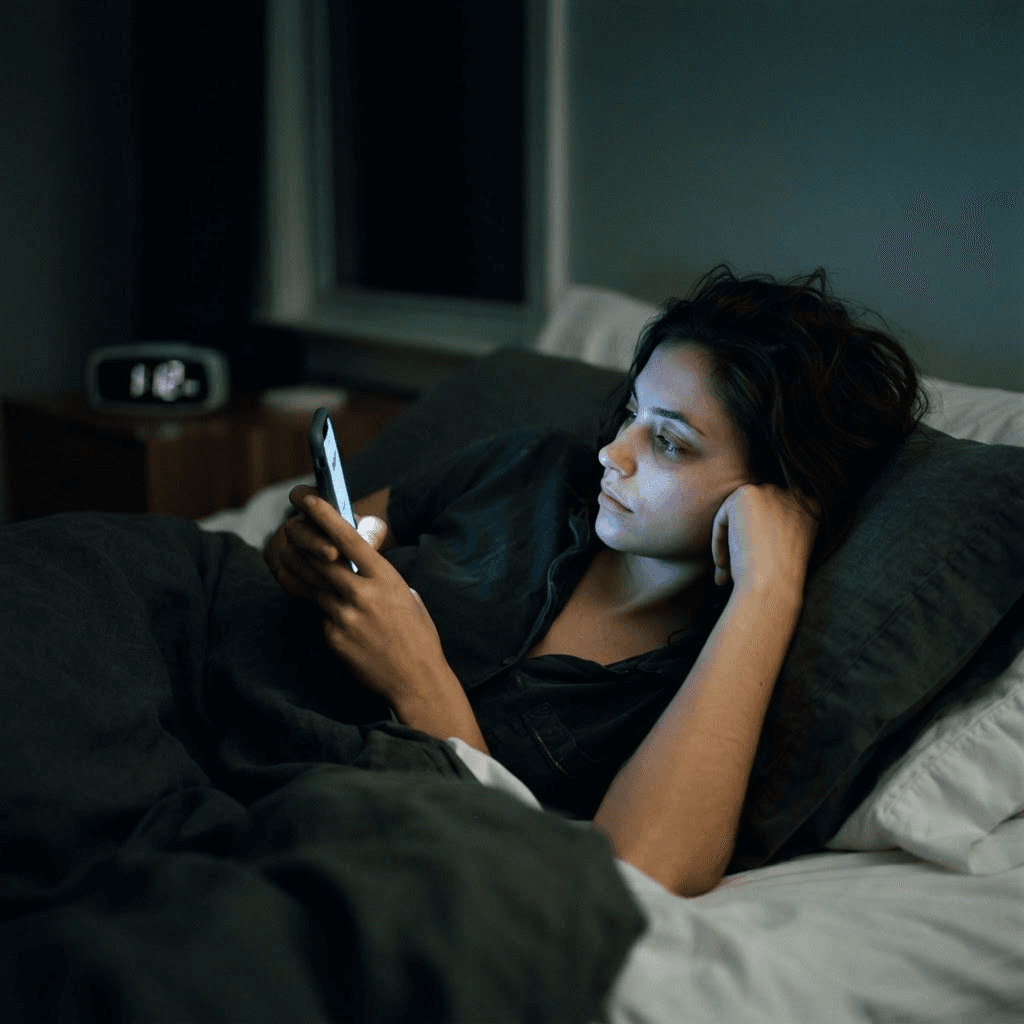
It is 12:47am. You have work in seven hours. And your brain — the same brain that could barely finish a sentence at 4pm — has suddenly decided this is the perfect moment to review a conversation from 2019, your finances, that email you phrased strangely, and whether the twinge in your shoulder is something serious. If that scene is familiar, you do not need another article telling you to "practise good sleep hygiene". You need to find the specific fault and repair it.
So this guide works like a repair manual. Scan the five problems below, find the one that matches your night, and go straight to it. Each one names the mechanism that is most likely producing your symptom and gives you one fix — drawn from cognitive behavioural therapy for insomnia (CBT-I), the treatment sleep clinics use first — that you can run tonight without buying anything.
Problem 1: Exhausted all evening, wide awake the moment you lie down
The symptom: you fight to keep your eyes open on the sofa at 10pm, then climb into bed and feel someone flip a switch. Suddenly you are alert, tense and thinking at full speed.
The likely cause: conditioned arousal. Brains learn by association, and if you have spent months lying in bed worrying, scrolling or watching the clock, your bed has quietly become a cue for wakefulness — the way the smell of a dentist's office is a cue for tension. The sofa carries no such association, which is exactly why you can sleep there.
The fix is called stimulus control, and it is one of the best-evidenced components of CBT-I. It has two rules. First, the bed is for sleep only — no phone, no laptop, no lying there "just resting" while your mind spins. Second, if you have been awake for what feels like fifteen or twenty minutes (do not check the clock — estimate), get up, go to another room, and do something quiet and dull in dim light until you feel genuinely sleepy. Then return to bed. Repeat as many times as it takes.

The first few nights of this feel worse, not better, and that is worth knowing in advance. You may be up three or four times. But most people notice the bed-equals-worry link weakening within two to four weeks, and unlike a sleeping pill, the result belongs to you.
Problem 2: The lights go off and the thoughts start racing
The symptom: the moment the room goes dark and quiet, your mind produces an agenda — unfinished tasks, worst-case scenarios, old embarrassments, tomorrow's logistics — and works through it at speed.
The likely cause: darkness removes competition. All day, your worries share bandwidth with meetings, messages, podcasts and other people. At night they finally get the stage to themselves, so they feel louder and more true. Researchers sometimes call the darker turn your reasoning takes after midnight "the mind after midnight" effect: the same thought is measurably more catastrophic at 2am than it will be at 2pm.
The fix comes in two parts. Part one happens hours before bed: scheduled worry time. Pick a fixed ten-to-fifteen-minute slot in the early evening — say 6:30pm, never within two hours of bed — and write your worries down in two columns: things you can act on (add the single next step) and things you cannot (name them and leave them on the page). When the same worries arrive at midnight, you tell your brain, honestly, that this item already has an appointment tomorrow at 6:30. It sounds almost too simple. Trials of the technique keep finding that it shortens the time anxious sleepers take to fall asleep.

Part two happens in bed: give your mind a task that is engaging enough to block worry but too meaningless to cause arousal. The "cognitive shuffle" works well — pick a neutral word like DREAM, then for each letter list random unrelated objects (desk, dolphin, doorknob...) until you drift. It occupies the verbal machinery your worries need, without giving them anything to grip. If you prefer a guided structure, the body-scan sequence in our beginner's guide to meditation does a similar job.
Problem 3: You wake at 3am with your heart pounding

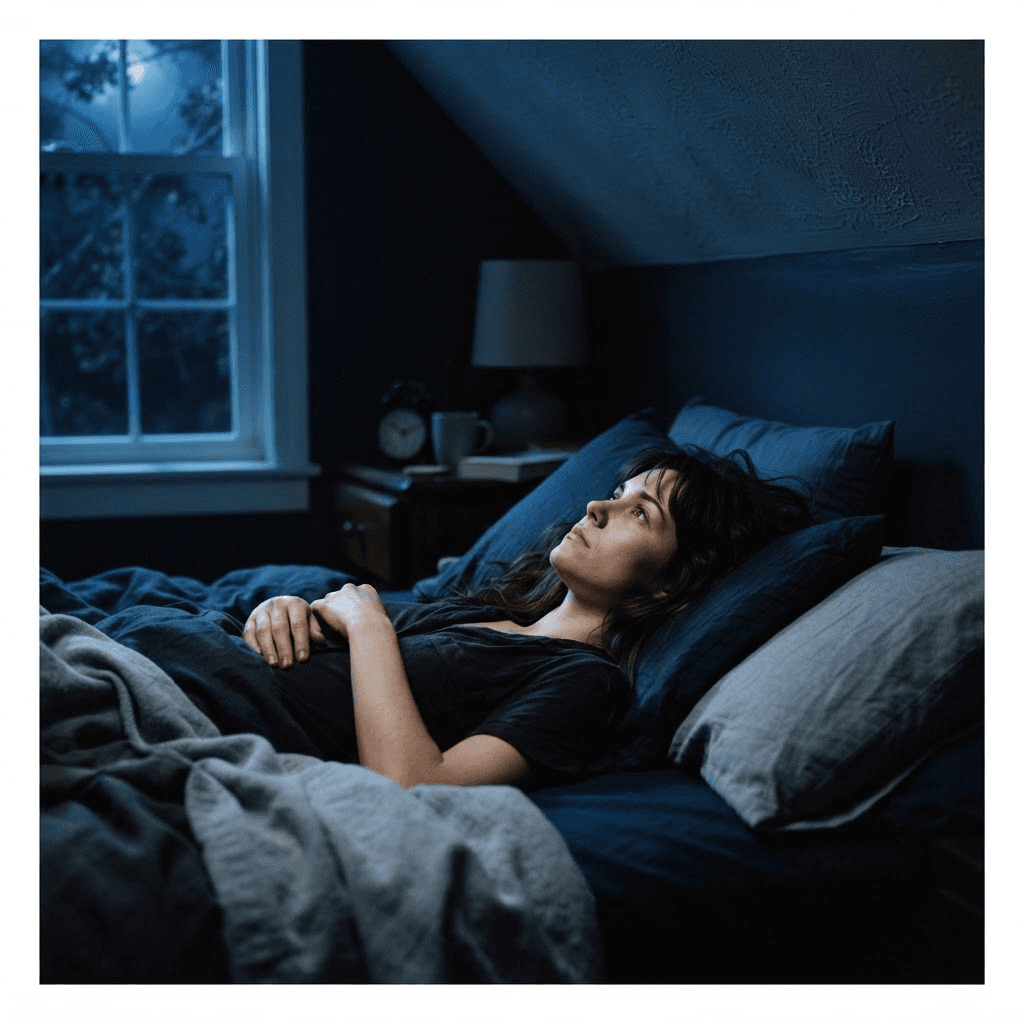
The symptom: you fall asleep fine, then surface abruptly in the small hours — often at an eerily consistent time — with a racing heart, a jolt of dread, and a mind that goes from zero to full alarm in seconds.
The likely cause: a collision of normal biology and an over-primed alarm system. Everyone surfaces briefly between sleep cycles, and the 3-to-4am window is where sleep is naturally lighter and cortisol starts its scheduled climb towards morning. If you drank alcohol, ate a heavy late meal, or are under sustained stress, that routine surfacing arrives with a stronger physiological jolt — and an anxious brain interprets the pounding heart as evidence of danger, which produces adrenaline, which speeds the heart further. The loop, not the wake-up, is the problem.
The fix targets the loop at its physical end, because at 3am your reasoning is not trustworthy enough to argue with. Use the physiological sigh: two short inhales through the nose — one full, one small top-up — followed by one long, slow exhale through the mouth. Repeat for ninety seconds to two minutes. The doubled inhale reinflates collapsed air sacs and the extended exhale presses the vagal brake on your heart rate; it is among the fastest voluntary ways to downshift arousal. Then apply the same quarter-hour rule from Problem 1: still awake after fifteen-ish minutes, leave the bed. And whatever you do, do not check the time — clock-watching at 3am is anxiety fuel with a glowing screen.
Problem 4: You now dread bedtime itself
The symptom: sleep has become a performance you are failing. You start calculating hours at dinner ("if I fall asleep by eleven I can still get six and a half"), you approach the bedroom with a knot in your stomach, and the harder you try to sleep, the more awake you become.
The likely cause: sleep effort. Sleep is one of a small family of processes — like relaxing, or being spontaneous — that are destroyed by direct effort. Trying to sleep requires monitoring whether it is working, monitoring requires vigilance, and vigilance is the opposite of sleep. Insomnia researchers consider this self-defeating effort a core engine of chronic insomnia, and the anxiety about not sleeping frequently causes more daytime damage than the lost sleep itself.
The fix is paradoxical intention: get into bed, make yourself comfortable, keep your eyes gently open in the dark, and try to stay peacefully awake. Not with screens or stimulation — just lie there, resting, mildly intending to remain awake. This dismantles the performance. There is nothing to fail at, no progress to monitor, and for many anxious sleepers the pressure collapses so completely that sleep arrives through the side door. It pairs well with a truth worth writing down where you will see it: one bad night costs you almost nothing. Humans are built to absorb occasional short nights; it is the fear of them that does the damage.
Sleep is the one door that only opens when you stop pushing on it.
Problem 5: Your mind is quiet but your body will not power down
The symptom: no racing thoughts, no specific worry — just a body that hums. Jaw tight, shoulders up, legs restless, a faint electrical alertness that will not switch off.
The likely cause: residual sympathetic arousal. If your day runs at high revs until 10pm — work, screens, intense exercise, difficult conversations — your nervous system does not have a hard off switch. It has a dimmer, and the dimmer needs time and darkness to travel. Going straight from full stimulation to lying still in the dark leaves the body idling fast with nowhere to put it.
The fix is a deliberate descent: a thirty-to-forty-five-minute wind-down that starts at the same time nightly and moves in one direction — dimmer, slower, warmer. The sequence matters less than the slope. A warm shower or bath about an hour before bed helps mechanically as well as psychologically: the after-cooling drops your core temperature, which is itself a sleep signal. In bed, progressive muscle relaxation gives a humming body a job: tense each muscle group for five seconds, release for ten, moving from feet to face. If daytime movement is part of your picture, gentle outdoor activity earns compound interest at night — the cortisol-lowering effects covered in our guide to hiking for mental health show up hours later, when you lie down.

Quick reference: match the fix to your night
| Your symptom | Most likely mechanism | First fix to try |
|---|---|---|
| Sleepy on the sofa, alert in bed | Conditioned arousal — bed cues wakefulness | Stimulus control: bed for sleep only, up after ~15 awake minutes |
| Racing thoughts when the lights go off | Worries finally have no competition | Scheduled worry time at 6:30pm + cognitive shuffle in bed |
| 3am wake-up, pounding heart | Normal arousal spike amplified by alcohol, late food or stress | Physiological sigh for 90 seconds; no clock-checking |
| Dread of bedtime, sleep-hour maths | Sleep effort — performance anxiety about sleep itself | Paradoxical intention: rest comfortably and try to stay awake |
| Quiet mind, humming body | Residual sympathetic arousal from a high-rev day | 30–45 min descending wind-down + progressive muscle relaxation |
Pick one fix and run it for two full weeks before judging it. Rotating through techniques nightly is itself a form of sleep effort — you end up monitoring the monitor. If your mornings are also anxious, the two problems usually share plumbing, and the routines in our guide to reducing anxiety with morning habits work the daylight end of the same system.
When this stops being a DIY problem
Self-help has honest limits, and pretending otherwise is how wellness writing loses people's trust. Book an appointment with a clinician if any of the following is true: the sleeplessness has run three nights a week for three months or more; you snore heavily, gasp or stop breathing at night (possible sleep apnoea, which masquerades convincingly as anxiety); night-time panic arrives with chest pain, or the anxiety is seeping into your days; or dark thoughts are showing up in the small hours. Insomnia with anxiety responds very well to structured treatment — clinician-guided CBT-I outperforms sleeping medication over the long term — but you have to be in the room to get it.
Sources behind this guide
The mechanisms and fixes above are drawn from clinical guidelines and peer-reviewed research on insomnia and anxiety. Follow the links to read the originals.
- Cognitive behavioural therapy for insomnia (CBT-I) as first-line treatment for chronic insomniaAmerican College of Physicians — Annals of Internal Medicine
- Stimulus control therapy: evidence review for the behavioural treatment of insomniaNational Library of Medicine (PubMed)
- "The mind after midnight": nocturnal wakefulness and dysregulated cognition and moodFrontiers in Network Physiology
- Brief structured respiration practices (including cyclic sighing) enhance mood and reduce physiological arousalCell Reports Medicine
- Anxiety disorders — symptoms, causes and when to seek careNational Institute of Mental Health (NIMH)
- Insomnia: what it is, how it is diagnosed and treatedNational Heart, Lung, and Blood Institute (NHLBI)
Night anxiety: what readers ask us most
The questions that arrive in our inbox most often after a bad night, answered without padding.
Why does my anxiety get worse at night for no reason?
There is a reason — several, in fact. At night the distractions that dilute anxious thoughts all day disappear, so worries get your full attention. Fatigue weakens the prefrontal circuits that keep perspective, darkness nudges the brain toward threat-scanning, and the natural pre-dawn cortisol rise adds a physiological edge in the small hours. Nothing about your problems has changed at 11pm; the volume on the machinery that processes them has.
How can I fall asleep fast when my mind is racing?
In the moment, give your mind a boring competing task rather than fighting the thoughts: try the cognitive shuffle (list random unrelated objects for each letter of a neutral word) or slow physiological sighs — two nasal inhales, one long mouth exhale. But the durable fix happens earlier in the evening: a ten-minute scheduled worry session hours before bed reliably shrinks the midnight edition of the same thoughts.
Why do I keep waking up at 3am with my heart racing?
Everyone surfaces briefly between sleep cycles, and the 3–4am window is where sleep is lightest and cortisol begins climbing toward morning. Alcohol, heavy late meals and sustained stress all amplify the jolt that comes with that surfacing. The pounding heart is usually your alarm system overreacting to a routine event — but if it comes with chest pain, gasping or choking awake, or loud snoring, see a clinician to rule out sleep apnoea and cardiac causes.
Should I stay in bed if I cannot sleep?
No — this is one of the most consistent findings in sleep medicine. Lying awake trains your brain to associate the bed with frustration and worry. After roughly fifteen to twenty awake minutes (estimated, not clock-checked), get up, sit somewhere dim and do something quiet and dull until real sleepiness arrives, then return. It feels counterproductive for the first few nights and pays off within weeks.
When should I see a doctor about night anxiety?
Use the three-three-three rule as a floor: trouble sleeping three or more nights a week, for three months, with daytime consequences. Go sooner if you have signs of sleep apnoea (snoring, gasping, unrefreshing sleep), night-time panic with chest pain, anxiety that is spreading into your days, or any thoughts of self-harm. Clinician-guided CBT-I plus treatment for the anxiety itself outperforms medication alone over the long run.
Vitality Editorial Team
Vitality publishes practical mental-health guidance based on cited sources and established clinical recommendations.
Medical disclaimer: This guide offers general education about sleep and anxiety, not a diagnosis or a treatment plan. Persistent insomnia, panic symptoms and suspected sleep apnoea deserve an assessment from a qualified clinician. If you are in crisis, contact a local emergency service or crisis line rather than relying on any article.