The 10-3-2-1-0 Sleep Rule: A Countdown That Starts Your Night Long Before Bed
- No caffeinehours beforeSet the cut-off in the early afternoon.
- No food or alcoholhours beforeLet digestion finish before you lie down.
- No workhours beforeGive your mind a runway to wind down.
- No screenshour beforeSwap the scroll for something slow.
- No snoozein the morningUp on the first alarm, curtains open.
Four daytime deadlines and one morning promise — the night is decided long before the pillow
You did everything right in bed — dark room, no phone, eyes shut by eleven. And still you lay there, wide awake. Here is the uncomfortable truth: most bad nights are decided hours earlier, in daylight. The 10-3-2-1-0 rule is a countdown that fixes that, turning five easy-to-remember numbers into deadlines you set across your day.
The short version
- The 10-3-2-1-0 rule is a countdown of daytime deadlines: no caffeine 10 hours before bed, no food or alcohol 3 hours before, no work 2 hours before, no screens 1 hour before, and 0 snoozes in the morning.
- It is not a new treatment — it is a memorable way to repackage ordinary sleep-hygiene advice so you actually act on it during the day, not at midnight.
- The numbers are guidelines, not a prescription; caffeine sensitivity, work and family life all vary, so adjust the timings to fit your evening.
- You do not have to nail all five at once. For many people, even one or two of the rungs — usually caffeine or screens — makes the biggest difference.
- A countdown helps a night lost to habits. If you cannot sleep for months despite doing everything right, that is a reason to see a clinician, not to try harder.
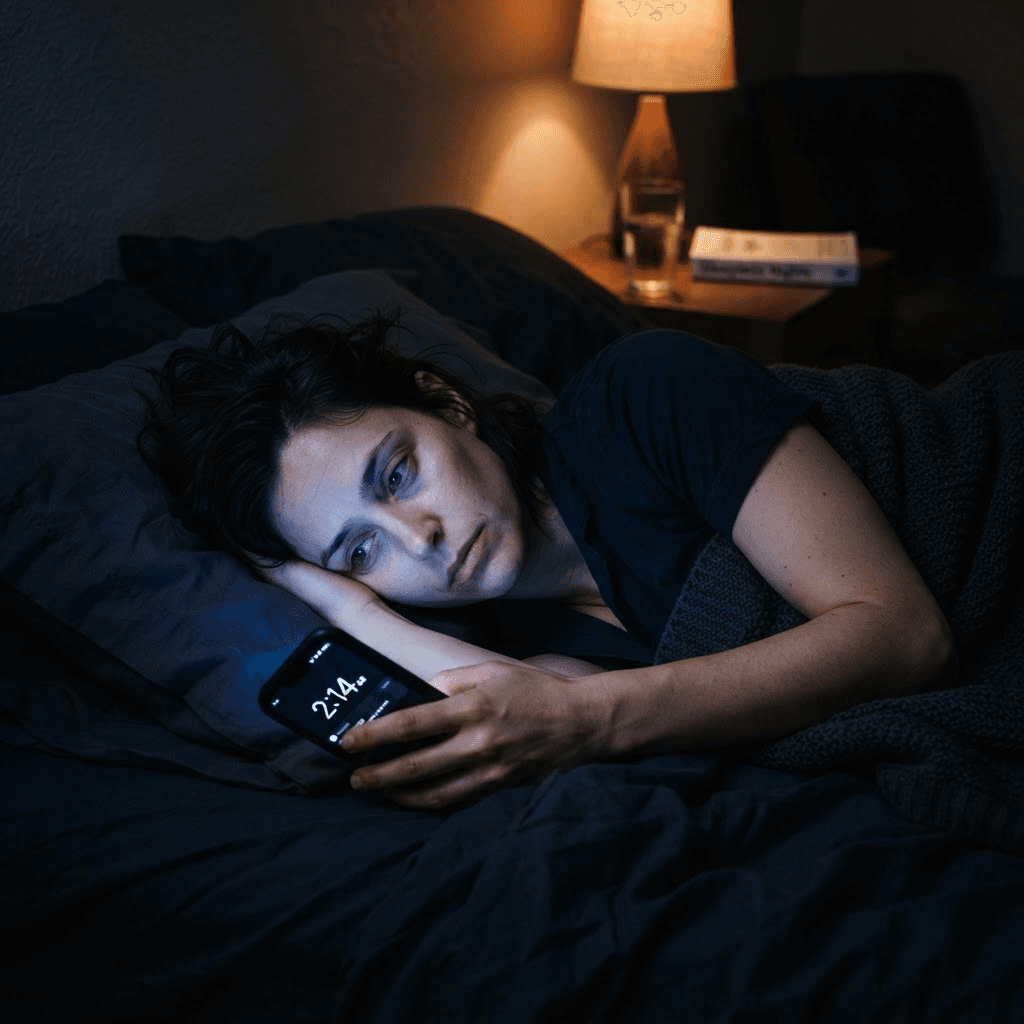
Picture the scene. It is 11:14 pm. The room is dark, the phone is in another room, the sheets are cool. By every rule you have ever read, you should be asleep. Instead you are staring at the ceiling, heart faintly ticking, replaying a message you sent and mapping out tomorrow in far more detail than tomorrow deserves. You did the bedtime part perfectly. So why are you still awake?
Because bedtime was never where the night was decided. The 3 pm coffee, the 9 pm dinner, the work email you answered at 10, the twenty minutes of scrolling that were meant to be two — those were the real turning points, and by the time your head hit the pillow the outcome was mostly locked in. The 10-3-2-1-0 rule exists to move your attention back to where it belongs: earlier, in daylight, when you can still change what kind of night you are about to have.
What the 10-3-2-1-0 rule actually is
Strip away the branding and the 10-3-2-1-0 rule is a mnemonic — a way to remember a handful of long-standing sleep-hygiene habits by hanging them on a countdown. There is nothing secret or clinical about the individual pieces; sleep specialists have recommended cutting caffeine, finishing meals earlier, winding down and getting off screens for decades. What the countdown adds is not new science but a shape you can actually hold in your head at 4 in the afternoon.
That framing matters more than it sounds. Most sleep advice fails not because it is wrong but because it arrives too late — you read "don't drink coffee too close to bed" while lying awake at midnight, which is useless. Turning each habit into a numbered deadline attached to your bedtime quietly converts vague good intentions into specific times on a specific day. You are no longer trying to "sleep better" in the abstract; you are deciding what to do at 1 pm, 8 pm, 9 pm and 10 pm.

10 — hours before bed: stop the caffeine
Caffeine is the longest lever in the whole countdown, which is why it sits at the top. It is a stimulant that blocks the brain's "time for sleep" signalling, and it lingers: it takes hours for even half of a dose to clear your system, and that clearance rate varies a great deal from person to person depending on genetics, medication and how much you use. Set the cut-off wide — around ten hours before bed — and you give yourself a generous margin rather than betting on your own metabolism.
The tricky part is that a late-afternoon coffee often feels harmless. You may fall asleep fine and still get lighter, more broken sleep without connecting the two the next morning. That gap between "I slept" and "I slept well" is exactly where caffeine does its quiet damage. If you want the detail on timing and why the effect is so individual, our guide to how late is too late for coffee goes deeper than a single number can.
3 — hours before bed: stop food and alcohol
The "3" covers two different offenders that happen to share a deadline. A large, late meal leaves your digestive system working while you are trying to power down, and for people prone to reflux, lying flat on a full stomach can make heartburn worse and fragment the night. Finishing your last real meal roughly three hours before bed gives digestion a head start so it is not competing with sleep.
Alcohol is the sneakier half. A nightcap genuinely can help you fall asleep faster, which is why so many people swear by it — but as your body processes it through the night, sleep tends to become lighter and more disrupted in the second half, and you often wake earlier than you wanted. The sedation at the start and the disruption later are two sides of the same drink, so the countdown treats "a glass to relax" as part of the pre-sleep window, not separate from it.
| What you had | What it can do to the night | Gentler swap |
|---|---|---|
| A large late dinner | Digestion competing with sleep; reflux worse lying flat | Eat the main meal earlier; keep anything late light |
| A nightcap or late glass of wine | Faster to fall asleep, but lighter, more broken sleep later | Finish alcohol earlier in the evening, or skip it on work nights |
| Genuine late-night hunger | Hunger itself can keep you awake | A small, plain snack beats going to bed hungry |
2 — hours before bed: stop working
This is the rung most people skip, and often the one they need most. Work — the actual laptop-open kind, but also the invisible kind where you keep "just checking" and mentally rehearsing tomorrow — keeps your mind in a problem-solving, alert state. Sleep needs the opposite: a gradual drop in arousal, a sense that the day is genuinely finished. Slamming the laptop shut at 10:55 and expecting to be asleep by 11 is asking your brain to change gears with no runway.
Two hours is the buffer that lets the transition happen. You do not have to fill it with anything special — dinner, tidying up, a walk, a shower, a chapter of something undemanding all count. What matters is that the effortful, evaluative part of your day has a clear finish line well before the pillow. If your evenings tend to disappear and you find yourself defending your free time by staying up, the pattern in our guide to revenge bedtime procrastination is worth recognising here.

1 — hour before bed: stop the screens
The screen rung gets talked about mostly in terms of blue light suppressing melatonin, and while light late in the evening can nudge your body clock, the honest picture is broader than one wavelength. The bigger problem for many people is engagement: the endless feed, the group chat, the one more episode, the news. Screens are engineered to hold your attention, and an alert, stimulated mind is the opposite of a drowsy one — regardless of the colour of the light.
So treat the "1" as a screen curfew rather than a lighting tweak. An hour without a phone, laptop or TV before bed gives your mind space to slow down and your body its normal cue that night has arrived. Replace the scroll with something deliberately low-stimulation: a paper book, a warm shower, stretching, quiet music, prepping the morning. If the real issue is that your mind will not stop once the lights are out, the cognitive shuffling technique is built for exactly that.

0 — the morning number: no snooze
The final digit breaks the pattern: it is the only one that happens after you wake. Hitting snooze feels like a small mercy, but the ten-minute doze it buys is fragmented, shallow sleep that your brain cannot use well — and you often surface from it groggier than if you had simply got up. That heavy, foggy feeling has a name, sleep inertia, and drifting in and out of light sleep for half an hour tends to feed it rather than fix it.
Aiming for zero snoozes also protects the whole system by anchoring a consistent wake time, which is one of the most reliable ways to keep your body clock steady. The trick is to make getting up the path of least resistance: put the alarm across the room, open the curtains straight away, and let daylight do the waking. If mornings feel brutal no matter how early you turned in, our guide to why you wake up tired even after a full night covers the usual culprits.

Build the countdown around your own bedtime
The numbers only become useful once you attach them to a real clock. Pick your target bedtime first, then count backwards to find your four daytime deadlines. Here is the whole thing mapped to an 11 pm bedtime so you can see the shape; slide every time earlier or later to match your own night.
| Number | Deadline | What it means | For an 11 pm bedtime |
|---|---|---|---|
| 10 | 10 hours before | Last caffeine | 1:00 pm |
| 3 | 3 hours before | Last food and alcohol | 8:00 pm |
| 2 | 2 hours before | Stop working | 9:00 pm |
| 1 | 1 hour before | Screens off | 10:00 pm |
| 0 | The next morning | Zero snoozes | Up on the first alarm |
Do not try to install all five at once. A countdown you abandon by Wednesday helps nobody. Pick the single rung that maps to your worst habit — for most people that is either the afternoon caffeine or the last hour of screens — and hold just that one for a week or two until it stops taking effort. Then add the next. Stacking the habits slowly is far more durable than a dramatic overhaul you cannot sustain.
When a rung keeps slipping: quick troubleshooting
If the countdown keeps falling apart at the same point every night, that is information, not failure. Usually one specific rung is the sticking point, and each has a fix that is more about design than willpower. Change one thing at a time so you can tell what actually helped.
| Where it slips | Likely reason | Try this |
|---|---|---|
| You forget the caffeine cut-off | The "10" is invisible until it is too late | Set one afternoon alarm; switch to decaf or herbal after it |
| You eat late most nights | Dinner is genuinely late for work or family reasons | Move the main meal earlier; keep anything after it small and plain |
| Work bleeds into the evening | No clear finish line to the day | Set a hard shutdown time and put it in your calendar |
| Screens creep back in | The phone is within arm's reach in bed | Charge it in another room; keep a book on the nightstand instead |
| You snooze anyway | The alarm is too easy to reach | Alarm across the room; open the curtains the moment you are up |
Does the 10-3-2-1-0 rule actually work?
Here is the honest answer. There is no single study on "the 10-3-2-1-0 rule" as a branded package, because it is not a treatment — it is a repackaging of individual sleep-hygiene habits, most of which are supported to varying degrees on their own. Reducing evening caffeine, not eating heavily right before bed, winding down and cutting late screen use are all standard, sensible recommendations. Bundling them into a countdown does not add new biology; it adds memorability and follow-through, which for a lot of people is the actual missing ingredient.
- It is free, low-risk and easy to start tonight, so trying it costs you very little.
- It works best for nights lost to habits — the late coffee, the doom-scroll, the work that never ended.
- The exact numbers are guidelines, and the benefit of each rung varies from person to person.
- It is a scaffold for better routine, not a fix for a sleep disorder or a night driven by pain, anxiety or a medical condition.
The countdown does not make you sleepy. It just clears away the things that were quietly keeping you awake — and then lets your body do what it already knows how to do.
So set your expectations where they belong. If your sleepless nights are mostly self-inflicted by a hectic evening, a countdown can be genuinely transformative simply by making good habits automatic. If they are not — if you keep every rung faithfully for weeks and still lie awake — then the problem was never the routine, and a stricter countdown is the wrong medicine.
When a countdown is not enough
A structured evening is the right tool for the common kind of bad sleep: the kind you can trace back to your own day. It is the wrong tool for persistent insomnia or an undiagnosed sleep problem. If trouble falling or staying asleep is happening several nights a week, has gone on for months, and is dragging on your mood, focus or functioning during the day, that pattern deserves proper assessment rather than a tighter set of rules.
This is general information, not a diagnosis, and it is not a reason to label yourself. What matters is that effective help exists: cognitive behavioral therapy for insomnia (CBT-I) is widely recommended as the first-line treatment for chronic insomnia and tends to outlast any single habit change. Loud snoring with pauses in breathing, gasping awake, or overwhelming daytime sleepiness can point toward conditions like sleep apnoea that no bedtime routine can address. If any of that sounds familiar, the next step is a clinician, not a stricter countdown.
For everyone else — the person undone by a 4 pm latte, the one who works until the lights go out, the endless late scroller — the 10-3-2-1-0 rule is a small, forgiving structure worth trying. Choose your bedtime, count backwards, pick one number to protect this week, and let the rest of the countdown fall into place from there. If you also need to shift your whole schedule earlier, pair it with our guide to fixing your sleep schedule.
Sources and further reading
The guidance above draws on public-health and clinical sources for the individual habits the countdown bundles together — caffeine, food and alcohol, wind-down, screens, and a consistent wake time. Follow the links to read the original material, and note where the strength of the evidence varies and where effects differ between people.
- Tips for better sleep and healthy sleep habitsCDC — Sleep
- Healthy sleep habits and what affects your sleepNational Heart, Lung, and Blood Institute (NIH)
- Sleep tips: 6 steps to better sleep (caffeine, meals, wind-down)Mayo Clinic
- Spilling the beans: how much caffeine is too much?U.S. Food & Drug Administration (FDA)
- Alcohol and sleepSleep Foundation
- Cognitive behavioral therapy for insomnia (CBT-I) as first-line treatmentMayo Clinic
The questions people ask about the 10-3-2-1-0 rule
What is the 10-3-2-1-0 sleep rule?
It is a countdown of daytime deadlines built around your target bedtime: no caffeine 10 hours before bed, no food or alcohol 3 hours before, no work 2 hours before, no screens 1 hour before, and 0 hits of the snooze button in the morning. It is a memorable way to remember standard sleep-hygiene habits, not a new medical treatment.
Does the 10-3-2-1-0 rule actually work?
There is no single study on the branded rule, because it simply bundles together individual habits — reducing evening caffeine, eating earlier, winding down and cutting late screen use — that are broadly supported on their own. The countdown mainly adds memorability and follow-through. It helps most with nights lost to habits, and is not a fix for a sleep disorder.
Do I have to follow all five numbers?
No. Trying to change everything at once is the fastest way to give up. Pick the single rung that maps to your worst habit — usually the afternoon caffeine or the last hour of screens — and hold just that for a week or two before adding the next. The exact times are guidelines you can adjust to your own evening.
Why does the rule say no caffeine 10 hours before bed?
Caffeine is a stimulant that lingers for hours, and how quickly it clears varies a lot between people. A ten-hour cut-off is deliberately conservative so you have a generous margin rather than betting on your own metabolism. If you are very sensitive you may need an even earlier cut-off; the main point is to set the cut-off in the afternoon, not after dinner.
Is hitting snooze really that bad?
The extra ten minutes tends to be fragmented, shallow sleep that can leave you groggier rather than more rested, a state called sleep inertia. Aiming for zero snoozes also helps anchor a consistent wake time, which keeps your body clock steady. Putting the alarm across the room and opening the curtains straight away makes getting up on the first alarm much easier.
When should I see a doctor instead of using the countdown?
Consider professional help if trouble sleeping happens at least three nights a week for three months or more, clearly affects your daytime functioning, comes with low mood or anxiety, or if a partner notices you snoring loudly, gasping or stopping breathing in your sleep. Cognitive behavioral therapy for insomnia (CBT-I) is the recommended first-line treatment for chronic insomnia.
Keep reading
More from the sleep desk for turning a good evening into a genuinely good night.