How to Stop Emotional Eating: a playbook for the 9pm fridge door
You are not weak, and you did not "fall off the diet." You are eating to feel better, and it works for about ninety seconds. This is a hands-on playbook for the moment the craving hits — how to tell real hunger from emotional hunger, find the trigger underneath it, and run a five-minute pause that gives you your choice back.
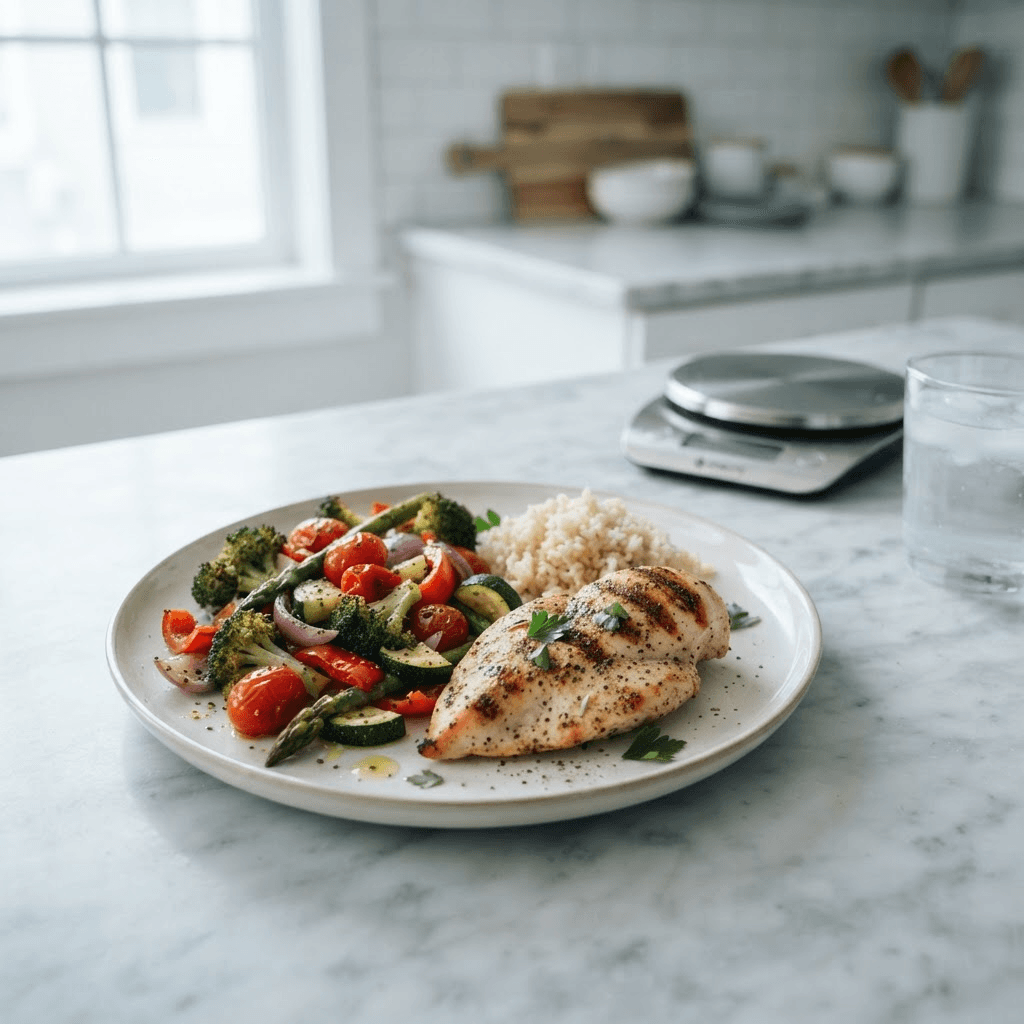
- Builds slowly over an hour or two
- Felt in the stomach — hollow, low energy
- Open to any food, even an apple
- Stops when you are comfortably full
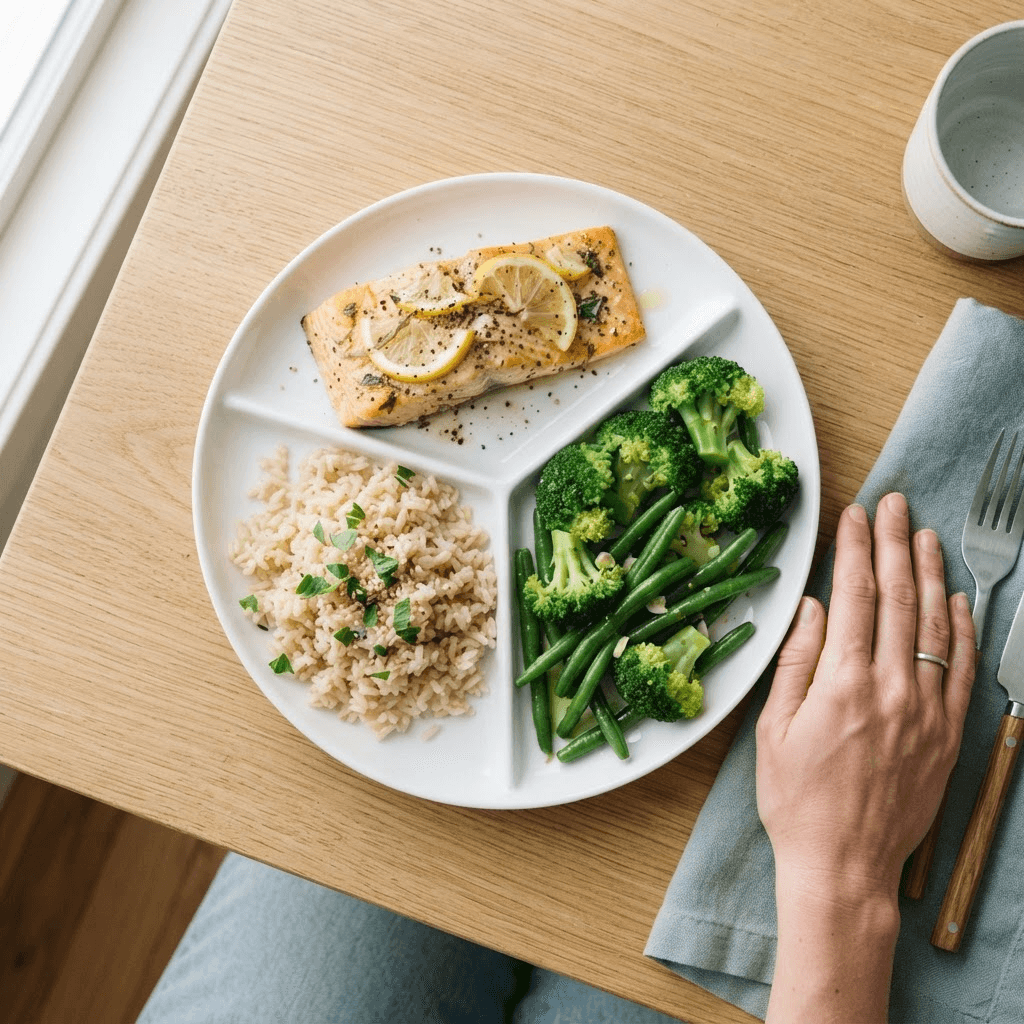
- Hits suddenly and feels urgent
- Felt in the head or mouth as a craving
- Wants one specific comfort food
- Keeps going well past full
The apple test settles most cases: if an apple sounds good, eat. If only the chocolate will do, that is emotional hunger — and food is not the answer to what it is asking.
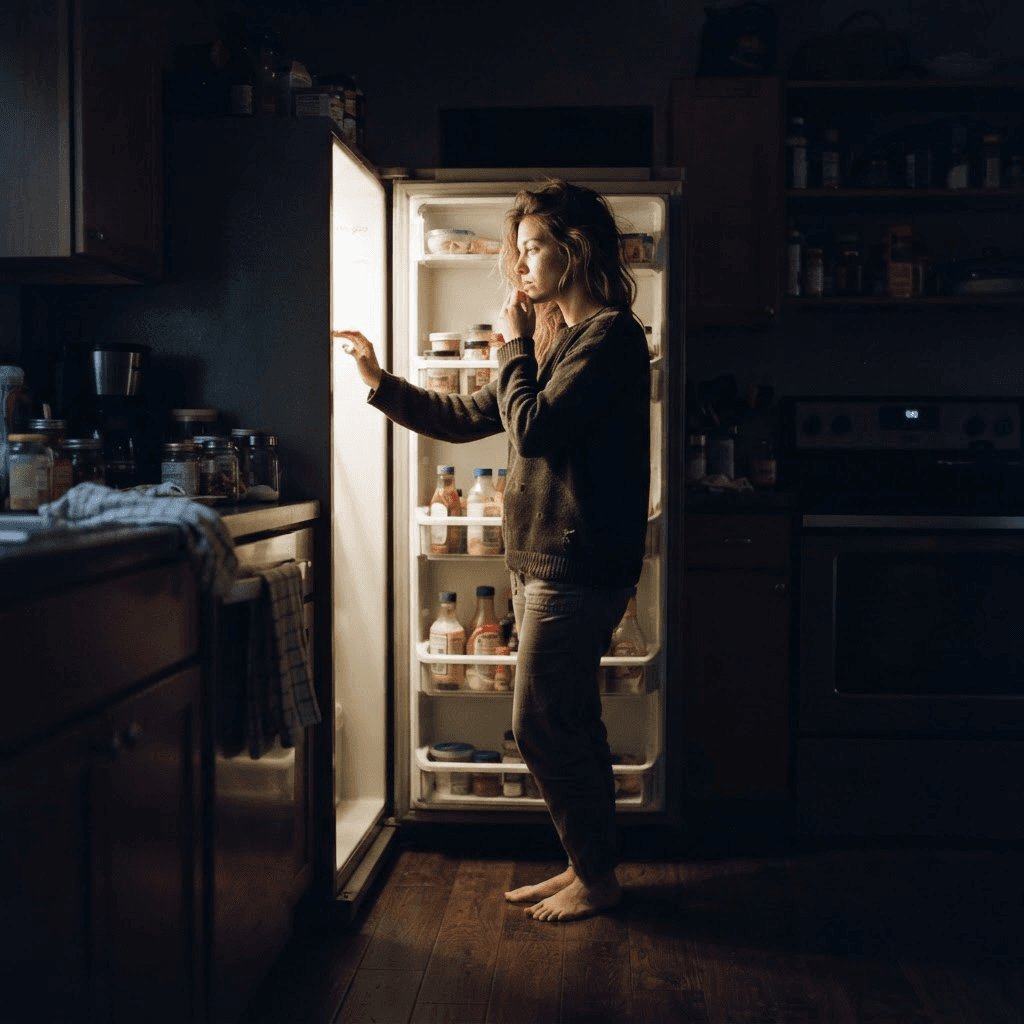
It is 9:47pm. The kids are down, the inbox is finally quiet, and you are standing in the cold light of the open fridge — not hungry, not really, but reaching anyway. You have already eaten dinner. You know you will feel worse in ten minutes. And yet the pull toward the leftover chocolate or the cheese or the cereal is louder than any of that. If you have ever wondered why the moment feels so automatic, this guide is written for exactly that fridge door.
Let us start by taking one thing off your shoulders: reaching for food when you feel bad is not a willpower defect. It is a coping strategy your brain learned because it works — food genuinely does turn down distress for a short while. The problem is only that the relief is brief and the feeling it was covering is still there afterwards, now with a side of guilt. So this is not a lecture about discipline. It is a practical playbook for the ninety seconds where the decision actually gets made.
The one distinction that changes everything
Almost every emotional-eating fix rests on a single skill: being able to tell physical hunger from emotional hunger while you are standing there, not an hour later. They feel similar in the moment but they behave completely differently, and once you can name which one is driving, you stop treating a mood like a stomach. The American Psychological Association describes emotional eating as using food to manage feelings rather than to satisfy hunger — and the tell is usually in how the urge arrives, not what it wants (APA, "Stress and eating").
| Notice this | Physical hunger | Emotional hunger |
|---|---|---|
| How it arrives | Builds gradually over an hour or two | Hits suddenly, feels urgent, needs feeding now |
| Where you feel it | In your stomach — rumbling, hollow, low energy | In your head or mouth — a craving, a pull, tension |
| What it accepts | Most foods sound fine, even an apple or leftovers | Only one specific thing will do — sweet, salty, crunchy |
| When it stops | You feel full and naturally put the fork down | You keep going past full, often on autopilot |
| How you feel after | Satisfied, neutral | Guilt, regret, or "why did I do that again?" |

Why your brain reaches for food when you are not hungry
When you are under pressure, your body pushes you toward quick, energy-dense food — and eating it can genuinely dull the sensation of stress for a short time. Harvard Health notes that ongoing stress is linked to a stronger drive for high-fat, high-sugar foods, which is why the craving under duress is rarely for steamed vegetables (Harvard Health, "Why stress causes people to overeat"). None of that makes you broken. It makes you a person with a nervous system doing exactly what it evolved to do.
There is also a learned loop underneath it. Feeling → eat → brief relief → the brain files "that helped." Repeat it enough evenings and the reach for the cupboard becomes as automatic as putting your seatbelt on. The good news hidden in that sentence: anything learned can be re-learned. You are not trying to delete the loop by force. You are going to insert a small gap into it — and that gap is where all your power lives.
Find the trigger under the craving
Emotional eating almost never comes out of nowhere, even when it feels like it does. It is usually answering one of a short list of unmet needs. Clinicians often teach the HALT check for exactly this — Hungry, Angry, Lonely, Tired — and for food specifically it helps to add a fifth: Bored, or under-stimulated. Run down the list the next time you catch yourself reaching, and see which one lands.
- Hungry — you genuinely under-ate earlier, so this is real hunger wearing an emotional coat. The fix is a proper meal, not a pause.
- Angry / anxious — tension needs an outlet, and chewing is one. The real need is discharge: a walk, a vent to a friend, a hard exhale.
- Lonely — food is company that never cancels. The real need is connection, even a two-line text to one person.
- Tired — willpower is lowest when you are exhausted, and food is a quick hit of alertness. The real need is rest, not sugar.
- Bored / under-stimulated — eating is something to do with your hands and mouth. The real need is a different small activity.

The five-minute pause: what to do at the fridge door
This is the core of the whole guide — the move you run in real time, in the kitchen, mid-reach. It is not about saying no forever. It is about buying five minutes so the automatic urge has to become an actual decision. Cravings behave like waves: they rise, peak, and fall on their own if you do not feed them. You are simply learning to stay on your feet while the wave passes.
- Name it out loud. "I am not hungry, I am wired." Naming a feeling reliably takes some heat out of it — it moves the moment from reflex to awareness.
- Rate the urge, 1 to 10. Giving the craving a number turns it into something you are observing rather than obeying. Notice it is a wave, not a wall.
- Set a five-minute timer. Tell yourself you can still eat the thing after — you are only agreeing to wait five minutes first. That small honesty makes the pause possible.
- Do one small thing. Fill a glass of water, step outside, brush your teeth, put on one song, text a friend. Anything that occupies your hands and changes the scene.
- Recheck the number. When the timer goes, rate the urge again. If it dropped, the wave has passed. If it is still a real 8 and an apple sounds good, eat a proper snack — mindfully, sitting down.
You are not trying to win a war with food. You are trying to insert five minutes between the feeling and the fork — and let the wave do the rest.

Meet the real need, not just the craving
Willpower fails because it fights the urge without answering the question underneath it. The trick is to give the actual need what it is asking for. Once you have named your trigger, you can reach for the right tool instead of the nearest snack. Use the table below as a cheat sheet — screenshot it and keep it in the kitchen for the first couple of weeks.
| If the trigger is… | What you actually need | Try this instead |
|---|---|---|
| Genuinely hungry | Food — this one is real | Eat a balanced snack with protein and fibre, sitting down |
| Stressed / anxious | To discharge tension | A brisk five-minute walk, cold water on the face, slow exhales |
| Lonely | Connection | Text or call one person, even just to say hello |
| Tired | Rest | Go to bed earlier tonight; a short lie-down or a real break now |
| Bored | Stimulation | A ten-minute task, a hobby, a walk around the block, a puzzle |
| Rewarding yourself | To feel cared for | A bath, a chapter of a book, a show — a reward that is not food |
A quick word on the food itself: banning your comfort foods outright tends to backfire, because deprivation makes the craving louder and the eventual slip bigger. You are far better off keeping trigger foods out of easy reach than swearing them off entirely — which brings us to the most underrated lever of all.
Redesign the moment, not just your resolve
The most reliable way to eat less on autopilot is to make the autopilot choice a better one. This is not about a spartan, joyless kitchen. It is about spending your willpower once, at the supermarket, instead of a hundred times at 9:47pm when you have none left. Environment beats intention almost every time.
- Keep trigger foods out of sight and out of the house, or at least off the counter and up high. What you do not see, you rarely reach for.
- Make the good choice the easy one: a fruit bowl on the counter, water in the front of the fridge, pre-portioned snacks at eye level.
- Do not eat straight from the packet. Portion onto a plate or into a bowl — the packet has no bottom and neither does mindless eating.
- Create a "kitchen closed" signal after dinner: wipe the counters, dim the lights, make a herbal tea. A closing ritual tells your brain the eating day is done.
- Eat enough during the day. Skipping meals to "save calories" almost guarantees an evening you cannot steer. A protein-forward breakfast and lunch is quiet insurance against night eating.

What to do the moment after you slip
You will still eat emotionally sometimes. Everyone does. What decides whether it stays a blip or becomes a spiral is the next thirty seconds — and specifically whether you reach for shame. Shame does not make you eat less tomorrow; it reliably makes you eat more, because feeling terrible is itself a trigger. So the skill here is a clean reset, not a punishment.
- Drop the "I have ruined it" story. One evening of eating does not undo your progress any more than one salad creates it.
- Get curious, not critical. Ask what the trigger was — you just gathered free data about your pattern.
- Return to normal at the very next meal. Do not "make up for it" by skipping breakfast; that under-eating is what sets up the next binge.
- Note the one thing you would do differently, and let it go. Momentum comes from the next choice, not the last one.
A slip is a single data point, not a verdict on your worth. The people who succeed are simply the ones who restart faster.
When emotional eating needs more than a playbook
Everything above is for the ordinary, everyday version of comfort eating. But sometimes the pattern is heavier than that, and it deserves real support rather than another self-help tip. Binge eating disorder is the most common eating disorder, and it is a recognised, treatable medical condition — not a lack of discipline (NIMH, "Eating disorders"). It is worth speaking to a doctor or a qualified therapist if you notice several of the following.
- Eating unusually large amounts in a short time, and feeling unable to stop while it is happening.
- Eating in secret, or hiding food, because of shame about how much or what you eat.
- Feeling significant distress, disgust or guilt regularly after eating.
- Making yourself vomit, using laxatives, fasting or over-exercising to "compensate" for eating.
- Feeling that food and eating occupy your thoughts most of the day.
For most people, though, the everyday playbook is enough: learn to tell the two hungers apart, spot your one recurring trigger, run the five-minute pause, and design a kitchen that helps the tired version of you. Do that and the 9:47pm fridge door slowly stops being a battle you dread — and becomes just a door.

Sources and further reading
The claims in this article are checked against public-health, clinical and psychological sources. Follow the links to read the originals.
- Stress and eatingAmerican Psychological Association
- Why stress causes people to overeatHarvard Health Publishing
- Eating disorders: overview and treatmentNIH — National Institute of Mental Health
- Binge eating disorder: symptoms and causesMayo Clinic
- Weight management and behaviour changeNHS
The move you run at the fridge door
Screenshot this. You are not saying no forever — you are buying five minutes so the wave can pass and the reflex becomes a choice.
- Name it"I am not hungry, I am wired." Saying the feeling out loud takes the heat out of the reflex.
- Rate the urgeGive it a number, 1 to 10. Now you are observing the craving instead of obeying it.
- Set 5 minutesAgree you can still eat it after — you are only promising to wait first.
- One small thingWater, a doorstep, brush your teeth, one song. Change the scene and busy your hands.
- RecheckRe-rate the urge. If the wave has passed, you are done. If it is real, eat a proper snack, sitting down.
Five things to hold onto
- Emotional eating is a coping strategy, not a character flaw — it soothes a feeling, briefly, then usually adds guilt on top.
- Physical hunger builds slowly and will accept an apple; emotional hunger arrives suddenly and demands one specific comfort food.
- Most emotional eating traces back to a short list of triggers — tired, tense, lonely, bored, or genuinely under-fed earlier in the day.
- The skill is a pause, not more willpower: name the feeling, rate the urge, set a five-minute timer, and do one small thing before you decide.
- A slip is data, not a disaster. Getting help matters if eating feels out of control, secretive, or followed by purging.
FAQ
The emotional-eating questions people actually ask
How do I tell emotional hunger from real hunger?
Physical hunger builds gradually over an hour or two, is felt in your stomach, and will accept most foods — even an apple or leftovers. Emotional hunger arrives suddenly, feels urgent, is felt more in your head or mouth as a craving, and usually demands one specific comfort food. A quick check: ask whether an apple would satisfy you right now. If yes, you are probably genuinely hungry; if only the chocolate will do, it is emotional hunger, and food will not answer what it is really asking.
Why do I eat when I am stressed even when I am full?
Under stress, your body pushes you toward quick, energy-dense food, and eating it briefly dulls the feeling of distress — so your brain learns that eating "helps" and starts reaching automatically. It is a learned coping loop, not a willpower defect. The way out is not more willpower but inserting a short pause between the feeling and the food so the automatic urge becomes a real choice.
What is the fastest way to stop a craving in the moment?
Run a five-minute pause. Name the feeling out loud ("I am not hungry, I am tired"), rate the urge from 1 to 10, set a five-minute timer while allowing yourself to eat afterward if you still want to, and do one small thing — water, a walk to the door, brushing your teeth, one song. Recheck the number when the timer ends. Cravings rise and fall like waves, and most have passed or shrunk by the time five minutes are up.
How do I stop night-time and late-night eating specifically?
Two things fix most night eating. First, eat enough during the day — skipping meals to save calories almost guarantees an evening you cannot steer, so anchor a protein-forward breakfast and lunch. Second, create a "kitchen closed" ritual after dinner: wipe the counters, make a herbal tea, dim the lights. Keep trigger foods out of the house or up high, and pre-portion one snack you enjoy onto a plate while you are still calm.
Should I just ban my trigger foods completely?
Usually not. Strict bans tend to backfire because deprivation makes the craving louder and the eventual slip bigger. It works better to keep trigger foods out of easy reach — off the counter, out of the house, not eaten from the packet — while still allowing yourself them sometimes, portioned and eaten mindfully. You are managing the environment and the moment, not waging war on the food.
When should I get professional help for emotional eating?
Speak to a doctor or qualified therapist if you regularly eat large amounts and feel unable to stop, eat in secret out of shame, feel significant guilt or distress after eating, try to compensate by vomiting, using laxatives, fasting or over-exercising, or find food occupies most of your thoughts. These can be signs of binge eating disorder, which is common and treatable. Cognitive behavioural therapy has strong evidence, and a GP is a good first step. Reaching out is a strength, not a failure.
Keep reading