Portion Control for Weight Loss: Eat Less Without Counting
You do not need an app, a food scale or a spreadsheet to eat less. You need to know what a real portion looks like — and you carry the measuring tools with you everywhere. This is the hand-and-plate method, the science behind why our portions ballooned, and exactly how to right-size your meals at home, at work and out to dinner.
Order a plate of pasta at a restaurant today and it will arrive holding roughly three to four times what a plate of pasta held in 1985. The plate itself is wider. The glass is taller. The muffin at the coffee counter is the size of your fist, not your thumb. None of this happened because you lost self-control — it happened around you, gradually, until an enormous serving started to look like a normal one. That is the quiet trap at the heart of most weight gain, and portion control is simply the skill of stepping back out of it.
Here is the part nobody selling you a tracking app wants to admit: you can lose weight without ever logging a meal. Counting calories works, but it is admin, and most people abandon it within a few weeks. Portion control gets you to the same destination — eating a bit less than you burn — by changing the shape of your plate instead of the contents of a spreadsheet. This guide shows you how, using two tools you already own: your hands and a dinner plate.
Why portion control quietly beats calorie counting
Every method of weight loss shares one mechanism underneath. Whether it is keto, fasting, "clean eating" or a meal-replacement shake, it works only if it nudges you into a modest calorie deficit — taking in slightly less energy than you spend. Portion control is the most direct way to reach that deficit, because it acts on the single biggest lever most people have: the amount of food that lands in front of them.
And it has one huge advantage over calorie counting: friction. Weighing food, scanning barcodes and remembering to log the handful of nuts you ate at 4pm is a tax on your attention, and attention runs out. A portion habit costs you nothing after the first fortnight because it is built into how you plate food, not into a separate task you have to remember. You are not fighting your willpower five times a day; you set the plate up once and let it do the work.
Portion distortion: why "a normal amount" keeps growing
Researchers have a name for the reason your eye no longer recognises a sensible serving: portion distortion. Over the past four decades, the standard size of nearly everything we eat outside the home has crept upward, and our sense of "normal" crept up with it. When bagels, sodas and plates of chips all grow at once, no single change feels dramatic — but the cumulative effect is that people now serve themselves, and expect, far more than their grandparents did.
| Food | Then (1980s) | Now | Extra energy |
|---|---|---|---|
| Bagel | 3-inch, ~140 kcal | 5–6 inch, ~350 kcal | +210 kcal |
| Fizzy drink | 200 ml bottle | 500–600 ml bottle | +150 kcal |
| Restaurant pasta | ~1.5 cups | ~4–5 cups | +500+ kcal |
| Coffee-shop muffin | ~85 g | ~130–160 g | +250 kcal |
| Cinema popcorn | Small ~5 cups | Large ~20 cups | +900+ kcal |
The fix is not to memorise a chart. It is to recalibrate your eye using a reference you always have on you. Once you can glance at a plate and see "that is about two palms of chicken and three fists of vegetables", the distorted portions of the outside world stop being invisible. You will start noticing when a meal is double what your body actually asked for — and that noticing is most of the battle.
The hand method: a measuring set you never forget at home
The single most useful thing in this article is the hand method, because your hand travels with you and roughly scales to your body — bigger people have bigger hands and generally need more food. You do not need to be precise. You need to be in the right ballpark, consistently, meal after meal. Here is the whole system, built around four parts of one hand.

Protein — one palm per meal
A serving of protein is roughly the size and thickness of your palm, not counting your fingers. That is one chicken breast, one salmon fillet, a palm of mince, or a similar volume of tofu, tempeh, eggs or Greek yoghurt. Most people trying to lose weight do better with two palms per meal, because protein is the most filling macronutrient and it protects the muscle you want to keep while the fat comes off.
Vegetables — one to two fists
Non-starchy vegetables — leaves, broccoli, peppers, courgette, tomatoes, mushrooms — are measured in fists, and this is the one place you should feel free to be generous. A fist or two per meal adds volume, fibre and water for almost no energy, which means your stomach fills up long before your calorie total does. If you are ever unsure how to make a portion feel bigger without adding calories, the answer is almost always another fist of vegetables.
Starchy carbs — one cupped hand
Rice, pasta, potatoes, oats and bread are measured by your cupped hand — the amount you could hold in a rounded palm. This is the portion that has grown most in restaurants, so it is the one worth watching hardest at home. One cupped hand of cooked rice or pasta per meal is plenty for most people; active people and larger bodies can take two.
Added fats — one thumb
Oils, butter, nut butters, cheese and dressings are calorie-dense and easy to pour with a heavy hand, so they get the smallest measure: your thumb. One thumb of olive oil for a pan, one thumb of peanut butter on toast. Fats are not the enemy — they make food satisfying — but a "glug" of oil can quietly be three thumbs, and that adds up faster than anything else on the plate.
The plate method: build a balanced meal in ten seconds
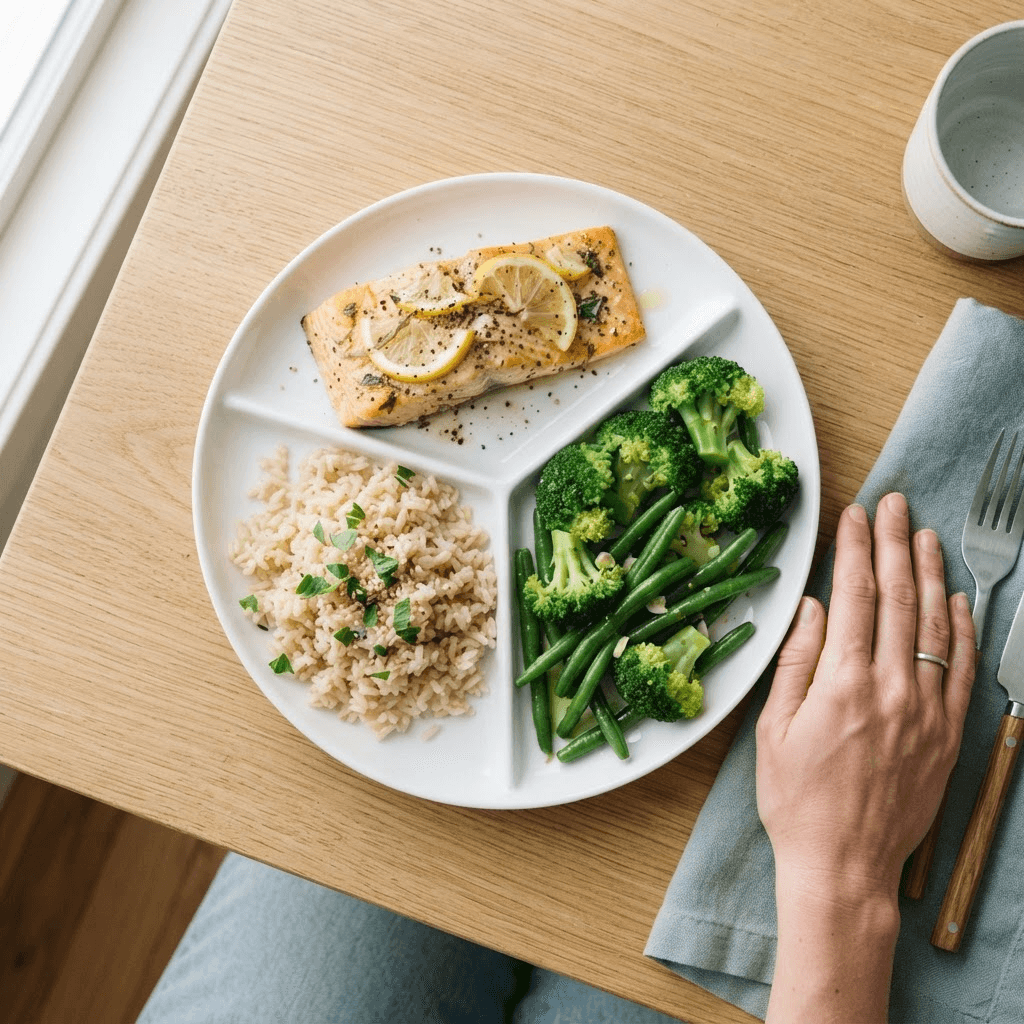
If the hand method is your measuring set, the plate method is your blueprint. It answers the harder question — not just how much of each food, but how they should share the plate. It is the approach public-health bodies quietly recommend precisely because it needs no numbers, and you can teach it to a child.
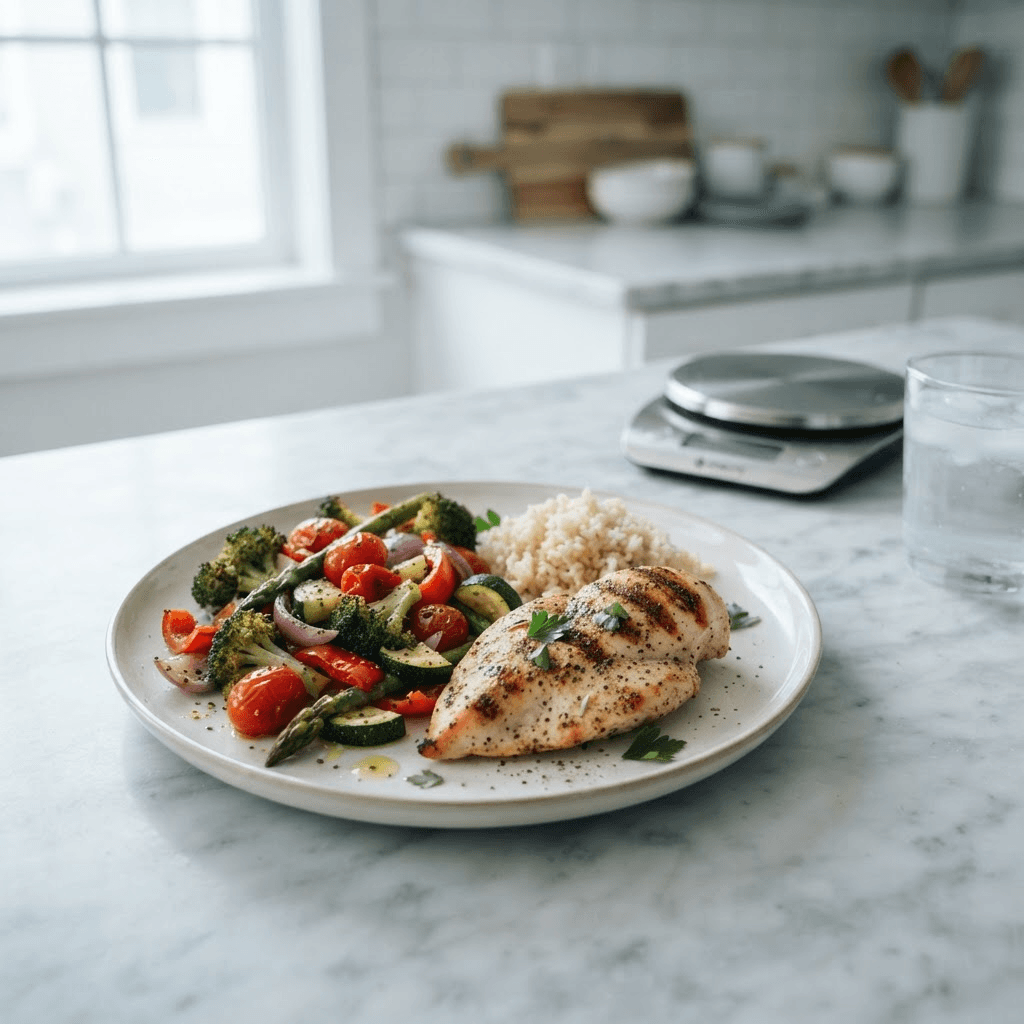
- Fill half your plate with non-starchy vegetables or salad. This is the anchor — it makes the meal look full and keeps you full.
- Fill one quarter with protein — a palm or two of chicken, fish, eggs, beans, tofu or lean meat.
- Fill the last quarter with starchy carbs — rice, potato, pasta, bread or grains, about a cupped hand.
- Add a thumb of healthy fat for flavour and satisfaction, and drink water rather than your calories.

The quiet genius of the plate method is that the vegetables displace the excess. When half the plate is committed to low-energy, high-volume food, there is simply less room for the pasta mountain that used to fill it. You end up eating fewer calories without ever setting out to, which is exactly the kind of change that lasts because it never felt like deprivation.
Shrink the plate, not just the food
Before you touch what goes on the plate, look at the plate itself. Dinner plates have grown along with our portions — many modern ones are 11 or 12 inches across, where a mid-century plate was closer to 9. That matters because of a simple perception quirk: the same amount of food looks skimpy on a huge plate and abundant on a smaller one, and your brain judges fullness partly with its eyes.

You do not need to buy anything. Use your side plates or salad plates for main meals, switch to a smaller bowl for cereal and ice cream, and pour drinks into a tall, narrow glass rather than a short, wide one — tall glasses look like they hold more, so you pour less. These are not gimmicks; they are ways of making the easy choice the default, so you spend zero willpower getting there.
Portion control when someone else is plating your food
Home is the easy part — you control the plate. Restaurants, takeaways and other people's kitchens are where portion habits get tested, because the serving is designed to feel like value, which usually means volume. You do not have to skip the meal out or eat sadly while everyone else enjoys themselves. You just need a few moves ready before the food arrives.

- Box half before you begin. Ask for a takeaway container when the food arrives and move half across immediately, so the portion in front of you is already right-sized.
- Order a starter as your main, or split a main and add a side salad. Two smaller plates often beat one enormous one.
- Make half the plate vegetables by ordering a green side, then treat the rest as your protein-and-carb quarters.
- Slow down and put the fork down between bites — fullness signals take about twenty minutes to arrive, and fast eating outruns them.
- Drink water alongside anything else. Liquid calories from soft drinks and alcohol do not trigger fullness, so they stack on top of the meal unnoticed.
The snack trap: portioning the foods you eat from the bag
Meals are rarely where portion control breaks down. Snacks are. Eating crisps straight from a large bag, nuts by the handful, or ice cream with a spoon out of the tub removes every natural stopping point, so you keep going until the food is gone rather than until you are satisfied. The fix is boring and extremely effective: never eat a moreish food from its original container.

- Tip a single serving into a small bowl and put the packet away before you sit down.
- Buy snacks in single-serve sizes if a big bag always vanishes in one sitting — you are paying a small premium for a built-in stop sign.
- Pre-portion nuts, dried fruit and treats into little containers on the day you shop, so future-you does not have to negotiate.
- Front-load your fridge with pre-cut vegetables and fruit at eye level, so the easy grab is also the low-calorie one.
A full day of hand-portioned eating
To make this concrete, here is what an ordinary day looks like when you plate by hand and eye rather than by the numbers. Nothing is weighed. Nothing is logged. Every portion is judged with the tools you were born with.
| Meal | What is on the plate | Hand portions |
|---|---|---|
| Breakfast | Greek yoghurt, oats, berries, scattering of nuts | 1 palm yoghurt, 1 cupped hand oats, 1 fist berries, ½ thumb nuts |
| Lunch | Chicken salad wrap with a big side salad | 2 palms chicken, 1 cupped hand wrap, 2 fists salad, 1 thumb dressing |
| Snack | Apple and a small bowl of nuts | 1 fist apple, 1½ thumbs nuts |
| Dinner | Salmon, roasted potatoes, broccoli and green beans | 2 palms salmon, 1 cupped hand potatoes, 2 fists veg, 1 thumb oil |
Notice there is no forbidden food and no meal skipped. Bread, potatoes and dessert all fit — they are simply sized rather than piled. That is why this survives real life: a birthday dinner, a stressful week, a holiday. You are not on a diet you can fall off. You are running a default you can flex and return to.
Troubleshooting: when portion control stalls
You are hungry an hour after eating
You have probably cut the volume too hard or leaned too light on protein and fibre. Add a second palm of protein and another fist of vegetables before you reduce anything else — both are extremely filling for their calories. Persistent hunger is a signal to rebalance the plate, not to grit your teeth. A hungry plan is a plan with a short shelf life.
The scale stopped moving
Your portions may have quietly crept back up — hands get generous when nobody is checking, and "one cupped hand" slowly becomes a rounded pile. Re-anchor for a few days by plating deliberately, watch the calorie-dense extras (oils, dressings, cheese, drinks) that are easy to under-count, and read our guide to breaking a weight-loss plateau for the other usual suspects.
It falls apart at social meals
Do not aim for a perfect portion at a party — aim for a reasonable one. Fill half your plate with the vegetable and salad options first, take single servings of the rest, and let one imperfect meal be exactly that. Consistency across the week matters far more than any single plate, and no birthday cake has ever undone a month of sensible dinners.
You cannot out-track a portion you never notice. Learn to see the plate, and the calorie counting becomes optional.
References and further reading
These sources support the portion-size, satiety and behavioural principles used in this guide. Links lead to the government agency, journal or public-health publisher.
- Portion distortion and how serving sizes have changed over timeUS National Heart, Lung, and Blood Institute (NHLBI)
- Portion size and its effect on energy intakeCochrane Database of Systematic Reviews
- The Healthy Eating PlateHarvard T.H. Chan School of Public Health
- Dietary protein, weight loss and satietyThe American Journal of Clinical Nutrition
- Fruit and vegetables and energy density in weight managementUS Centers for Disease Control and Prevention (CDC)
Keep these six on the fridge
What to remember when you plate up
- 01Portion control is the calorie deficit in disguise — it lowers energy intake without you tracking a single number.
- 02Your hand is a portable measuring set: palm for protein, cupped hand for carbs, fist for vegetables, thumb for fats.
- 03The plate method — half vegetables, a quarter protein, a quarter carbs — builds a balanced meal in ten seconds.
- 04Portion sizes have quietly doubled since the 1980s, so "a normal amount" is a moving target you have to reset on purpose.
- 05Smaller plates, pre-portioned snacks and boxing half a restaurant meal remove the decision before hunger makes it for you.
- 06Right-size, do not starve. Portions that leave you satisfied are the only ones you will keep for more than a fortnight.
Before you start
Portion control questions people ask before they start
Can you really lose weight with portion control alone?
Yes. Portion control lowers how much energy you eat, which is the one thing every successful weight-loss approach has in common. For many people it is more sustainable than calorie counting because it removes the daily tracking. It works best when portions are still satisfying and paired with mostly whole foods and plenty of vegetables.
How accurate is the hand portion method?
It is deliberately approximate, and that is the point. Hands roughly scale to body size, so a bigger person who needs more food also has a bigger palm and fist. The method will not match a food scale to the gram, but it is more than accurate enough to guide consistent, sensible portions without any equipment.
What is the plate method for weight loss?
Fill half your plate with non-starchy vegetables or salad, one quarter with protein and one quarter with starchy carbohydrates, plus a small amount of healthy fat. The vegetables add volume and fullness for very few calories, which naturally crowds out larger servings of higher-calorie foods.
Do smaller plates actually help you eat less?
Smaller plates can help because the same portion looks fuller and more satisfying, and there is less room to pile food. The effect is modest and works best alongside plating deliberately and keeping serving dishes off the table. Think of it as a helpful nudge, not a standalone solution.
How do I control portions when eating out?
Decide before you start that half the meal is going in a takeaway box, or order a starter as your main. Prioritise a vegetable side to fill half the plate, drink water instead of your calories, and eat slowly so fullness has time to register. One large restaurant portion often holds two or three sensible servings.
Is portion control safe if I have a history of disordered eating?
Rigid portion rules and any focus on eating less can be risky for people with a history of disordered eating. If that applies to you, speak with a doctor or a registered dietitian before changing how you eat. A qualified professional can help you build a flexible, non-restrictive approach that supports your health.
Keep the momentum