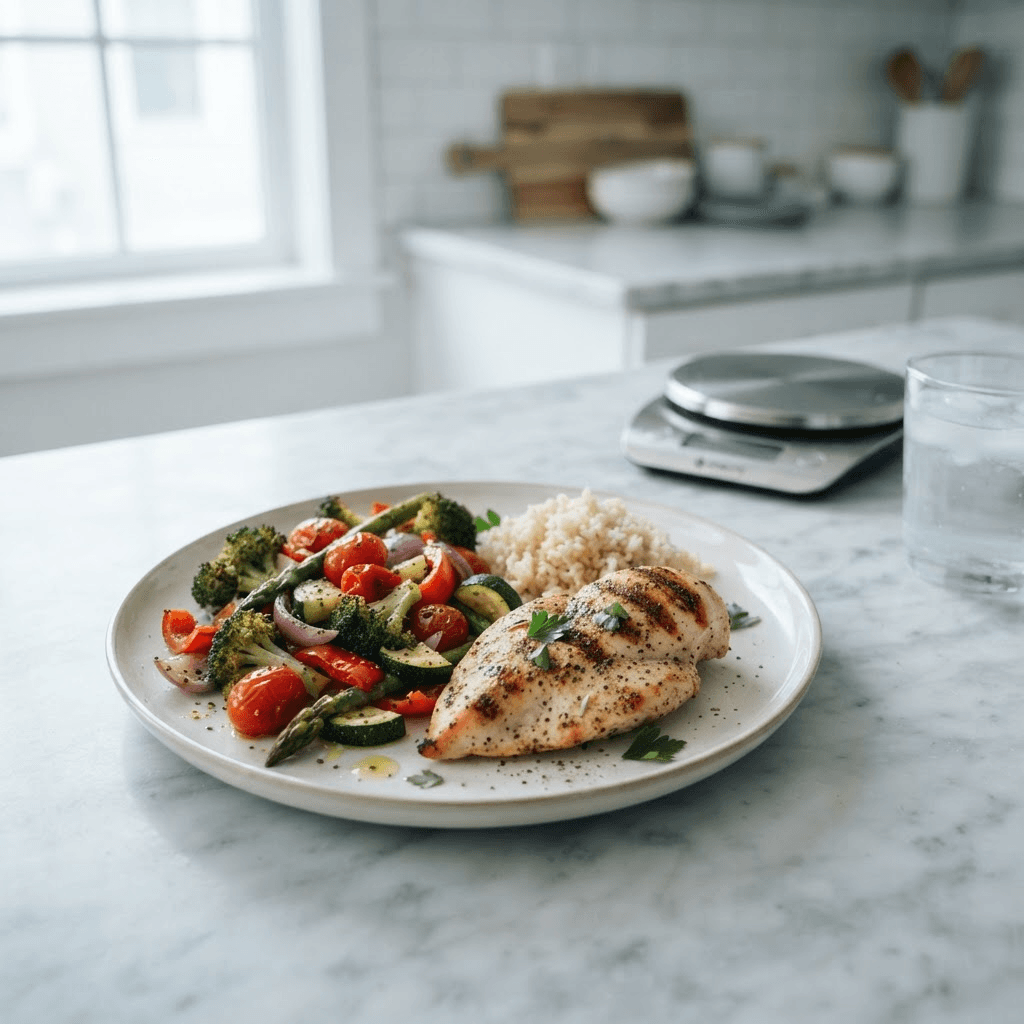
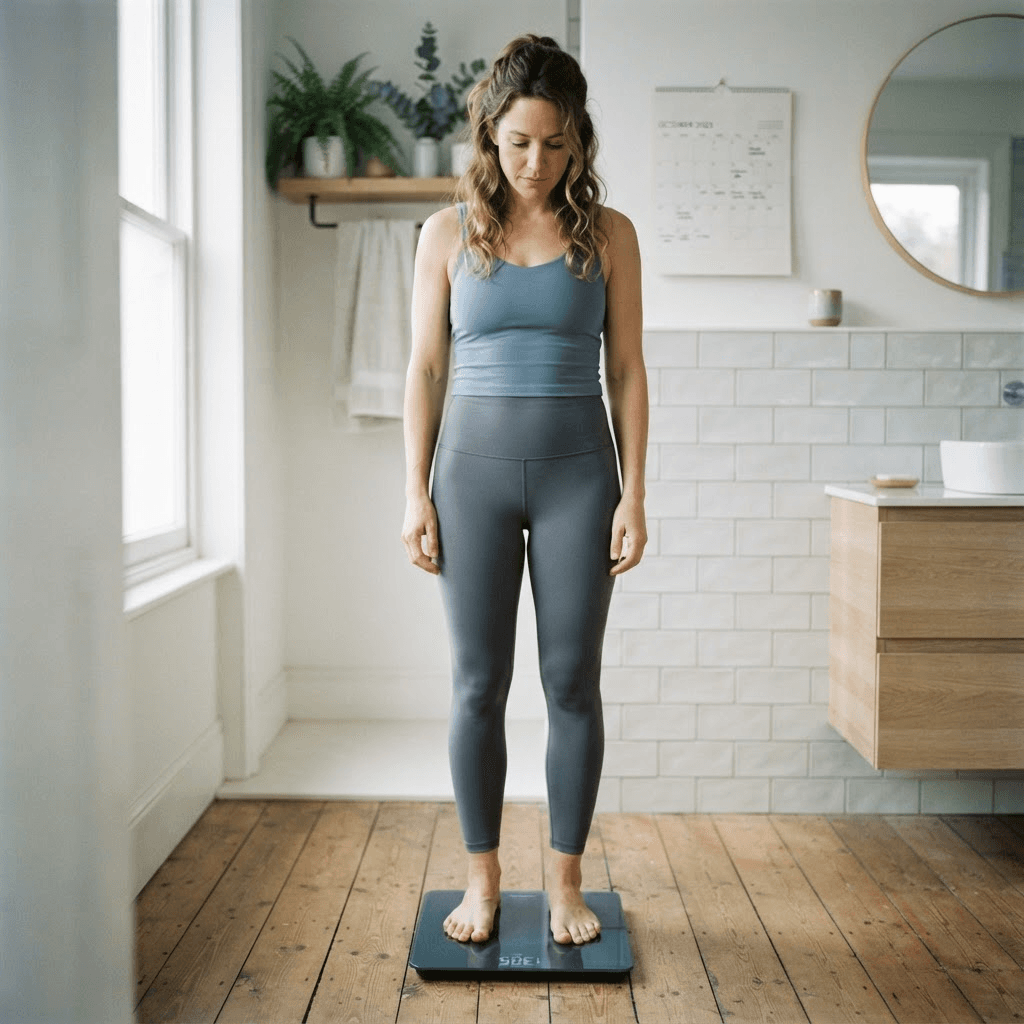
How to Lose Weight Without Exercise: What Actually Works When the Gym Is Not an Option
Losing a genuine amount of weight without ever booking a workout is entirely possible — researchers have known this for a long time. The problem is that most people stall for six predictable, fixable reasons. Here is how to spot yours, followed by the plan.

Audit before you cut further
Six leaks stop almost everyone. Two of them are yours.
- 01Calories in your glassMost common
- 02Portions crept up quietlyOff by 20–40%
- 03Cut too hard, then reboundedOvershoots the deficit
- 04You compensated by sitting stillBelow awareness
- 05Five hours of sleepHormonally hungry
- 06Judging the wrong weekNeeds 4 weeks
Being told to "just move more" lands badly when moving more genuinely is not an option. Perhaps your shifts run twelve hours and every gym is locked by the time you clock off. Perhaps your knees tolerate a stroll and nothing beyond it. Perhaps there is a newborn in the house, or a long-term health condition, or you have simply decided — sensibly — that you are not going to spend years grinding through a form of exercise you despise. The reason changes; the real question does not: can you still lose weight?
You can — and not as some watered-down alternative. Line up diet-only weight loss against exercise-only weight loss over the same stretch of time and diet comes out ahead, comfortably. That is not an argument against exercise, which does wonderful things for your heart, your mood, your blood sugar and the muscle you hold onto. But when the target is purely a lower number on the scale, the real work happens in your kitchen, in your sleep and in the everyday movement of your day.
That is why this guide skips the tired "eat less, move more" script. We start with a diagnosis — the six specific reasons people who cut back on food without adding workouts stop losing weight. Then we give you the four levers that fix those reasons, plus a daily checklist you can start tomorrow morning without buying a thing or signing up for anything.
Can you actually lose weight without exercise?
Yes, and there is nothing mysterious about how. Body fat shifts when the energy you take in and the energy you use stop lining up, week after week. A workout is one way to nudge the "energy used" side. For most people, though, it is a surprisingly minor lever — simply because a single session makes up so little of everything you burn in a day.
Picture where your calories actually go on an average Tuesday. Somewhere between 60 and 70 percent is your basal metabolic rate — the price of simply being alive, keeping your brain, heart, kidneys and immune system running while you do absolutely nothing. Around another 10 percent is spent digesting and processing your food. Whatever is left is movement, and movement comes in two very different flavours: the exercise you plan, and everything else you do while you are awake.
| Component | Share of daily burn | Can you change it easily? |
|---|---|---|
| Basal metabolic rate (staying alive) | 60–70% | Barely — mostly set by body size and muscle mass |
| Digesting food (thermic effect) | ~10% | Slightly — higher protein raises it a little |
| NEAT (walking, standing, chores, fidgeting) | 15–30% | Yes — this is the big lever without a gym |
| Formal exercise (workouts, sport) | 0–10% for most people | Yes, but it is the smallest slice |
Look at that table once more and the plan almost designs itself. If planned exercise is, at most, a tenth of your output, taking it away does not switch off your ability to lose weight — it merely removes a small contributor. NEAT, on the other hand — the movement nobody would ever call a workout — can differ by several hundred calories a day between two people of the exact same size. That is the slice you will be pulling on.
There is a second reason diet beats exercise that seldom gets aired: compensation. A 45-minute jog might burn 400 calories, which is real and useful — right up until you realise that most people, without noticing, eat a bit more, sit a bit longer for the rest of the day, or treat themselves as a reward. Studies that track this find people claw back a big chunk of what they burned. Food does not get compensated the same way. Choosing not to add 400 calories is just 400 calories that were never there.

NEAT: the movement that is not exercise
Non-exercise activity thermogenesis is the awkward scientific label for every calorie you burn outside of sleeping, eating and deliberate workouts. Nipping to the postbox. Standing up while you take a call. Hauling the shopping in from the car. Cooking, cleaning, shifting in your seat. In classic overfeeding studies, how much people moved of their own accord turned out to be the strongest predictor of who put on fat and who stayed lean — and the gap it created was far larger than any gym timetable would have produced.
The genuinely useful thing about NEAT is that it asks nothing of your motivation the way a workout does. Nobody needs to psych themselves up to take the stairs. It builds up quietly, in pieces too small to dread. Here is where it tends to hide:
- A 10-minute walk after each of your three meals stacks up to about half an hour of daily movement while also flattening the blood-sugar spike that follows eating.
- Standing or pacing during phone calls, rather than sitting through them, can add 100-plus calories over a day packed with meetings.
- Stairs over the lift, automatically — you make the choice once, not every single time.
- Parking at the far side of the car park, hopping off the bus a stop early, walking to the shop instead of driving.
- Doing the housework a notch faster: hoovering, laundry, washing up, tidying, gardening.
- Staying on your feet for the first half of anything you would usually sit through — a call, a pile of emails, an episode of something.
If you would rather aim at a number than a feeling, steps are the easiest stand-in. Most people notice the maths shift when they climb from a truly sedentary 3,000 to 4,000 steps a day up to somewhere around 8,000 to 10,000 — often 200 to 400 calories, which adds up to a real slice of a fat-loss deficit over a week. Our guide to walking for weight loss and how many steps you actually need digs into setting that target sensibly instead of chasing a random round figure.
Six reasons you are cutting food and not losing
This is the part that matters most, because hardly anyone who struggles with diet-led weight loss is undone by some baffling metabolic quirk. They are tripped up by one of six ordinary, identifiable, fixable things. Treat the list below as a checklist and be straight with yourself about which one is yours — for most people it is two.
1. You are drinking a meal you did not count
Calories in liquid form catch more people out than anything else, because your appetite barely clocks them. A 500ml orange juice, a large syrupy oat-milk latte, a couple of glasses of wine and two cans of cola can quietly rack up 900 calories in a day and leave you every bit as hungry as you were before. Solid food sets off stretch receptors and fullness hormones; a smoothie mostly slides straight past them.
2. Your portions crept without your permission
Without a food scale, most people undercount what they eat by 20 to 40 percent — one of the most repeatedly confirmed findings in nutrition research, and it trips up dietitians too, so it is nobody's personal failing. The oil in the pan, a second fistful of nuts, cheese grated by eye, the crusts left on your child's plate. None of it registers as eating. All of it adds up.
3. You are eating too little, then eating everything
The classic no-workout error is to gut your intake dramatically on the logic that "I have to make up for skipping the gym". A 1,200-calorie day with barely any protein or fibre builds a hunger you cannot reason with by evening, and the binge that follows does not just wipe out the deficit — it usually blows past it. A gentle deficit you can keep going for months beats a brutal one you ditch inside a week and a half. Our calorie deficit guide walks through pinning down that number properly.
4. You sat still more, to compensate
When calories drop, your body quietly dials down spontaneous movement to guard its energy reserves. You fidget less, reach for the lift, sit down a little sooner. This is adaptive thermogenesis, and it is entirely real — it can quietly reclaim a decent chunk of your deficit without you ever clocking it. The fix is to make NEAT deliberate and non-negotiable rather than leaving it up to how you happen to feel.
5. You are five hours short on sleep
Cutting sleep to five or six hours reliably pushes up ghrelin, the hormone that drives hunger, and drops leptin, the one that signals fullness. In controlled trials, people running short on sleep eat several hundred extra calories a day and lean towards refined carbs. You are not weak at 10pm on four hours' rest — you are hormonally hungry, and no quantity of resolve makes that a fair contest.
6. You are measuring the wrong week
Losing half a kilo of fat in a week vanishes completely beneath the everyday swings in water, glycogen, salt, hormones and digestion, which can move the scale by 1 to 2kg on their own. People call it a failure on day nine when the real signal takes three or four weeks of weekly averages to surface. If you have honestly held a deficit for a month with no change in your weekly average, your waist or the way your clothes sit, then something is off. Before that point, you simply have no data — and our guide on breaking a weight loss plateau explains how to separate a genuine stall from ordinary noise.
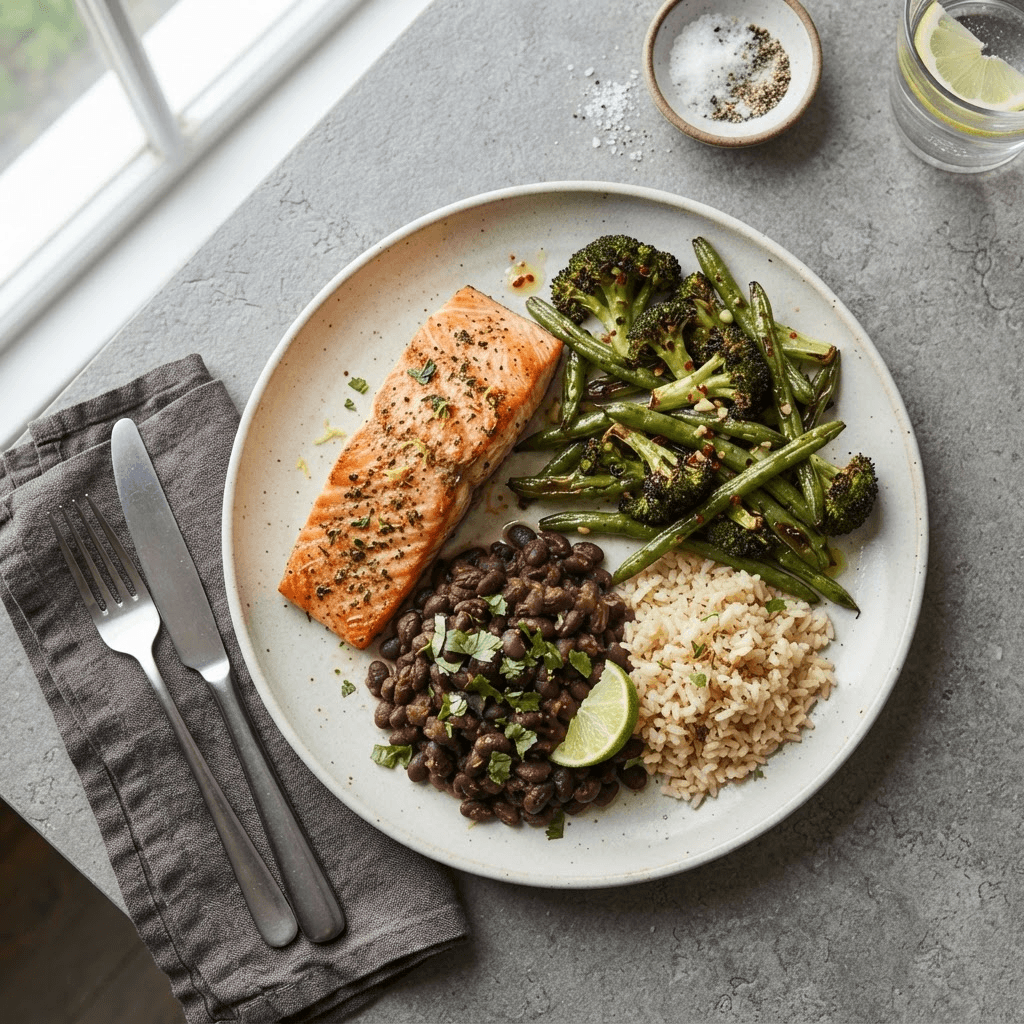
Lever one: build every plate protein and fibre first
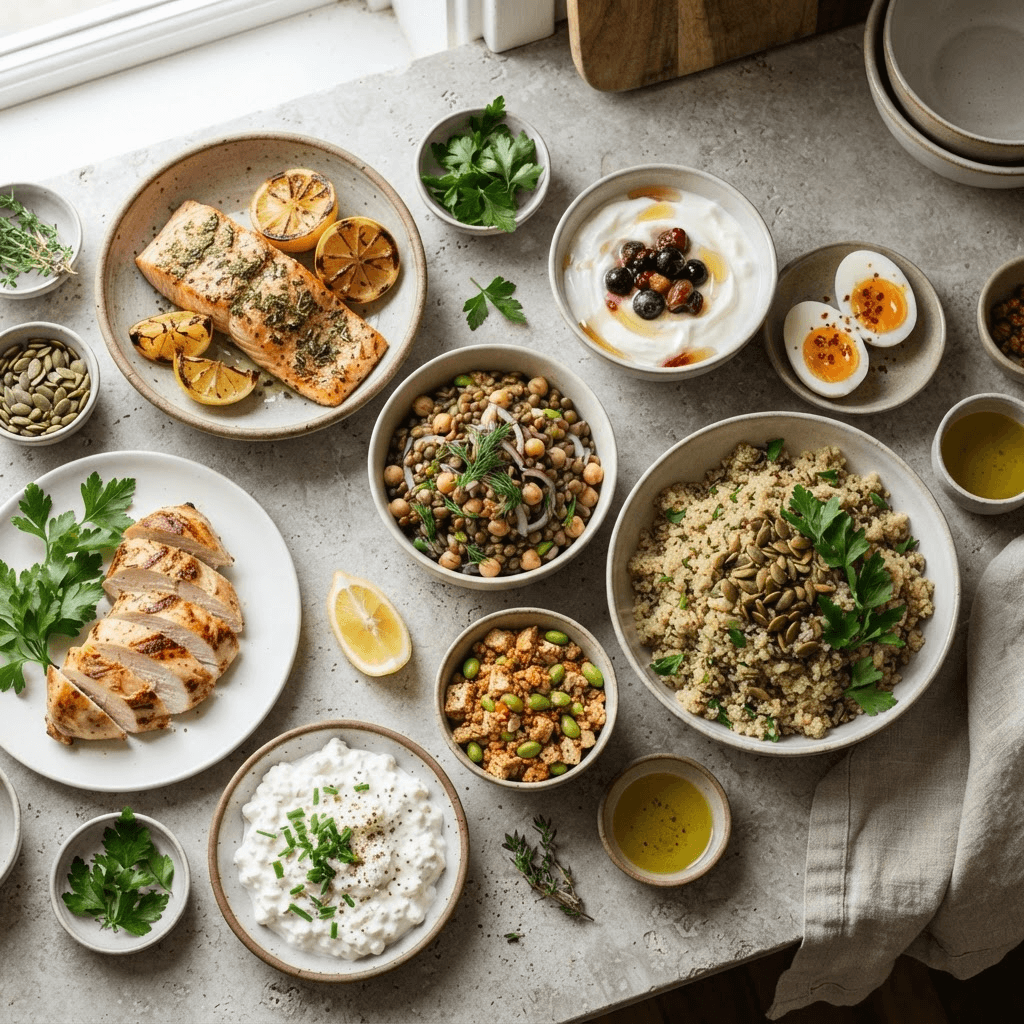
Without exercise in the mix, your diet has to pull double duty: create the deficit and stop you shedding more muscle than you have to. Protein does both jobs. It is the most filling of the three macronutrients, it costs your body more energy to process than either fat or carbohydrate, and it supplies the raw material that limits muscle loss while you are eating less than you burn.
Target roughly 1.6 grams of protein per kilogram of body weight a day while you are losing — for a 75kg person that works out to around 120 grams, spread over your meals rather than dumped into dinner. Then treat fibre as protein's wingman: 25 to 30 grams a day from vegetables, legumes, fruit and whole grains, which adds bulk and slows digestion so a smaller meal carries you further.
| Instead of | Try | What changes |
|---|---|---|
| Two slices of toast and jam | Greek yoghurt, berries and a spoon of seeds | +20g protein, +5g fibre, similar calories |
| Shop-bought sandwich and crisps | Chicken or chickpea salad with a wholegrain roll | +15g protein, roughly 200 fewer calories |
| Pasta with tomato sauce | Same sauce, half the pasta, added lentils and courgette | +12g protein, +8g fibre, far more volume |
| Handful of biscuits at 4pm | Cottage cheese with apple, or edamame | +15g protein, and you are not hungry at 6pm |
| Fruit smoothie | Whole fruit plus a boiled egg | Same calories, dramatically better fullness |
One more habit that earns its keep: eat in sequence. Vegetables and protein first, starch and anything sweet last. It sounds like a gimmick, and it works for a dull reason — by the time you get to the calorie-dense part of the plate, a good share of your stomach is already taken up by the parts that cost the least.
Lever two: audit what is in your glass
If you change nothing else, change this. Drinks are where diet-led weight loss most often quietly dies, and it is the easiest leak of all to seal, because you are not surrendering any food or feeling any hungrier — the calories you drop were never doing anything for your fullness in the first place.

| Drink | Rough calories | The fix |
|---|---|---|
| Large latte with syrup | 250–350 | Flat white or Americano with milk |
| 500ml fruit juice or smoothie | 220–280 | Whole fruit and water |
| Can of full-sugar soft drink | 140 | Sparkling water with lime |
| Two glasses of wine | 250–320 | One glass, or a spirit with soda |
| Pint of beer | 180–240 | Half, or a lower-alcohol option |
Tot them up across a normal week rather than one good day. Most people who do this turn up somewhere between 500 and 1,500 calories a week tucked away in drinks — a third to a whole week's worth of a modest deficit, recovered without eating a single gram less food.
Lever three: sleep and stress are appetite controls
Being told to sleep more when you asked how to lose weight feels like a dodge. It is not. Sleep is one of the rare interventions that changes how hungry you feel rather than asking you to white-knuckle through hunger, and with no exercise burning off your stress, this lever pulls proportionally harder.

Aim for seven to nine hours, keep a steady wake time even on weekends, take your last caffeine before early afternoon, and charge the phone somewhere that is not your bedside table. With stress, the aim is not calm — it is having any outlet at all that is not food. A ten-minute walk, five minutes of slow breathing, a call to someone who makes you laugh. Cortisol that stays high sharpens the appetite for calorie-dense food in particular, which is why stressed people reach for crisps and not carrots.
The people who pull this off without a gym are almost never the most disciplined. They are the ones who set up their days so that far less discipline was ever needed.
Lever four: design your kitchen so you decide less
Every food decision you settle with willpower is one you might lose. Designing your environment takes the fight off the table completely — and it is the most underrated tool going for anyone losing weight without the built-in structure of a training schedule.

- Keep fruit and prepped vegetables at the front of the fridge and out on the counter; shift biscuits and crisps into an opaque tin on a high shelf.
- Plate up in the kitchen, not at the table — going back for seconds should mean getting up.
- Use smaller plates, and tall narrow glasses for anything that is not water.
- Keep three no-thinking default meals you can throw together when you are exhausted, so "there is nothing in" never turns into a takeaway.
- Batch your protein ahead of time: a tray of chicken, a pot of lentils, boiled eggs, yoghurt portioned into cups on a Sunday.
- Never shop hungry, and shop from a list — this one habit reliably cuts the impulse buys of exactly the foods you are trying to eat less of.
The daily checklist
Everything above boils down to a short list you can follow without weighing, logging or overthinking. Do not try to tackle all eight from tomorrow. Choose the two that match your diagnosis from the troubleshooting section, hold them for two weeks, then add one more.
- Protein at every meal — a palm-sized portion, three times a day.
- Vegetables or fruit at a minimum of two meals, eaten before the starch.
- Nothing with calories in your glass except milk — otherwise water, black coffee or tea.
- A 10-minute walk after your biggest meal.
- Take the stairs and stand for phone calls, every time, with no deciding involved.
- One prepped protein and one prepped vegetable in the fridge at all times.
- Kitchen shuts after dinner — a single clear cut-off instead of an all-evening negotiation.
- Lights out with enough runway for seven hours, phone charging in another room.
What to expect, and when
Setting realistic expectations is not pessimism — it is the thing that keeps you from quitting in week three because a perfectly normal rate of progress looked like a flop.
| Timeframe | What usually happens | What to watch |
|---|---|---|
| Week 1 | 1–2kg drop, mostly water and glycogen | Do not extrapolate this rate. It will not continue. |
| Weeks 2–4 | Scale looks noisy, real fat loss begins at 0.25–0.7kg a week | Weekly averages, not daily numbers. |
| Weeks 4–8 | Clothes change before the mirror does; hunger settles | Waist measurement and how the waistband sits. |
| Weeks 8–12 | Visible change, roughly 4–8kg down for most people | Whether the habits still feel sustainable. |
| Beyond 12 weeks | Rate slows as a smaller body burns less | Recalculate intake; consider adding resistance work. |
The one thing you will eventually want to add
Here is the honest trade-off that "no exercise needed" pitches leave out. When the weight comes off through diet alone, a bigger share of what you lose is muscle — often a quarter or more of the total, against a far smaller fraction when resistance training is part of the picture. Losing muscle lowers your metabolic rate, which makes keeping the weight off harder, and it is the main reason people end up describing themselves as "smaller but softer".
You do not need a gym to soften that blow. A high protein intake does much of the work by itself. Two short weekly sessions of bodyweight movement — sit-to-stands out of a chair, wall or incline push-ups, a carrier bag in each hand for rows — take twenty minutes and change the make-up of what you lose. When that becomes doable, our bodyweight workout plan is built for exactly this: no kit, no membership, just a bit of floor space at home.
But do not let that turn into one more excuse to put off starting. The version of this that works is the one you actually begin this week, with the levers within reach, in the life you genuinely have. Sort out the drinks, front-load the protein, walk after dinner, sleep. That is not a compromise plan. For most people, it simply is the plan.
Sources
The energy-expenditure, satiety, sleep and body-composition claims in this guide come from peer-reviewed research and national public-health guidance. These are the primary sources.
- Levine JA. Non-exercise activity thermogenesis and its role in human energy balanceNational Library of Medicine
- Hall KD et al. Energy balance and its components — implications for body weight regulationAmerican Journal of Clinical Nutrition
- Spiegel K et al. Brief communication: sleep curtailment reduces leptin, elevates ghrelin and increases appetiteAnnals of Internal Medicine
- Leidy HJ et al. The role of protein in weight loss and maintenanceAmerican Journal of Clinical Nutrition
- Mattes RD. Dietary compensation by humans for supplemental energy provided as ethanol or carbohydrate in fluidsNational Library of Medicine
- Physical Activity Guidelines for Americans, 2nd edition — role of activity in weight managementU.S. Department of Health and Human Services
- Obesity: identification, assessment and managementNational Institute for Health and Care Excellence
Run it tomorrow
The whole plan on one card
Daily — pick two to start
- Protein at every meal — a palm-sized portion, three times a day.
- Vegetables or fruit at a minimum of two meals, eaten before the starch.
- Nothing with calories in your glass except milk — otherwise water, black coffee or tea.
- A 10-minute walk after your biggest meal.
- Take the stairs and stand for phone calls, every time, with no deciding involved.
- One prepped protein and one prepped vegetable in the fridge at all times.
- Kitchen shuts after dinner — a single clear cut-off instead of an all-evening negotiation.
- Lights out with enough runway for seven hours, phone charging in another room.
Worth remembering
What this comes down to
- On most days, planned workouts account for only about 5 to 10 percent of the calories you burn, which is exactly why your food choices do the heavy lifting.
- Without a gym, the movement that counts most is NEAT — walking, standing, stairs and chores — and it can shift your daily burn by several hundred calories.
- People who stall rarely lack willpower; they have almost always sprung one of six specific, correctable leaks.
- Protein and fibre are the two nutrients that make eating less feel manageable instead of miserable.
- What you drink is the most common hidden leak, because your appetite barely notices liquid calories.
- Too little sleep and unchecked stress push your appetite up directly — sorting them out is a weight-loss tool, not an extra.
- A realistic pace is 0.25 to 0.7kg a week. With no resistance training, a bigger share of that loss is muscle, so protein matters even more.
Straight answers
The no-gym weight loss questions people keep asking
Can you really lose weight without exercise?
Yes. Planned exercise usually makes up just 5 to 10 percent of the calories an adult burns each day, so dropping it does not stop fat loss — it only removes a small contributor. Study after study shows diet-only approaches produce more weight loss than exercise-only ones over the same period. Exercise still matters for your heart, your mood and holding onto muscle, but it is not what creates the deficit.
How much weight can you lose without exercise?
A sustainable diet-led pace is around 0.25 to 0.7kg per week, or roughly 4 to 8kg across twelve weeks for most people. The first week often shows a bigger drop of 1 to 2kg, but that is mainly water and glycogen rather than fat, so do not project it forward.
Is diet or exercise more important for weight loss?
For the number on the scale, diet, clearly. Exercise matters more for keeping the weight off over the long run and for protecting your muscle as you lose. The best approach uses both, but if you can only change one thing, changing what you eat delivers more weight loss for the effort involved.
I am eating less and not losing weight without exercise — what is wrong?
Nearly always one of six things: uncounted calories in your drinks, portions being underestimated by 20 to 40 percent, cutting so hard that you rebound in the evening, unconsciously moving less to compensate, short sleep driving up your appetite hormones, or judging progress by single days instead of four weeks of weekly averages. Work through them in that order.
How many steps a day should I walk to lose weight?
Climbing from a sedentary 3,000 to 4,000 steps up to 8,000 to 10,000 a day typically adds 200 to 400 calories of daily expenditure, which is meaningful over a week. The exact figure matters less than the increase from your own starting point — add 2,000 to whatever you do now and build from there.
Will I lose muscle if I lose weight without exercise?
Some, yes. Diet-only weight loss often takes a quarter or more of the total from lean tissue, versus a much smaller share when resistance training is included. Eating around 1.6 grams of protein per kilogram of body weight a day cuts this down considerably, and two short bodyweight sessions a week trims it further — no equipment or gym required.
What should I stop drinking to lose weight?
Fruit juice, smoothies, sugary soft drinks, syrup coffees and alcohol are the usual offenders, because liquid calories do not switch on the fullness signals that solid food does. Most people who audit a normal week find 500 to 1,500 calories hidden in drinks — removing them costs nothing in hunger, which makes it the highest-return change on offer.
How fast can I lose weight without exercise if I eat very little?
Quicker in the short term, and usually slower over three months, because very low intakes trigger rebound eating, more muscle loss and a steeper drop in everyday spontaneous movement. A deficit of roughly 300 to 500 calories a day that you can maintain for months beats an aggressive one you abandon within a fortnight. If you have a lot to lose or a health condition, do this alongside a clinician or registered dietitian.
Keep reading