How to Start Losing WeightYour first 30 days, made simple
A calm, judgement-free starter guide for absolute beginners: how to lose weight for the first time without crash diets or a gym membership, one small habit at a time. Follow the exact 30-day roadmap that gets the first pound moving.
The 30-day on-ramp
- 01Week 1Add proteinChange nothing else
- 02Week 2Start walkingPost-meal + more steps
- 03Week 3Build the plateHalf veg, tidy drinks
- 04Week 4Protect sleepLock the habits in
It usually starts on a Sunday night. You catch yourself in a photo, or your jeans send a message you did not ask for, and something quietly clicks: this is the week. Then Monday arrives, you open your phone, and the internet hits you with keto, fasting windows, 1,200-calorie plans, cold plunges and a woman insisting that celery juice changed her life. By Tuesday you are exhausted before you have lost a single pound. If that is roughly where you are standing, this guide is written specifically for you.
Here is the promise, and I mean it as a working dietitian, not a slogan: starting is far simpler than the internet makes it look. You do not need a gym, a meal-delivery subscription, or the willpower of a monk. You need a direction, a few small habits stacked in the right order, and a realistic sense of how the first month actually feels. Below is the exact 30-day on-ramp I give first-timers — the one designed to get the first pound moving without turning your whole life upside down.
Start here: the one mindset shift beginners have to make
Almost every failed first attempt shares the same root cause, and it is not laziness. It is the all-or-nothing trap: deciding that Monday will be perfect, white-knuckling four flawless days, then treating one biscuit as proof that you have "ruined it" and abandoning the whole thing until the next Sunday reset. Weight loss is not a test you pass or fail each day. It is an average you nudge over weeks.
So before you change a single meal, change the scoreboard. You are not aiming for perfect days. You are aiming for a good-enough week, repeated. A day with one unplanned treat and a 20-minute walk is a win, not a failure. This sounds soft. It is actually the difference between people who are still going in March and people who quit in the third week of January.
- Trade "I will be perfect" for "I will be consistent" — consistency beats intensity every single time.
- Pick a reason that is not the mirror. "I want to keep up with my kids" or "I want my knees to stop aching on stairs" survives a bad week better than "I want to look good".
- Expect the messy middle. Motivation is high on day one and gone by day nine — the plan below is built to run on habit, not hype.

How weight loss actually works (in plain English)
Strip away every diet brand and the mechanism is the same: your body runs on energy measured in calories. Take in a little less than you burn most days, and your body makes up the difference by using stored fat. That gap is called a calorie deficit, and it is the only thing every successful diet in history has in common, whether it calls itself keto, fasting, low-fat or "clean eating".
That is genuinely the whole secret. The reason a hundred different diets exist is that they are just a hundred different ways of eating slightly less without feeling starved. You do not have to pick the "best" one on day one. You have to pick one you can live with. For most beginners, the easiest lever is not weighing food — it is eating more protein and vegetables so you feel full on fewer calories almost by accident. If you want the numbers behind the gap, our complete guide to the calorie deficit breaks it down without the maths anxiety.
You do not need the perfect diet. You need the boring one you can still be doing in six months.
Your first 30 days, week by week
Here is the part most beginner guides skip: you should not do everything at once. Changing your food, your movement, your sleep and your drinks all on the same Monday is exactly how people burn out by Friday. Instead, treat the first month as a ramp. Each week you keep last week’s habit and add one new one on top. By day 30 you are doing four things that stick — without a single dramatic overhaul.
Week 1 — Add protein, change nothing else
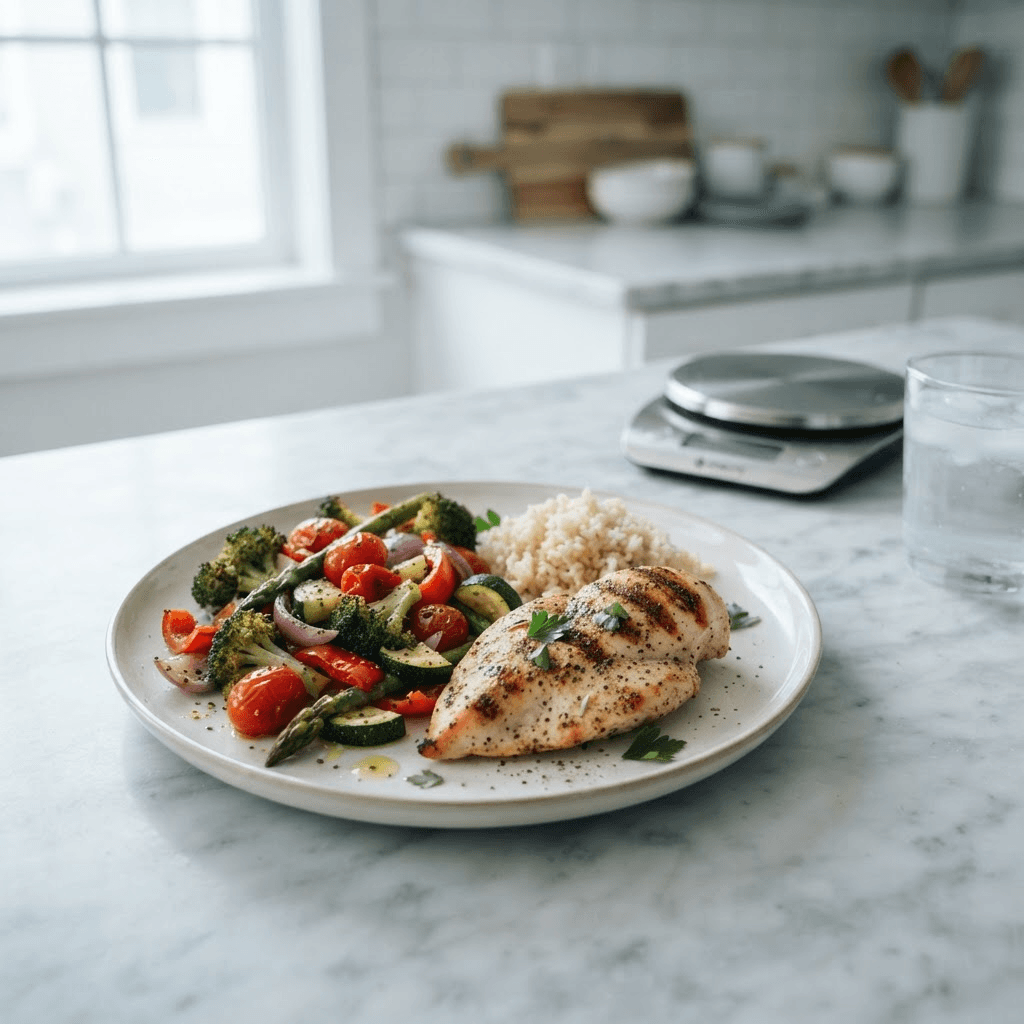
- Put a palm-sized portion of protein on your plate at every meal: eggs, Greek yoghurt, chicken, fish, tofu, beans or lentils.
- Do not cut anything yet. Do not count anything. Just add the protein — it blunts hunger and quietly crowds out the snacking that derails week two.
- Weigh yourself once, on day one, then put the scale away until day 8. This is your baseline, not a daily verdict.
Week 2 — Keep the protein, add the walks
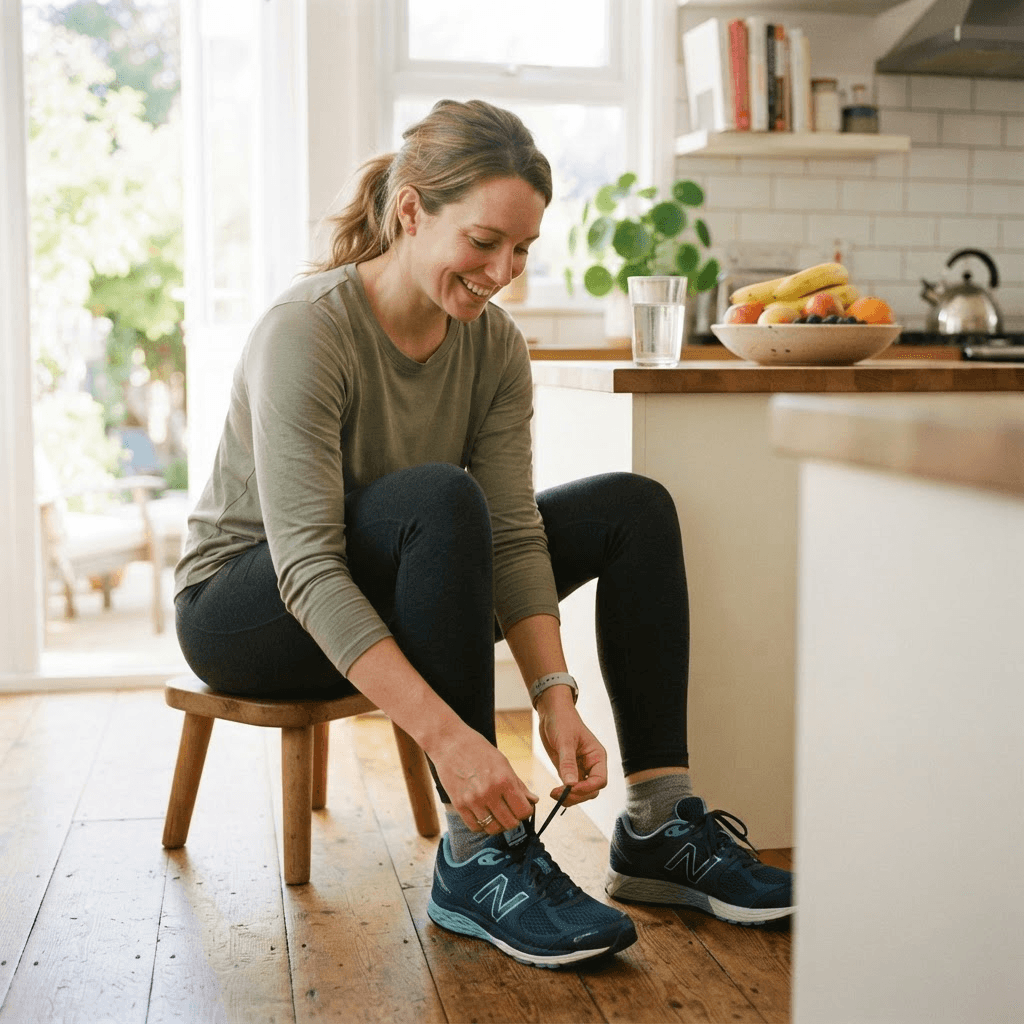
- Add a 10-minute walk after your largest meal. If you can manage two short walks, even better — movement after eating helps steady your energy and appetite.
- Aim to nudge your daily step count up by around 1,000–2,000 from wherever it is now. You do not need 10,000 on day one.
- Notice which meals leave you hungry an hour later — those are the ones to add more vegetables to next week.

Week 3 — Build the plate, tidy the drinks
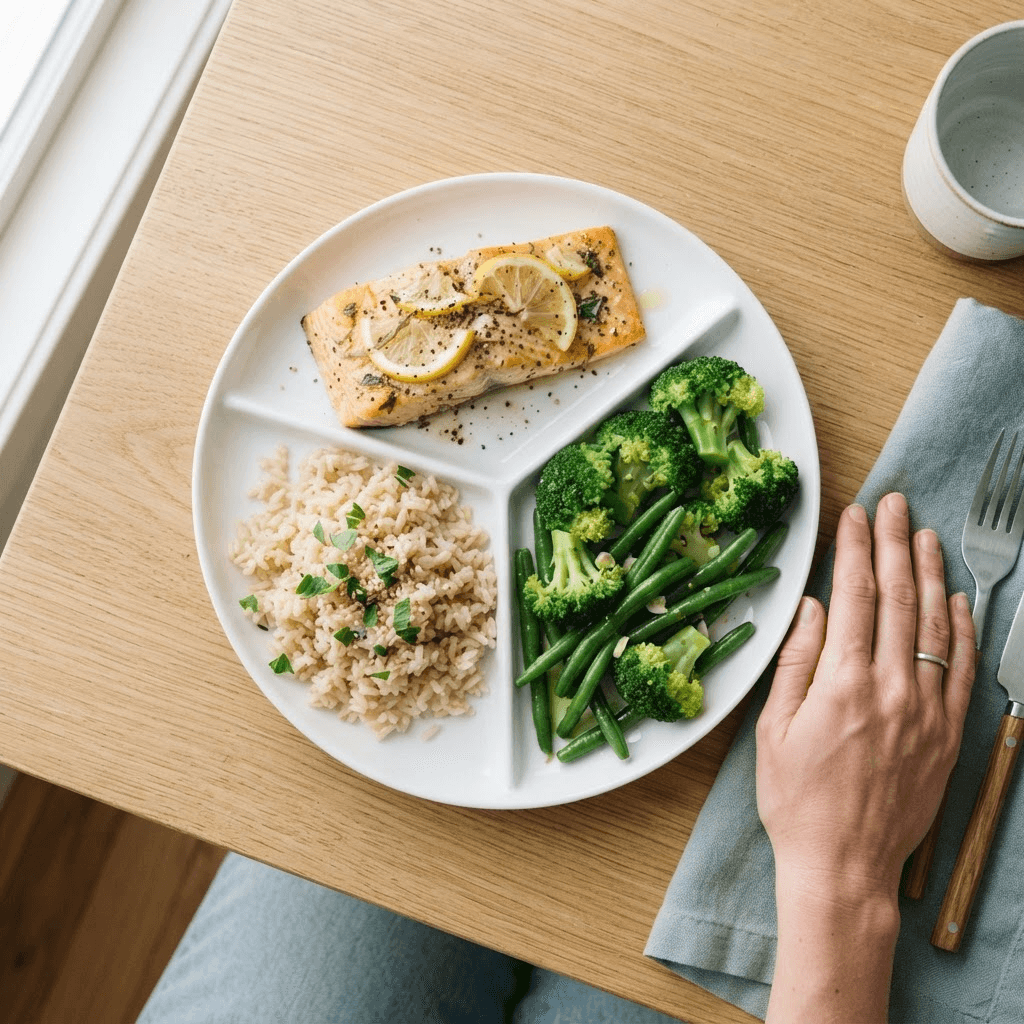
- Use the plate method: half your plate vegetables, a quarter protein, a quarter carbs. No weighing, no apps — just a visual.
- Swap one daily liquid-calorie source (fizzy drink, juice, flavoured latte, evening wine) for water, sparkling water or plain tea.
- Front-load water: a large glass before each meal takes the edge off hunger and is the single easiest habit on this whole list.
Week 4 — Protect your sleep and lock it in
- Aim for a consistent 7–9 hours. Short sleep raises hunger hormones and makes every other habit harder — this is not optional extra credit.
- Set a wind-down alarm 45 minutes before bed, not a wake-up alarm. Late nights are where most beginner plans quietly die.
- Review your four weeks. Which habits felt easy? Keep those on autopilot. Which felt hard? That is where next month’s attention goes.
| Week | New habit | Why it comes now | Effort |
|---|---|---|---|
| Week 1 | Protein at every meal | Kills the hunger that sabotages everything else first | Low |
| Week 2 | Post-meal walks + more steps | Adds burn and appetite control without a gym | Low |
| Week 3 | Plate method + water swaps | Cuts calories automatically, no counting required | Medium |
| Week 4 | Consistent sleep | Makes weeks 1–3 easier to sustain long term | Medium |
The four habits that do most of the work
Notice what the roadmap is quietly teaching you: four habits carry almost all the results. Everything else — supplements, specific diets, fasting windows, fancy equipment — is a rounding error until these four are automatic. If you only ever remember one section of this guide, make it this one.
- Protein first. It keeps you full, protects the muscle you do not want to lose, and makes a calorie deficit feel less like deprivation.
- Move more, all day. Daily steps and post-meal walks (what scientists call NEAT) often burn more than a single gym session and are far easier to keep up.
- Sleep enough. Under-slept beginners eat more, crave more sugar and quit sooner — sleep is a weight-loss habit, not a luxury.
- Hydrate on purpose. Thirst is easily mistaken for hunger; a glass of water before meals is the cheapest appetite tool you own.

How to eat without going on a "diet"
The word "diet" makes most beginners think of restriction, hunger and forbidden foods — which is exactly why diets fail. You are not banning anything. You are building a default way of eating that happens to be lower in calories, then leaving room for the foods you love so you never feel deprived enough to rebel.
- Anchor each meal with protein and vegetables first — fill up on those before the carbs and the rest sorts itself out.
- Keep trigger foods out of arm’s reach, not out of your life. Portioned in a bowl beats eating from the bag on the sofa.
- Use the 80/20 approach: eat well about 80% of the time and let 20% be pizza, cake and real life. The 20% is what makes the 80% survivable.
- Do not drink your calories. Liquid sugar is the single biggest hidden source most beginners overlook.
How fast should a beginner expect to lose weight?
This is the question that quietly ends most attempts, because beginners measure against reality-TV timelines and feel like failures at a perfectly healthy pace. A safe, sustainable rate is roughly 0.5 to 1% of your body weight per week — for many people that is about half a kilo to one kilo, or one to two pounds. Faster than that and you are mostly shedding water and muscle, both of which come straight back.
The first week is a fake-out in both directions. If you have a lot to lose, you might drop three or four pounds — mostly water as your body adjusts. If you have little to lose, the scale might not move for two weeks even though everything is working. Neither means anything on its own. The only number that tells the truth is the four-week trend line.

Beginner mistakes that quietly stall progress
None of these will ruin you on their own, but together they are why "I am doing everything right and nothing is happening" is the most common message I get. Scan the list — you will probably recognise one or two.
- Cutting calories too hard, too fast. Starve yourself in week one and you will binge in week two. A gentle deficit you barely notice always wins.
- Skipping meals then overeating at night. Most beginners do better with regular, protein-heavy meals than heroic all-day fasting followed by a 9pm free-for-all.
- Forgetting that drinks count. A daily large latte and a glass of juice can quietly cancel your entire deficit.
- Weighing daily and panicking. Normal fluctuation gets mistaken for failure and triggers a quit.
- Rewarding a good week with a bad weekend. Two great weekdays and two blowout weekend days average out to standing still.
- Doing endless cardio and ignoring food. You cannot out-walk a consistently oversized plate — the kitchen decides more than the treadmill.
How to keep going when motivation runs out
Motivation is a feeling, and feelings are unreliable employees. Around week two, the initial excitement fades and the whole thing starts to feel like effort. This is the exact point where the roadmap earns its keep: by then, protein and a short walk should already be semi-automatic, so you coast on habit while motivation is on holiday.
- Shrink the goal on hard days. "One walk and one good meal" is a complete, winnable day when you have nothing left in the tank.
- Track wins that are not the scale: better sleep, easier stairs, a looser waistband, more energy at 3pm.
- Tell one person, or find one. A friend, a partner, a forum — quiet accountability makes people far more likely to stick with it.
- Plan for the setback before it happens. A bad day is data, not defeat. The plan is simply: next meal, back on track. That is the entire recovery protocol.
When to check with a doctor first
For most healthy adults, adding protein, walking, water and sleep is about as safe as advice gets. But weight is tangled up with health, and a few situations genuinely warrant a professional conversation before you start.
- You have diabetes, heart, kidney or liver conditions, or take medication that may need adjusting as you lose weight.
- You are pregnant, breastfeeding, or recently postpartum.
- You have a history of disordered eating, or notice these habits tipping into obsession or fear around food.
- You are losing weight without trying, feel unusually unwell, or have a very large amount to lose and want a structured, supported plan.
Sources and further reading
The recommendations in this beginner guide are grounded in established public-health and clinical guidance on safe, sustainable weight loss.
- Choosing a safe and successful weight-loss programmeNational Institute of Diabetes and Digestive and Kidney Diseases (NIH)
- Healthy weight: getting started and losing weightCenters for Disease Control and Prevention (CDC)
- Physical activity guidelines for adults (steps and moderate activity)World Health Organization (WHO)
- Dietary protein, satiety and body-weight managementThe American Journal of Clinical Nutrition
- Sleep duration and its association with appetite and weightNational Heart, Lung, and Blood Institute (NIH)
Print & pin this
Your beginner's daily checklist
You do not have to nail all eight from day one. Add one a week using the on-ramp above, and let the list fill in as the habits stick.
- Put a palm of protein on every plate
- Drink a glass of water before each meal
- Take a 10-minute walk after your biggest meal
- Fill half your plate with vegetables
- Weigh in once a week, not every day
- Aim for 7–9 hours of sleep
- Swap one sugary drink for water
- Treat a bad meal as data, not defeat
The short version
Five things to remember on day one
- 01You do not need a gym, a special diet or perfect willpower to start — you need one repeatable habit at a time.
- 02Aim for a gentle 0.5–1% of your body weight per week; slower loss is the loss that actually stays gone.
- 03Four habits — protein at every meal, more steps, better sleep and drinking water — do most of the heavy lifting.
- 04Build the first 30 days as a ramp: add one new habit each week instead of changing everything on Monday.
- 05Progress is not linear. Judge it by the four-week trend, not tomorrow morning’s number.
FAQ
Beginner weight-loss questions, answered simply
What is the very first thing I should do to start losing weight?
Do not overhaul everything. For your first week, add a palm-sized portion of protein to every meal and change nothing else. Protein keeps you full, which quietly reduces snacking and makes every later step easier. Weigh yourself once on day one as a baseline, then build from there one habit at a time.
Can I lose weight without going to the gym?
Yes. Most beginner weight loss is driven by food and daily movement, not formal workouts. Walking, taking the stairs and short post-meal walks (called NEAT) often add up to more than a single gym session, and they are far easier to sustain. The gym helps later for protecting muscle, but it is not where you need to start.
How much weight should a beginner lose per week?
Aim for roughly 0.5 to 1% of your body weight per week — often about one to two pounds (0.5–1 kg). Faster than that is usually water and muscle rather than fat, and it tends to come straight back. Slower, steadier loss is the loss that actually stays gone.
Do I have to count calories to lose weight?
No, and most beginners do better without it. Counting works, but it is a chore that many people quit. The plate method (half vegetables, a quarter protein, a quarter carbs), eating protein first and cutting liquid calories create a calorie deficit automatically, with no app required. You can always add tracking later if progress stalls.
Why is the scale not moving even though I am doing everything right?
Weight naturally swings 1–2 kg (2–4 lb) a day from water, salt, carbohydrate and hormones, which can completely hide real fat loss for a week or two. Judge progress by the four-week trend, how your clothes fit and a monthly photo, not by tomorrow’s number. If it is genuinely flat for three-plus weeks, that is when to review portions and steps.
What should I eat to lose weight as a beginner?
You do not need special foods. Build most meals around lean protein and vegetables, add a moderate portion of carbs, and keep the foods you love in smaller portions rather than banning them. Drink water before meals and avoid drinking your calories. This is filling, flexible and does not feel like a diet, which is exactly why it lasts.
How long does it take to see results?
You may notice less bloating and more energy within the first week or two, before the scale reflects much. Visible changes in the mirror usually take four to eight weeks of consistency. The people who see results are simply the ones still doing the basics at week six, so protect consistency over speed.
What if I mess up and eat badly for a day?
One off day changes almost nothing — it is the reaction that does the damage. Do not "start again Monday" or write off the week. The entire recovery plan is one sentence: get back on track at your next meal. Weight loss is an average over weeks, and a single day barely moves the average.
Keep reading