Beginner HIIT Workout Plan: A Safe 6-Week Low-Impact Program at Home
A six-week beginner HIIT workout plan with low-impact movements, exact work-to-rest intervals, effort checks and progression rules for building fitness safely at home.

Key takeaways
- Begin with two 16- to 20-minute sessions a week, not daily all-out workouts.
- Use a 20-second work and 40-second recovery ratio until your breathing settles reliably between rounds.
- Low impact does not mean low effort: fast marching, chair squats and incline push-ups can create a strong cardiovascular stimulus without jumping.
- Finish most work intervals at an effort of 7 out of 10, with enough control to repeat the same quality next round.
- Progress only one variable each week — rounds, work time, recovery time or movement difficulty — and keep at least 48 hours between sessions.
What HIIT should mean for a beginner
High-intensity interval training alternates relatively hard efforts with easier recovery. The word “high” describes intensity relative to your current capacity, not somebody else’s speed. A brisk march may be high intensity for a person returning after five sedentary years; a trained runner may need a steep hill. Both can be valid intervals because the relevant question is how strongly the work challenges that person today.
Classic laboratory HIIT sometimes uses efforts near 85 to 95 percent of maximum heart rate. That definition is useful in research and less useful in a living room, where wrist monitors lag during short intervals and age-predicted maximums can be wrong by twenty beats or more. Beginners need a method that works without a lab. Use effort and speech first: the work should feel like 7 out of 10, and by its end you should manage only a short phrase. During recovery, you should regain a full sentence before the next interval.
This is not sprint interval training. You are not going all-out, collapsing on the floor or treating nausea as evidence of success. Maximum efforts create more fatigue, disrupt technique and are difficult to dose for someone whose movement skill is still developing. Submaximal intervals produce meaningful cardiovascular work while leaving room to learn. The American College of Sports Medicine also emphasises gradual progression and individualisation; the safest session is the one matched to your present ability rather than its label.
The first purpose of a beginner interval is not to prove how hard you can work. It is to discover an effort you can recover from and repeat well.
What a low-impact HIIT workout can — and cannot — do
Intervals are time-efficient. Reviews comparing interval and continuous aerobic training show that both can improve cardiorespiratory fitness, with interval formats often producing similar or somewhat larger gains in VO2 max when the programmes are appropriately matched. Better cardiorespiratory fitness is associated with lower long-term cardiovascular risk, and the changes can begin with a surprisingly modest weekly dose.
HIIT can also improve insulin sensitivity, blood-pressure responses and confidence with harder effort. Low-impact variations preserve those cardiovascular demands while reducing landing forces. Removing jumps is especially sensible when you are deconditioned, live above neighbours, have a larger body or have joints that dislike rapid impact. “Low impact” describes contact with the floor; it says nothing about whether your heart and lungs are working.
The limits matter. HIIT is not uniquely capable of burning fat, and the dramatic “afterburn” often advertised is small in practical terms. Body-fat change still depends mostly on sustained energy balance. Nor does a twelve-minute circuit replace strength training, easy aerobic work, sleep or normal daily movement. Think of intervals as one tool. Pairing them with the beginner strength training plan and comfortable walking produces a more complete week than trying to turn every session into HIIT.
Before week one: a five-minute readiness check
You do not need to “get fit before getting fit,” but you should be able to tolerate the movements you plan to repeat. On a clear patch of floor, march comfortably for two minutes. Then complete five controlled sit-to-stands from a firm chair, five wall push-ups and ten alternating step-backs while holding the chair. Finish with another minute of easy marching.
You are ready for the starting programme if you can complete that check without sharp pain, dizziness or breathlessness that remains severe after two minutes of rest. Mild muscular effort is expected. Joint pain that changes your gait, pressure in the chest or a sense that you may faint is not. If the screen feels too hard, spend two weeks building a walking base with the walking for weight loss guide, then repeat it.
Set up your training space
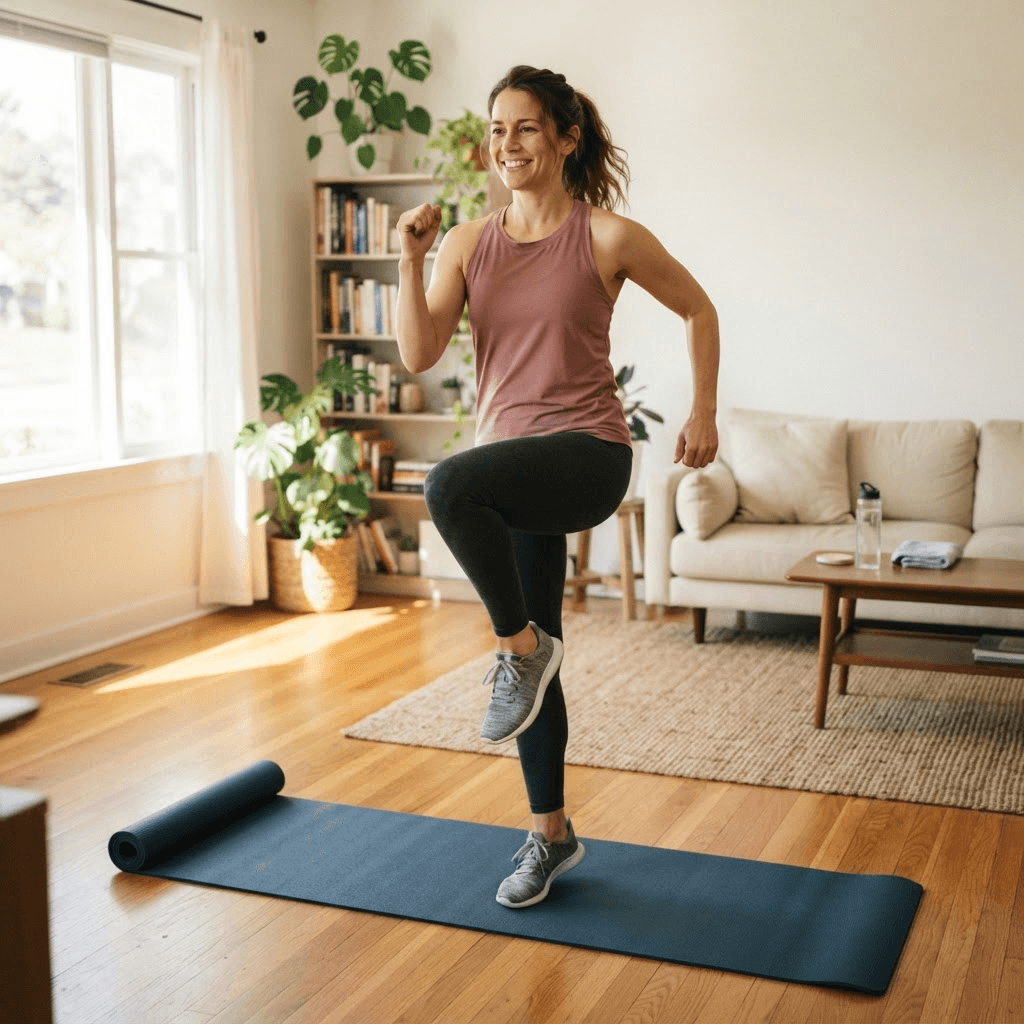
Use a non-slip floor with enough room to step forward, backward and sideways. Place a sturdy chair against a wall; wheeled office chairs are not exercise equipment. Wear shoes if bare feet feel unstable. Keep water nearby, silence notifications and use an interval timer you can hear without looking down. If you train alone, tell somebody when you are starting if you have any reason to be cautious.
Use three simple intensity checks
- Effort: finish work intervals around 7 out of 10 in weeks one and two, rising briefly toward 8 in later weeks only if form remains unchanged.
- Talk test: a short phrase during work; a complete sentence before the next round. If speech does not return, extend recovery.
- Technique: stop the interval when movement becomes smaller, louder or less controlled. The timer is a ceiling, not a command.
The six-minute warm-up to use every time
A warm-up should raise temperature, move the joints through the ranges you will use and rehearse the session. It should not tire you. Spend one minute on each item below, moving continuously but comfortably. In cold conditions or first thing in the morning, repeat the first two minutes.
- Easy march: relaxed arms, quiet feet and a pace at which conversation is effortless.
- Purposeful march: lift the feet a little higher and let the arms swing, still below workout pace.
- Alternating step-back: touch one foot behind you, bend the front knee slightly and return; hold the chair if needed.
- Chair squat rehearsal: send hips toward the chair, touch lightly and stand, completing six to eight smooth repetitions.
- Wall push-up rehearsal: complete six slow repetitions while keeping a straight line from ears through hips.
- Practice interval: perform ten seconds of faster marching, twenty seconds easy, then repeat once.
Five low-impact HIIT exercises to learn first
The programme rotates five movements so local muscle fatigue does not ruin the cardiovascular work. Practise each slowly before starting the timer. Use the easiest version that lets you move confidently for every scheduled second. A harder variation is useful only after the basic one looks the same at the beginning and end of a round.
1. Fast march
Stand tall and march briskly, driving opposite arm and leg. Land quietly under your body rather than reaching forward. Increase effort through quicker arm action and cadence, not by leaning back and hauling the knees toward the chest. Easier: hold the chair with one hand. Harder: travel two steps forward and two back while keeping the floor impact quiet.
2. Chair squat
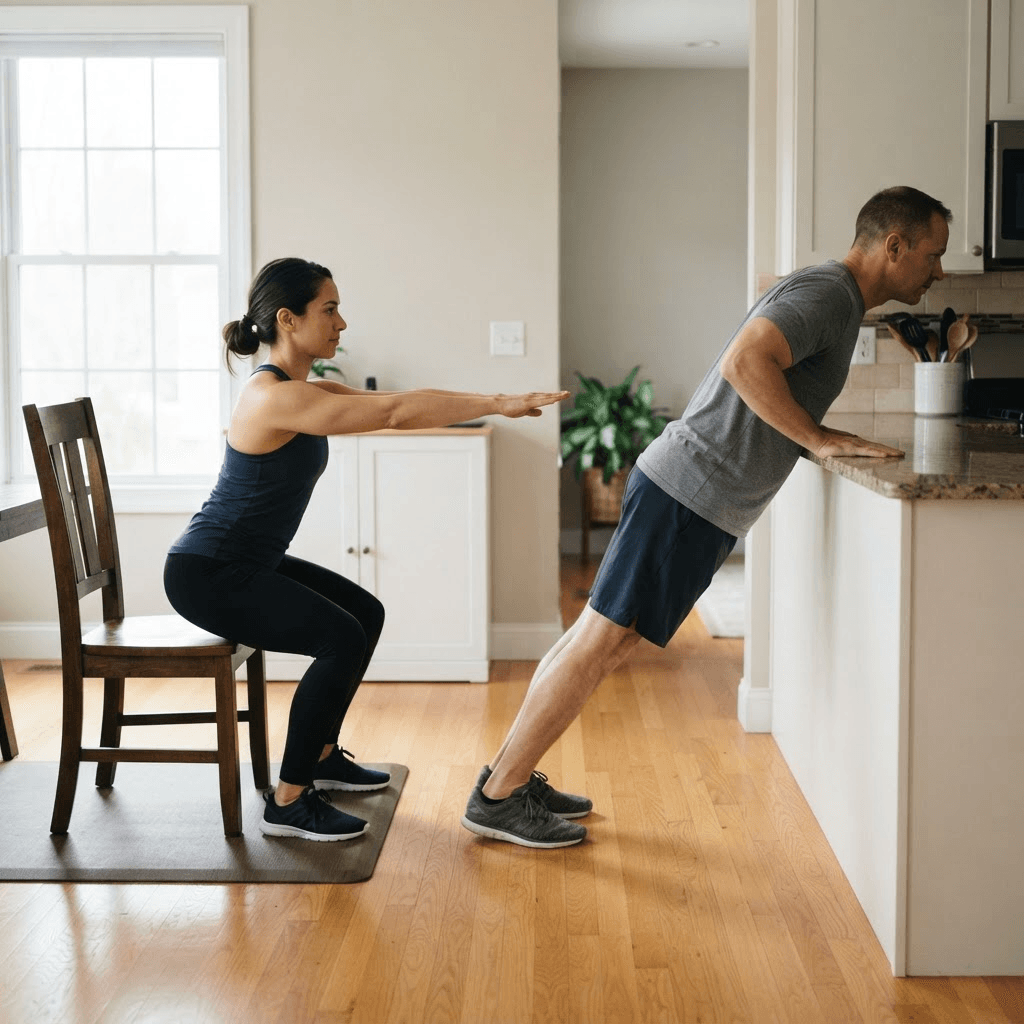
Stand a few centimetres in front of a firm chair, feet around shoulder width. Send the hips back, bend the knees and touch the seat without dropping onto it, then press through the whole foot to stand. Keep knees tracking in the same direction as the toes. Easier: add a cushion to raise the seat and use your hands lightly. Harder: hover just above the seat for one second.
3. Incline push-up
Place hands on a wall or sturdy counter slightly wider than shoulder width. Walk the feet back until your body forms a straight line. Bend the elbows diagonally back, bring the chest toward the surface and press away without letting the hips sag. A wall is the most accessible start. Lower surfaces increase the load. Do not progress to the floor simply because push-ups are “supposed” to happen there.
4. Alternating step-back
From standing, step one foot back and lower only as far as both legs can control, then drive through the front foot to return. Alternate sides. Keep most pressure through the front foot and use a chair for balance. If knees object, shorten the step and make it a toe tap. A reverse step is usually more manageable than a forward lunge because the front shin can stay more vertical.
5. Standing cross-body knee drive
Reach both hands overhead, then bring one knee toward the opposite elbow while pulling the arms down. Alternate at a pace that keeps the trunk tall. This creates useful whole-body rhythm without floor transitions. Easier: lift the knee lower and hold a chair. Harder: increase speed while preserving balance; do not add a hop during this six-week beginner phase.
Your exact beginner HIIT workout
Complete the six-minute warm-up. Set the timer for twenty seconds of work and forty seconds of easy recovery. Perform each movement once in order. During recovery, march slowly or stand and breathe; do not sit unless you feel unsteady. One trip through all five movements is a round and takes five minutes. In week one, complete two rounds with one extra minute of easy walking between them.

| Interval | 20-second work | 40-second recovery | Primary focus |
|---|---|---|---|
| 1 | Fast march | Easy march | Raise heart rate smoothly |
| 2 | Chair squat | Walk and shake legs out | Leg strength and control |
| 3 | Incline push-up | Easy march | Upper-body push |
| 4 | Alternating step-back | Stand or walk slowly | Single-leg control |
| 5 | Cross-body knee drive | Easy march | Whole-body rhythm |
How the session should feel
The first two intervals may feel almost too easy. That is intentional; heart rate and ventilation take time to rise. By intervals four and five, you should be breathing firmly and speaking only a short phrase. The second round should be challenging but recognisably similar to the first. If repetitions drop by more than roughly twenty percent, your effort was too high. Slow the pace or use an easier movement next time.
The four-minute cool-down
Walk slowly for two minutes rather than stopping abruptly. Then stand with hands supported and take five quiet breaths, making the exhale a little longer than the inhale. Finish with a comfortable calf stretch and chest-opening reach, about twenty seconds each side. Stretching is optional; gradual movement is the important part because it helps circulation adjust as intensity falls.

The six-week HIIT progression
Do two sessions per week on non-consecutive days. Keep the exercise order and warm-up stable so you can identify whether fitness is changing rather than constantly learning new choreography. Add ordinary walking and strength work on other days, but preserve at least one genuinely easy or rest day each week. Only progress when you completed both sessions with no sharp pain, no concerning symptoms and normal day-to-day energy by the following morning.
| Week | Work : recovery | Rounds | Weekly aim |
|---|---|---|---|
| 1 | 20 sec : 40 sec | 2 | Learn movements; finish at effort 6–7 |
| 2 | 20 sec : 40 sec | 2 | Increase pace slightly; keep quality even |
| 3 | 25 sec : 35 sec | 2 | Extend work without harder variations |
| 4 | 25 sec : 35 sec | 3 | Add one round; keep a minute between rounds |
| 5 | 30 sec : 30 sec | 3 | Reach effort 7–8 only near each round’s end |
| 6 | 30 sec : 30 sec | 3 | Consolidate; do not add jumps or a fourth round |
The readiness rule for moving forward
Move to the next week when your final interval still has clean form, your talk test recovers before the next effort, and soreness does not change how you climb stairs the next day. Repeat the week if one of those is missing. Step back if two are missing. Progression is not a calendar obligation. Illness, poor sleep, a stressful week or a new medication can change the correct dose temporarily.
At the end of week six, take a lower-volume week: return to two rounds at twenty seconds on and forty seconds off. Then you can repeat weeks four to six with slightly faster movement, or keep two HIIT sessions and add one longer easy cycling or walking session. If strength is a priority, the bodyweight workout plan offers a structured next step without requiring equipment.
Eight common beginner HIIT mistakes
1. Treating every interval as a maximum test
Going all-out makes the first interval impressive and the rest progressively worse. Keep one or two gears in reserve. The training signal comes from accumulated high-quality work, not from winning the opening twenty seconds.
2. Choosing complex exercises
Fatigue magnifies technical uncertainty. Burpees, jump lunges and fast floor transitions combine skill, impact and intensity when you need only intensity. Use movements you can perform without watching a screen. Complexity is not progression.
3. Cutting recovery before earning it
Recovery lets you repeat the desired intensity. If you begin the next interval unable to say a sentence, add ten or twenty seconds. Short rests are not inherently better, and a 1:2 work-to-rest ratio is a sensible starting dose.
4. Adding jumps to make low impact “real”
Speed, range and arm action can raise cardiovascular demand without leaving the floor. Jumping is a separate skill with separate tissue demands. Add it later only if you want it, your joints tolerate it and your landings stay quiet.
5. Doing HIIT every day
Hard training needs recovery. Two sessions are enough for this plan; three may suit trained people later. Daily HIIT often turns intended hard days into mediocre ones and makes easy movement feel like another obligation.
6. Trusting calorie numbers
Watches and machines estimate energy expenditure from imperfect assumptions. Use them to observe trends, not to “earn” food or compare workouts. Pace, completed intervals and recovery tell you more about training progress.
7. Ignoring delayed joint pain
A movement can feel acceptable while warm and cause swelling or altered gait later. Review how you feel that evening and the next morning. Muscle heaviness is common; joint swelling, catching or sharp focal pain warrants modification and, if persistent, professional assessment.
8. Progressing everything at once
Longer work, shorter rest, more rounds and harder movements are four separate increases. Stack them and you cannot know which exceeded your capacity. Change one, hold the others still, and evaluate two sessions before changing again.
How to fit HIIT into a balanced week
A useful week contains different signals. Place HIIT on Tuesday and Saturday, for example. Add full-body strength on Monday and Thursday, easy walking on Wednesday, and let Friday and Sunday be easy or restful according to life. If consecutive scheduling is unavoidable, do not place HIIT beside demanding leg strength sessions. Your muscles may be willing before tendons and joints have recovered.
Sleep and food are not performance decorations. Arrive reasonably hydrated and avoid beginning immediately after a large meal. A normal meal containing carbohydrate and protein within a few hours is enough; beginners do not need specialised supplements. If morning training feels faint or unusually weak, a small snack and water may help. Persistent symptoms deserve medical discussion rather than a stronger pre-workout drink.
Measure progress without chasing exhaustion
After each session, record the work-rest ratio, rounds completed, final effort from one to ten and the time until you could speak comfortably. Add one sentence about technique or symptoms. Within weeks, improvement often appears as faster breathing recovery, a slightly quicker march at the same effort, fewer chair touches needed for balance or more even repetitions across rounds.
Do not use sweat as a score. Sweat rate depends on temperature, clothing, genetics and acclimatisation. Soreness is equally poor evidence; it usually reflects novelty and tissue stress rather than the quality of a cardiovascular session. The best six-week outcome is not being destroyed by a harder workout. It is doing more controlled work, recovering sooner and trusting that you can return.
The quiet standard that makes HIIT work
Use that standard for these six weeks. Begin with the humble 20:40 ratio. Keep the movements quiet enough to control and hard enough to challenge your breathing. Repeat weeks when life asks you to. The adaptation happens between sessions, and consistency is easier when training leaves some dignity intact.
Evidence and further reading
These sources support the programming principles, health context and safety guidance used in this article.
- ACSM Guidelines for Exercise Testing and Prescription, 11th editionAmerican College of Sports Medicine
- WHO guidelines on physical activity and sedentary behaviourWorld Health Organization
- Interval training for cardiometabolic health: systematic review and meta-analysisBritish Journal of Sports Medicine
- Physical Activity Guidelines for Americans, second editionU.S. Department of Health and Human Services
- Exercise preparticipation health screening recommendationsAmerican College of Sports Medicine
Beginner HIIT questions, answered carefully
How long should a beginner HIIT workout be?
About 16 to 25 minutes including warm-up and cool-down is enough at first. The working portion of this plan begins with ten 20-second intervals across two rounds. Longer is not automatically better; finish while your final repetitions still resemble your first.
How often should beginners do HIIT?
Start with two non-consecutive sessions per week and leave at least 48 hours between them. Use the remaining days for strength training, comfortable aerobic activity, mobility or rest. More frequent HIIT is unnecessary for a beginner and may reduce session quality.
Can I do HIIT if I cannot jump?
Yes. Fast marching, chair squats, incline push-ups, step-backs and cross-body knee drives can raise breathing and heart rate without jumping. Low impact describes lower landing force, not low cardiovascular intensity.
What is the best work-to-rest ratio for beginner HIIT?
A 1:2 ratio is a sensible start: 20 seconds of work followed by 40 seconds of recovery. Move toward 25:35 and eventually 30:30 only when you can regain a full sentence before each interval and keep technique consistent.
Should I use heart rate to guide the workout?
Heart rate can provide context, but short intervals and wrist sensors create lag. Beginners are usually better served by a 1-to-10 effort scale and the talk test. Aim near 7 out of 10 and recover until you can speak a complete sentence.
Is HIIT good for weight loss?
HIIT can contribute to weekly energy expenditure and improve fitness, but it is not uniquely effective for fat loss. Sustainable nutrition, total daily movement, strength training, sleep and consistency matter more than the small post-exercise calorie effect often advertised.
What if my knees hurt during the workout?
Stop the painful movement. Shorten squat and step-back depth, raise the chair, hold support or substitute fast marching. Sharp pain, swelling, catching, giving way or pain that changes your gait deserves assessment by a qualified clinician rather than being pushed through.
How do I know when to progress?
Progress after two sessions in which your final interval kept clean form, breathing recovered before the next effort and next-day soreness did not change normal movement. Change only one variable: work time, recovery, rounds or exercise difficulty.
Vitality Editorial Team
Vitality publishes practical fitness guidance based on cited sources and established public-health recommendations.
Medical disclaimer: This article is educational and general in nature. It is not a diagnosis, prescription or personalised training plan. Speak with a qualified healthcare professional before starting a new exercise programme, particularly if you have an existing condition, injury or are pregnant.