Brown, Pink, or White Noise for Sleep? How to Pick Your Color
The gap — where most people lose the second half of the night
You lie down, the house goes quiet, and suddenly you can hear everything — the fridge, a car door, your own pulse. So you reach for noise. But brown, pink, and white are not moods or marketing; they are three different ways of spreading sound across frequencies, and that difference is the whole reason one might work for you while another just annoys you.

The short version
- The "colors" are not about mood — they describe how sound energy is spread across low and high frequencies, from bright and hissy (white) to deep and rumbly (brown).
- Steady background sound can help mainly by masking sudden noises — a slammed door or a snore stands out less against a constant wash of sound.
- Match the color to your disturbance: white tends to cover sharp, high-pitched sounds; brown leans toward low rumbles like traffic; pink sits in between.
- Evidence that any noise color measurably improves sleep is still limited and mixed, so treat it as a low-risk experiment, not a proven fix.
- Keep the volume modest and the source at arm’s length, and if you need sound to sleep every single night despite a good routine, that is worth raising with a clinician.
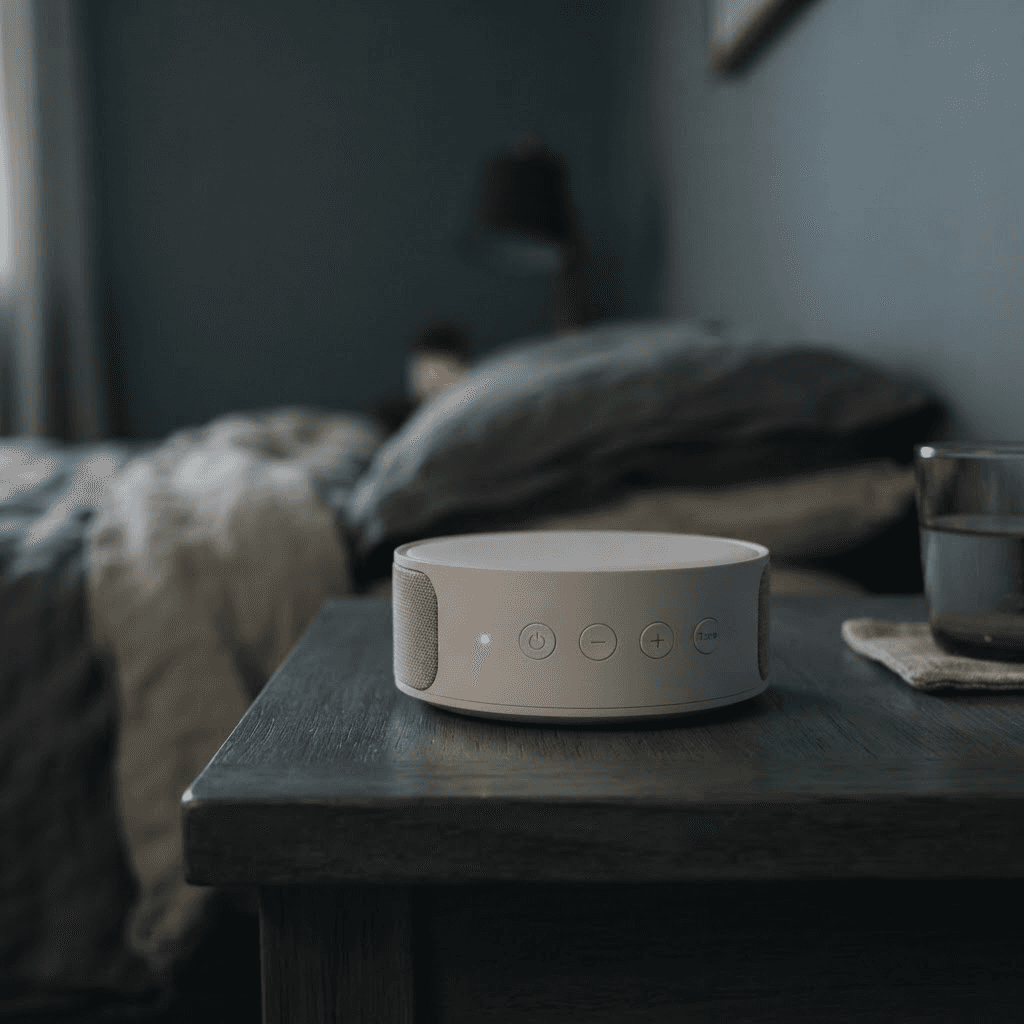
There is a particular kind of quiet that is not restful at all. The house finally settles, everyone else is asleep, and instead of drifting off you become a human microphone: the fridge cycling on, a car three streets over, the tiny tick of the radiator, the sound of your own heartbeat in the pillow. The silence you were craving turns out to be the problem, because in a truly quiet room every small noise arrives like an event. This is the moment most people first type "noise for sleep" into a search bar — and immediately hit a wall of colors.
White, pink, brown, sometimes even green or grey. It reads like a paint chart, and the marketing around it does not help. So let's strip the mystery out. These colors are not vibes and they are not brands. They are a plain description of how a sound's energy is distributed across frequencies, and once you understand that one idea, choosing between them stops being guesswork and starts being a fairly simple match to whatever is actually keeping you awake.
What the "colors" of noise actually mean
The color labels are borrowed from light, where different colors correspond to different frequencies. Sound works on a spectrum too, from low bass notes up to high treble. When engineers talk about a "color" of noise, they are describing how much energy the sound carries at low frequencies versus high ones. That balance is the only real difference between them, and it is what your ears — and your sleeping brain — respond to.
White noise contains roughly equal energy across all frequencies at once. Because your ear is more sensitive to higher pitches, that even spread comes across as bright and hissy, like an untuned radio or TV static. Pink noise dials the higher frequencies down so the energy is more balanced to the human ear, which is why it sounds fuller and more natural — think steady rain or wind through trees. Brown noise (named after a type of random motion, not the color) pushes even more energy into the low end, producing a deep, rolling rumble closer to a distant waterfall or a heavy shower.
- White noise — equal energy everywhere, perceived as bright and hissy. Static, a fan on high, an air conditioner.
- Pink noise — more balanced to the ear, fuller and softer. Steady rainfall, rustling leaves, ocean surf at a distance.
- Brown noise — heavy on the low end, deep and rumbling. Distant thunder, a strong shower, the drone of a plane cabin.
That is genuinely the whole taxonomy. Everything else — "green noise," "grey noise," branded sleep sounds — is a variation on the same idea of shaping where the energy sits. You do not need to memorise the physics. You just need to know that moving from white to pink to brown means trading brightness for depth, and that the right trade depends on what you are trying to drown out.
How steady sound might actually help you sleep
The most convincing reason a wash of sound helps is not mystical. It is masking. In a silent room, the gap between background and a sudden noise is huge, so your brain flags the noise as something to check. A steady sound shrinks that gap. The slammed car door, the partner's snore, the neighbour's late footsteps — all of them stand out less when there is already a constant, unremarkable sound filling the space. Less contrast means fewer of those little arousals that fragment a night without fully waking you.
There may be a second, gentler effect: a predictable, monotonous sound gives a busy mind something dull to rest on instead of tomorrow's to-do list, which some people find genuinely calming at lights-out. That overlaps with why techniques like cognitive shuffling work — they occupy the part of your mind that would otherwise keep narrating. But the honest headline is masking. If your sleep is broken by noise you cannot control, covering it up is the clearest thing sound can do for you.
It is worth being clear about what this is not. Noise does not detox your brain, reset your hormones, or force you into deep sleep on command. It is a tool for a specific problem — an unpredictable or intrusive sound environment — and for the racing-mind version of falling asleep. If neither of those is your issue, a sound machine may do very little, and that is not a failure of the machine.
Think of it less as a sleep aid and more as a volume knob for the world. You are not adding something that knocks you out — you are lowering the contrast so the world stops interrupting you.
Which color for which problem
Here is where the frequency differences finally earn their keep. Because each color emphasises a different part of the spectrum, each is best at masking sounds in that same range. Match the color to the disturbance and you get the most cover for the least volume.
| Color | Sounds like | Tends to mask best | Worth trying if |
|---|---|---|---|
| White | Static, hiss, a fan on high | Sharp, high-pitched sounds — voices, clinks, notifications, birdsong | You are woken by talking, TVs, or bright sudden sounds |
| Pink | Steady rain, wind, distant surf | A broad mix of sounds without the harsh top end | White noise feels too hissy but you still want good all-round cover |
| Brown | Distant thunder, a heavy shower, a plane cabin | Low rumbles — traffic, HVAC hum, some snoring, footfalls | You are near a road, machinery, or a low, droning disturbance |
Two practical notes on that table. First, high-pitched noises are the hardest to sleep through, so if your problem is voices or sudden clinks, white or pink usually gives you more useful cover than brown. Second, brown noise has become genuinely popular lately — especially among people who describe racing thoughts or find bright sounds grating — and if the deep rumble is what lets your shoulders drop, that preference is a perfectly good reason to use it. Comfort is not a tie-breaker here; it is a real variable, because a sound you find pleasant is one you will actually leave on.

What the research does — and does not — show
This is the part that usually gets skipped, so let's be straight about it. The idea that steady sound can mask disturbances is well grounded in how hearing works. But the stronger claim — that a particular color of noise reliably improves the sleep of healthy adults — is not settled. Reviews of the available studies have generally found the research to be limited in size, mixed in results, and modest in quality, which means we should hold any specific promise loosely.
Pink noise is the color with the most cited research, and some small studies have linked it with slow-wave (deep) sleep and, in a few cases, memory measures. That work is genuinely interesting, but the samples are small and the findings are preliminary rather than the last word — not a reason to expect a transformation. Brown noise, despite its recent wave of popularity, has been studied even less, so most of what you read about it is anecdote and personal preference rather than trial data. That does not make it useless; it just means we cannot claim more than "some people find it helpful."
None of this is a reason to skip it. Because the downside is so low and the cost can be zero, trying a noise color is a reasonable, low-risk experiment. The right mindset is a personal test with a clear question — does this help me fall asleep or stay asleep? — rather than faith in a color chart. Give one color three or four nights, notice what changes, and let your own sleep, not the internet's, decide.
How to use it well: volume, placement, habit
If you decide to try it, a few details separate a genuinely helpful setup from one that quietly causes new problems. The most important is volume. Louder is not better, and sound played too loud for too long carries its own risks to hearing over time. Aim for the lowest level that still covers your disturbance — roughly the volume of a soft shower or gentle rain, not a roar.
- Keep it quiet. Set the volume just high enough to blunt the disturbance and no higher; if you have to raise your voice over it, it is too loud.
- Give it distance. Place a sound machine or speaker across the room rather than right next to your head, which lowers the effective volume at your ear.
- Prefer a speaker to earbuds overnight. Sleeping in earbuds every night can irritate the ear canal or trap wax for some people; if you share a bed and must use them, choose soft, low-volume options and clean them.
- Make it steady and boring. A constant loop works better than music with build-ups and drops, which can pull attention rather than release it.
- Let it run through the night. Because a lot of the benefit is masking the sudden noises that surface you in the small hours, a sound that switches off after 30 minutes may leave the second half of the night unprotected.
A word on babies and children, since parents search this constantly: infant sleep has its own specific safe-sound and safe-volume guidance, and sound machines for babies should be kept quiet and placed well away from the crib. Follow advice from your pediatrician or a national child-health service rather than applying adult settings to a nursery.

One trade-off is worth naming. Reaching for your phone to start the sound puts a glowing screen and an infinite scroll in your hand at the exact moment you are trying to wind down — the opposite of what a calming bedtime routine is for. A cheap dedicated sound machine, or starting the audio and then physically putting the phone across the room, keeps the sound without the screen.
When noise is not the answer
Sound is a tool for a sound problem, and it is easy to ask it to do work it cannot. If you are dependent on noise every single night to sleep at all, that is less a preference and more a signal worth paying attention to — often it points at an underlying issue that masking cannot touch, from an irregular schedule to anxiety at lights-out to something medical.
If your nights are broken but the room is already quiet, the cause is probably elsewhere. A body clock that has drifted is a common one; our guide to fixing a broken sleep schedule covers that. Consistently surfacing in the small hours has its own set of usual suspects, which we walk through in why you wake up at 3 a.m.. And if you are logging a full night yet still waking exhausted, waking up tired even after eight hours is the better place to start than the volume dial.
For most people, though, the takeaway is refreshingly small. If a quiet room leaves you listening to every creak, a steady sound can lower the contrast so the world stops interrupting you. Match the color to whatever is breaking through, keep it quiet, run it low and constant, and judge it only by whether you wake less. There is no best color in the abstract — only the one that fits your room, your ears, and the particular sound you are trying not to hear.
Sources and further reading
The guidance above draws on sleep-medicine and public-health sources on noise, masking and sleep. Follow the links to read the original material, and note where the evidence is still limited, mixed or preliminary rather than settled.
- White noise and sleep: what the evidence showsNational Sleep Foundation
- The effects of white noise on sleep — systematic review of the evidenceSleep Medicine Reviews (via PubMed)
- Acoustic (pink noise) stimulation and slow-wave sleep and memoryFrontiers in Human Neuroscience (via PubMed)
- Environmental noise and its effects on sleepWorld Health Organization — Environmental Noise Guidelines
- Noise and hearing: protecting your hearing over timeNational Institute on Deafness and Other Communication Disorders (NIH)
- Healthy sleep habits and the sleep environmentNational Heart, Lung, and Blood Institute (NIH)
The noise-color questions people actually ask
What is the difference between white, pink, and brown noise?
They differ only in how sound energy is spread across frequencies. White noise has roughly equal energy at all frequencies and sounds bright and hissy, like static. Pink noise reduces the higher frequencies so it sounds fuller and more natural, like steady rain. Brown noise puts even more energy into the low end, giving a deep rumble like distant thunder. That balance of low versus high is the entire difference.
Which noise color is best for sleep?
There is no single best color — it depends on what is disturbing you. White tends to mask sharp, high-pitched sounds like voices and notifications, brown leans toward covering low rumbles like traffic, and pink sits in between. The most reliable approach is to try each for a few nights and keep whichever helps you wake less. Comfort matters too, because a sound you find pleasant is one you will actually leave on.
Is brown noise actually good for sleep?
Many people say they find brown noise calming, and its deep rumble can help mask low-frequency disturbances like traffic. However, it has been studied far less than white or pink noise, so most of the enthusiasm is based on personal preference rather than strong trial evidence. It is a reasonable, low-risk thing to try, but claims that it deepens sleep or fixes insomnia go beyond what the research supports.
Does white noise really help you sleep, or is it a myth?
It can help, mainly by masking sudden noises so they are less likely to wake you, and some people find a steady sound calming at lights-out. That said, reviews of the research have found the evidence limited and mixed rather than conclusive, so it is best treated as a low-risk experiment for a noisy environment rather than a guaranteed sleep aid. If your room is already quiet, it may do little.
Is it bad to sleep with white noise every night?
For most people, using a modest volume is considered low-risk. The main cautions are volume and dependence: sound played too loudly for long periods can affect hearing over time, so keep it quiet and place the source away from your head. And if you feel you cannot sleep at all without it every night despite a good routine, that reliance is worth discussing with a clinician, because it can point to an underlying issue.
What volume should I use for sleep sounds?
Use the lowest volume that still covers your disturbance — roughly the level of a soft shower or gentle rain, not a roar. If you have to raise your voice to be heard over it, it is too loud. Placing a speaker or sound machine across the room rather than beside your pillow lowers the volume reaching your ear while still masking the noises that would otherwise wake you.
Keep reading
More from the sleep desk for the room, the routine and the hours that decide the rest of the night.
 Mental HealthNight Anxiety: Why Your Brain Switches On at Bedtime (and 5 Fixes That Actually Work)
 Mental HealthRevenge Bedtime Procrastination: Why You Stay Up Late When You Are Exhausted (and How to Stop)
 Mental HealthHow to Regulate Your Nervous System: A Beginner’s Guide to Calming Anxiety in Your Body