How to Deal With Intrusive Thoughts: Why They Happen and What Actually Stops Them
A thought is not a confession. It is an alarm going off, and alarms are built to be wrong more often than they are right.
A thought arrives that is violent, shameful or absurd, and it does not feel like yours. Here is the mechanism behind it, why arguing with it makes it louder, and the four-move response that shrinks it — plus the line where self-help ends and treatment begins.
Four things people believe about intrusive thoughts, corrected
- Thinking it means part of me wants it.
- The thought is repellent to you. That reaction is what makes it intrusive rather than intended.
- Having these thoughts is rare and abnormal.
- Roughly 94% of people report them. The themes repeat across every continent studied.
- I need to push the thought away.
- Suppression reliably increases how often a thought returns. Monitoring for it keeps it in mind.
- Once I work out what it means, it will stop.
- Analysis is the fuel. Thoughts fade when they stop being treated as important, not when they are solved.

You are standing at the edge of a train platform. The train is about ninety seconds out. And a thought arrives, fully formed and uninvited: what if I stepped forward. Not a plan. Not a wish. Just a sentence that appeared in your head wearing your own voice, and now you have taken two steps back from the yellow line and your heart is going, and the rest of the journey home you are quietly wondering what kind of person thinks that.
Here is the thing nobody tells you at the platform: that particular thought is common enough that psychologists gave it a name in the 1980s. The French call it l’appel du vide, the call of the void. Researchers who have surveyed it find it in people with no history of self-harm, no depression and no wish to be anywhere but on the platform. It is a glitchy, harmless piece of mental static that a great many commuters have had and almost none of them mention.
This guide is about that class of thought and all its relatives — the violent image, the blasphemous line in a quiet church, the sexual thought about the wrong person, the sudden certainty that you left the gas on. What follows is the mechanism, a way to read what a thought theme actually means, the four responses that reliably make things worse, and one practice that does not.
The alarm is not the fire
An intrusive thought is an unwanted, involuntary thought, image or urge that enters awareness on its own and feels out of step with who you are. That last clause is the important one. Clinicians call it ego-dystonic — a thought that arrives feeling foreign, unwelcome, not-mine. It is the opposite of a wish.
The most useful way to understand what your brain is doing is the smoke alarm. A smoke alarm exists to be oversensitive. It is designed to go off at burnt toast, because a device that only sounded for genuine house fires would occasionally let you die in your sleep. The cost of a false alarm is irritation; the cost of a missed alarm is catastrophic. So evolution set the dial to twitchy.
Your threat-detection system runs on the same logic. It generates worst-case scenarios constantly, most of them below the level of your notice, and occasionally one surfaces loudly enough that you hear it as a sentence. When that happens, the alarm has gone off. It has not told you there is a fire. It has told you there is smoke-shaped input in the room, and it would rather be wrong than quiet.
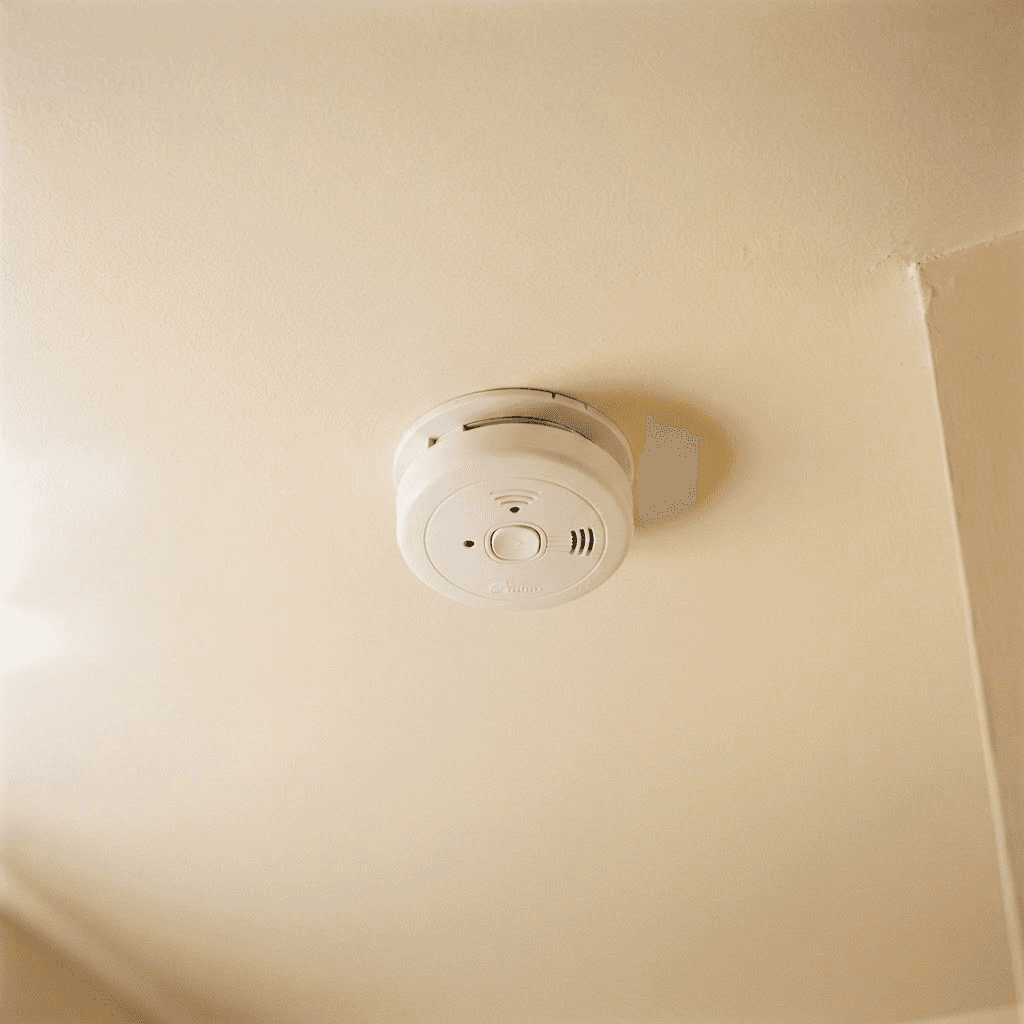
This is why the intensity of a thought tells you nothing about its truth. A thought that arrives with a jolt of adrenaline feels enormously significant, and that feeling of significance is manufactured by the alarm itself, not by the content. Loudness is not evidence.
Almost everyone, almost never mentioned
In one widely cited international study, researchers surveyed 777 university students across thirteen countries and six continents. Roughly 94 percent reported having experienced at least one intrusive thought in the previous three months. The themes clustered in the same handful of categories everywhere: harm, contamination, sex, religion, doubt. Culture changed the costume; the machinery was identical.
Sit with that number for a second, because it undoes the loneliest part of this experience. If you are on a bus with fifty people, roughly forty-seven of them have had a thought in the last quarter that would horrify them if it were broadcast. Not one of them is going to bring it up. The silence is what makes an ordinary event feel like a personal verdict.
The thought is not rare. Talking about it is.
What separates someone who barely notices these thoughts from someone whose week is organised around them is not frequency and it is not content. Studies comparing people with obsessive-compulsive disorder to people without it find their intrusive thoughts are strikingly similar in theme. The difference is appraisal — what you decide the thought means about you — and what you do next.
Reading the theme: a translation table
People rarely ask for help with intrusive thoughts in general. They ask about their specific one, convinced theirs is the exception that really does mean something. So here is a plain translation of the most common themes, what people fear each one proves, and what it usually indicates.
| Theme | The fear it triggers | What it usually reflects |
|---|---|---|
| Harm to a loved one | "Some part of me wants this." | A protective attachment so strong the brain simulates the worst outcome to rehearse against it. Most common in new parents and carers. |
| The call of the void | "I might be secretly suicidal." | A high-place phenomenon documented in people with no suicidal intent. Often read as the brain double-checking a survival instruction. |
| Sexual or taboo imagery | "This reveals what I really am." | The alarm reaching for the most forbidden category available. Revulsion at the image is the tell that it contradicts you. |
| Blasphemous or sacrilegious | "I am a fraud in my own faith." | Almost exclusively reported by the devout. The thought targets what you hold sacred because that is what generates a reaction. |
| Contamination and germs | "I have made someone ill." | A disgust-and-responsibility loop. Frequently intensifies after illness, a health scare or a period of caretaking. |
| Doubt: locks, gas, emails | "I cannot trust my own memory." | Checking behaviour degrades memory confidence. The more you verify, the less certain the memory feels. The loop is self-feeding. |
Notice the pattern running down the third column. The thought consistently aims at the thing you care about most. That is not coincidence and it is not irony. An alarm calibrated to your values will always sound loudest near them.
The four responses that feed it
Everything in this section feels like coping. That is what makes it difficult to give up. Each of these actions delivers genuine relief within about ninety seconds, and each one teaches your brain that the thought was worth the alarm — which guarantees a repeat performance.
1. Suppression: "just stop thinking about it"
Daniel Wegner’s white bear experiments established this decades ago. Participants told not to think about a white bear thought about it more than participants given no instruction at all, and more still once the suppression period ended. The monitoring process that checks whether you are successfully not-thinking about something has to keep the thing in mind to do its job. Suppression is a search engine for the thing you are avoiding.
2. Reassurance-seeking
Asking your partner, again, whether you would ever hurt anyone. Googling the phrase at one in the morning. Reading a forum thread until you find someone whose story matches yours closely enough to settle you. Relief lands quickly and decays inside a day, and the interval between requests shortens over months. You are not gathering information at that point; you are taking a painkiller with a shrinking dose window.
3. Checking and avoidance
Going back to the door a third time. Putting the kitchen knives in a high cupboard. Declining to hold the baby. Each one purchases a moment of calm at the price of a permanent lesson: the danger was real and only your vigilance prevented it. Avoidance is the most expensive form of reassurance because it takes territory from your life and keeps it.

4. Mental arguing
The subtlest of the four, because it looks like insight. You review the evidence, list your good deeds, examine your motives, cross-examine yourself. You may even feel briefly satisfied by the verdict. But the act of putting a thought on trial confirms that it was worth prosecuting, and the case reopens on the next available doubt.
What to do instead: four moves, roughly a minute
This is not a technique for making the thought vanish. Aiming at disappearance is suppression with better branding, and it fails for the same reason. The aim is to change your relationship to the thought so completely that your brain stops flagging it as important. Frequency falls afterwards, as a side effect, usually over weeks rather than days.
- Notice it out loud, silently. "There it is." Two words. You are marking an event, not opening a file. This alone breaks the reflex of sliding straight into analysis.
- Name the category, not the content. "That is a harm thought." Or "that is a doubt thought." Labelling shifts processing away from the emotional centres and toward the language regions — the effect behavioural researchers describe as affect labelling, and it measurably lowers the charge.
- Let it stay. Do not argue, do not reassure, do not push. Allow the sentence to sit in the room unattended, the way you would let a stranger’s phone ring on a train. Discomfort will rise for perhaps thirty seconds and then begin to fall on its own. It always does; you have simply never stayed long enough to watch it.
- Return to the sentence you were in. Not a distraction, a resumption. Go back to the email, the conversation, the washing up — with the thought still present if it wants to be. You are demonstrating, behaviourally, that this thought does not get to redirect your day.
The fourth move is where most people quit, because returning to ordinary activity while still uncomfortable feels like ignoring a warning. That discomfort is the entire treatment. Every time you finish loading the dishwasher with an unresolved thought in the room, you are filing evidence that the alarm can sound without the house burning down.

A note on timing. These thoughts spike when the nervous system is already elevated, which is why they cluster at 2am, in the week before a deadline and in the months after a birth. If yours arrive mostly in the dark, the practical fixes in our guide to night anxiety when you cannot sleep address the state underneath them, and the drills in how to regulate your nervous system lower the baseline the alarm is calibrated against.
Where self-help stops
Everything above is aimed at ordinary intrusive thoughts in an otherwise functioning life. There is a real line past which this becomes a clinical matter, and crossing it is not a failure of the techniques — it means a different tool is required.
- The thoughts and your responses to them are taking more than an hour of most days.
- You are avoiding people, places or responsibilities to manage them — particularly avoiding being alone with a child, a partner or a kitchen.
- You have developed rituals, checks or mental routines that must be completed before you can move on.
- The distress is affecting sleep, work or your relationships in a way other people have started to notice.
- The thoughts are accompanied by any genuine intent, planning or urge to act — which is clinically distinct from an intrusive thought and needs urgent, same-day assessment.
The last point deserves precision, because the fear of it is what keeps people silent. An intrusive thought is unwanted and repellent to you. An intent is wanted, or at least considered, and carries a pull toward action rather than away from it. Clinicians are trained to tell these apart quickly, and disclosing an intrusive thought does not result in you being taken away. It results in an accurate diagnosis, which is generally the point at which the fear collapses.

The treatment with the strongest evidence base is a specific form of cognitive behavioural therapy called exposure and response prevention, which trains the "let it stay" move systematically rather than opportunistically. Acceptance and commitment therapy takes a different route to a similar destination, focusing on defusion — loosening the grip of a thought without disputing it. Both are covered in our comparison of therapy types if you want to know what you would be walking into.
Where to go from here
Rather than a general reading list, route yourself by what is actually happening. Pick the line that matches your week.
- If they arrive mostly at night and keep you awake, start with night anxiety and the 3am wake-up.
- If they come with a body that will not settle, the drills in how to regulate your nervous system work on the baseline rather than the thought.
- If they turn into long spirals of analysis, the reset in how to stop overthinking targets rumination specifically.
- If they got noticeably worse after months of exhaustion, read how to recover from burnout before adding another practice.
- If reassurance-seeking online is part of your loop, the seven-day phone reset removes the delivery mechanism.
- If you want to build the "let it stay" muscle deliberately, meditation for beginners is rehearsal for exactly that skill.
Sources and further reading
Claims about prevalence, suppression and treatment are drawn from the following. Each link goes to the publisher so you can read the original rather than our summary.
- Radomsky et al., "Part 1 — You can run but you can’t hide: intrusive thoughts on six continents"Journal of Obsessive-Compulsive and Related Disorders
- Wegner et al., "Paradoxical effects of thought suppression" (the white bear studies)Journal of Personality and Social Psychology
- Obsessive-compulsive disorder: overview, symptoms and treatmentNational Institute of Mental Health
- What is exposure and response prevention (ERP) therapy?International OCD Foundation
- Hames et al., "The high place phenomenon: an urge to jump reflects an affirmation of life"Journal of Affective Disorders
- Unwanted intrusive thoughts: an explainer for the publicAnxiety & Depression Association of America
If a thought stops feeling unwanted
Everything in this guide describes thoughts you do not want. If a thought has started to feel like something you might act on, or you are thinking about harming yourself or another person, that is a different situation and it needs same-day help. Contact your doctor, an emergency service, or a crisis line in your country — in the US and Canada dial or text 988, in the UK and Ireland call 116 123. Telling someone does not get you taken away. It gets you assessed by a person who has heard this many times before.
The questions people are usually too embarrassed to ask
Read these once. Re-reading them daily turns an explanation into a compulsion.
Do intrusive thoughts mean I secretly want to do the thing?
No, and the distress itself is the clearest counter-evidence. A thought you want is experienced as appealing or at least neutral; an intrusive thought is experienced as repellent. Researchers describe this as ego-dystonic, meaning it conflicts with your values rather than expressing them. People who genuinely intend harm characteristically do not lie awake horrified by the prospect.
Why are my intrusive thoughts about the worst possible thing?
Because the alarm is calibrated to what you value. A thought about mildly inconveniencing a stranger produces no reaction, so your brain does not repeat it. A thought about harming your own child produces an enormous reaction, which flags it as significant and makes a repeat more likely. The theme tracks your moral priorities almost exactly, which is why devout people get blasphemous thoughts and devoted parents get harm thoughts.
Are intrusive thoughts always a sign of OCD?
No. Around 94 percent of people report them, and the vast majority have no diagnosable condition. What distinguishes OCD is not the presence of the thoughts but the appraisal and the response: the thought is treated as meaningful, and rituals, checking or mental compulsions develop to neutralise it. If the thoughts and your reaction to them are consuming more than an hour a day or shaping your behaviour, that is worth a professional assessment.
How long does it take for this to improve?
Most people notice the intensity dropping within two to three weeks of consistently not engaging — not arguing, not checking, not seeking reassurance. Frequency takes longer, often six to eight weeks, and it declines unevenly. Expect stretches of relief punctuated by a bad day, particularly during illness, poor sleep or high stress. A bad day after a good fortnight is a normal part of the curve, not a relapse.
Is it bad to talk about my intrusive thoughts with someone?
Saying it once, to one trusted person or a clinician, is usually enormously relieving and often the biggest single reduction in shame. The caution is repetition: if you find yourself telling the same person repeatedly and watching their face for reassurance, the disclosure has become a compulsion. One honest conversation helps; a weekly audit of their reaction does not.
Can medication help with intrusive thoughts?
For thoughts occurring within OCD or a significant anxiety disorder, SSRIs have a solid evidence base and are frequently combined with exposure and response prevention therapy, which together outperform either alone. For ordinary intrusive thoughts in an otherwise well person, medication is not indicated. That decision belongs with a prescribing clinician who can assess your full picture rather than a single symptom.
Why do they get so much worse at night?
Three things converge after dark. Fatigue reduces the prefrontal capacity you use to dismiss a thought calmly, there is no external task competing for attention, and lying still in the dark removes the sensory input that usually crowds thoughts out. It is a state problem more than a thought problem, which is why sleep-directed fixes tend to work better than thought-directed ones at 3am.
You are not going to win an argument with your own alarm system. You are going to stop attending the hearing.
The next time one arrives, try the smallest version of this: name the category, leave it alone, and carry on with whatever you were doing while it is still in the room. That is the whole practice. It will feel like doing nothing, which is exactly why it works.
Vitality Editorial Team
Vitality publishes practical mental-health guidance based on cited sources and established clinical recommendations.
Medical disclaimer: This article is general mental-health education and is not a diagnosis, a treatment plan or a substitute for care from a qualified professional. Intrusive thoughts can occur on their own or as part of conditions including OCD, anxiety disorders, post-traumatic stress and postpartum illness, each of which is treated differently. If your thoughts are distressing, persistent or changing your behaviour, please speak with a doctor or mental-health professional.