Kettlebell Workout for Full Body Fat Loss and Core Strength at Home
A 20-minute kettlebell workout that burns calories, builds functional core strength and protects your lower back with one piece of equipment — plus the hip hinge technique most beginners get wrong and a four-week progression you can run in a spare room.
Key takeaways
- One kettlebell and a two-metre square of floor is genuinely enough for a full body fat loss workout.
- The swing is a hip hinge, not a squat and not a lift with your arms — learn the hinge before you touch the bell.
- Fat loss comes from the density of the work, not from the exercise being exotic: short rests, big muscles, repeated weekly.
- Core strength from kettlebells is built by resisting movement — carries and presses — far more than by crunching.
- Most beginners should start at 8–12kg for women and 12–16kg for men, and almost everyone guesses too light for swings.
- Two or three 20-minute sessions a week produces visible change by week six if you eat and sleep like you mean it.
I did not choose kettlebells. A physiotherapist in Salford handed me a 16kg bell in 2015, about four months after a scrum collapsed on my lower back and quietly ended any future I had in rugby. I was twenty-eight, I could not sit through a film without shifting, and I was fairly sure that swinging a lump of cast iron around was the last thing a damaged spine needed. I said so. She told me to hinge my hips and stop talking.
Eleven years and roughly 1,400 students later, that is still the whole argument in miniature. Almost everything people fear about kettlebells — the back, the shoulders, the sense that it looks reckless — comes down to whether they have learned to hinge at the hip. Get that one pattern right and a single bell becomes the most efficient piece of equipment you can own. Get it wrong and yes, you will hurt yourself, though probably not in the dramatic way you imagine.
One note before we start. A kettlebell is a conditioning tool and a strength tool, but it is not a complete training programme on its own. If you have a gym available, the barbell and dumbbell work in our 12-week strength training plan for beginners will build maximal strength faster than any bell can, and the two approaches complement each other well.
Why one kettlebell outperforms a rack of dumbbells for fat loss
The honest answer is not that kettlebells are magic. It is that the kettlebell makes a particular kind of training convenient, and that kind of training happens to be very good at burning calories. Because the weight hangs below your hand rather than sitting in it, the bell can be swung, and swinging means you can move a heavy object fast, repeatedly, without needing to put it down or reset. That is a ballistic movement, and ballistic movements let you keep large amounts of muscle working continuously.
That matters for fat loss because the thing that drives calorie burn in a workout is how much muscle you involve and for how long, not how novel the exercise looks. A set of fifteen swings recruits your glutes, hamstrings, lats, forearms, abdominals and everything holding your spine steady, all at once, with your heart rate climbing to somewhere that feels genuinely uncomfortable. Research on kettlebell circuits has repeatedly put energy expenditure in the same territory as moderate running, which is a striking result for something you can do barefoot in a bedroom.
The second advantage is friction, and I mean that in the behavioural sense. My students who train at home with one bell are dramatically more consistent than the ones with gym memberships. There is no commute, no waiting for a rack, no getting changed in a public space you would rather not be in. The workout is twenty minutes and it is in the corner of the room, so it happens on the days when it would otherwise not have happened. Over a year, that consistency beats any programme design.
The third, which nobody advertises, is that kettlebell work is quietly excellent for core strength — but not in the way fitness marketing suggests. Your trunk gets strong here by resisting forces rather than producing them. Holding a bell on one side while you walk, or pressing it overhead while your ribs try to flare, teaches your midsection to stay rigid under load. That is what a strong core actually is, and it transfers to carrying shopping and picking up children in a way that a hundred crunches does not.
The hip hinge: the one pattern everything else depends on
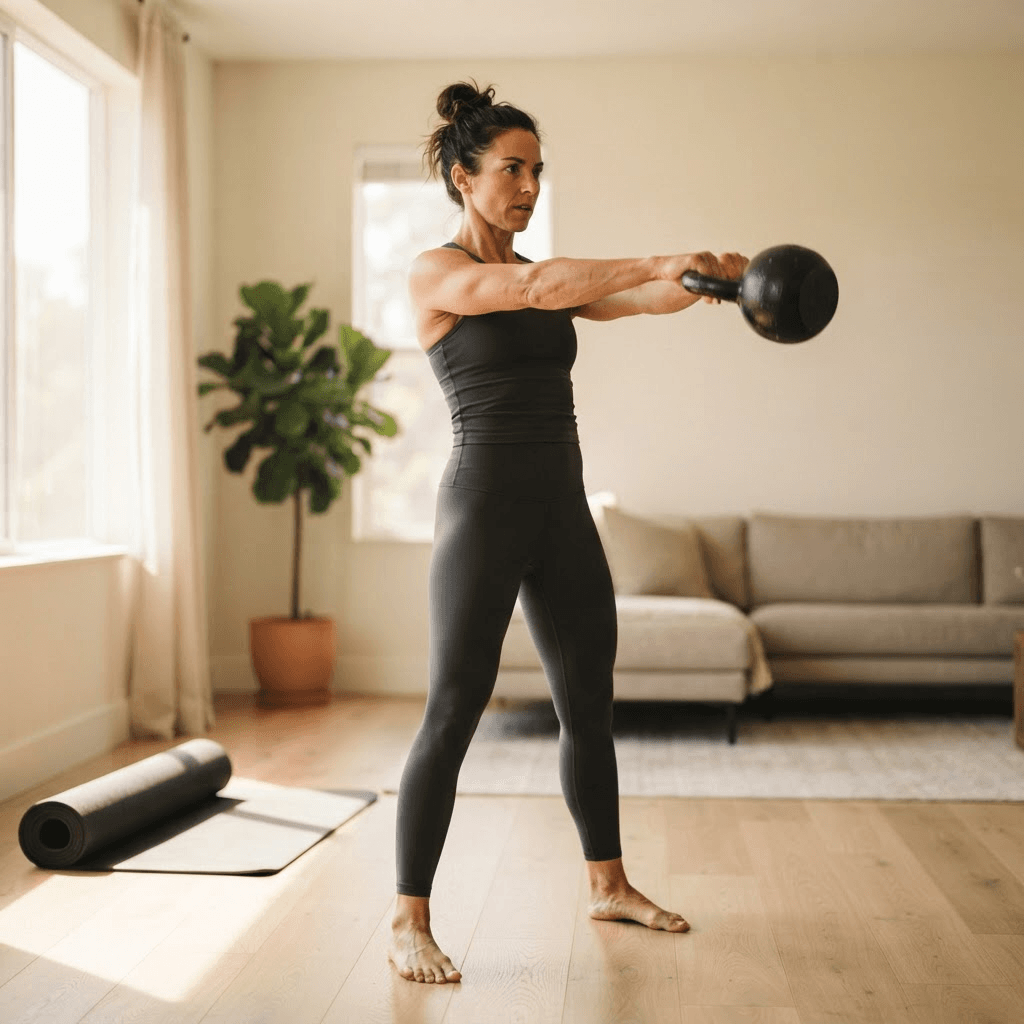
If you take one thing from this article, take this. The kettlebell swing is not a squat, and it is not a lift performed with your arms. It is a hip hinge — a fast, aggressive snap of the hips with your knees only slightly bent — and your arms are ropes that happen to be attached to the bell. When people tell me swings hurt their lower back, nine times out of ten I watch them squat the bell up and then lean back at the top to get it to shoulder height. Their spine is doing a job their glutes should be doing.
Learn the hinge without the bell first. Stand about a foot from a wall, facing away from it, feet hip-width. Push your hips backwards until your backside touches the wall, letting your chest angle forward and keeping your shins close to vertical and your back long. Stand up by squeezing your glutes hard, as if you were trying to crack a walnut. That is the movement. Ten repetitions, twice, and you have already done more preparation than most people who buy a kettlebell.
Then move the wall further away and do it faster. Then hold a bell with two hands and let it swing back between your thighs �� high up, near your groin, not down by your knees �� before snapping your hips forward. The bell should float up to roughly chest height on its own momentum. You are not raising it. If you feel your shoulders working hard, you are lifting rather than hinging, and the bell is telling you so.
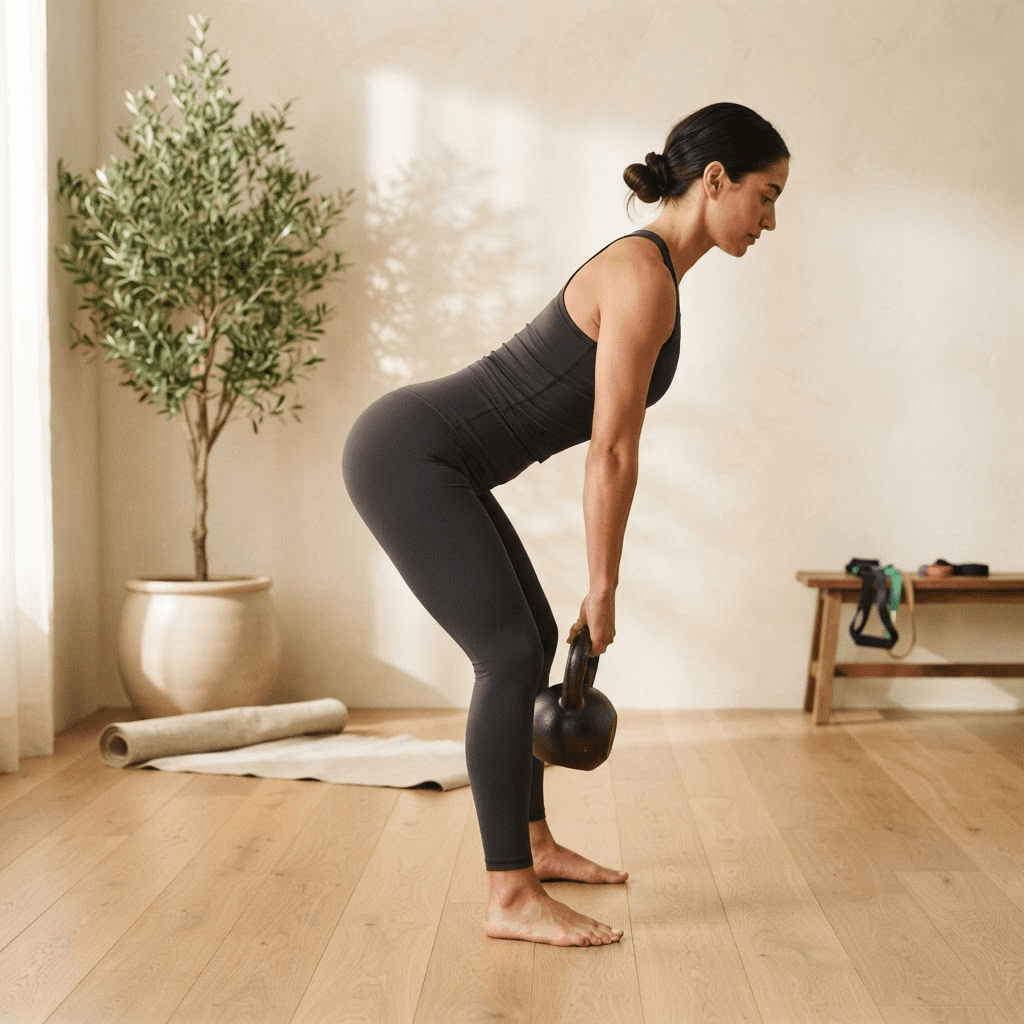
One more detail that saves lower backs. At the top of a swing, your body should be a plank standing up: glutes clenched, abdominals braced, ribs down, a hard exhale through the teeth. There should be no arch in your lower back and no leaning away from the bell. If someone shoved your chest at that instant you would barely move. Every student I have taught who found swings uncomfortable was missing exactly this, and fixing it took one session rather than a course of physiotherapy.
The six kettlebell exercises this workout is built from
You need six. Two ballistic movements for conditioning and fat loss, four grinds for strength and core control. I have deliberately left out the snatch, the clean and the turkish get-up — they are wonderful, and they need a coach watching you, not a paragraph.
The two ballistics
- Two-handed swing — the engine of the whole workout. Hinge, snap, let the bell float to chest height, guide it back between your thighs. Hardstyle swings stop at chest height on purpose; overhead swings ask a lot more of your shoulders and your ability to keep your ribs down, so leave them for later.
- Alternating swing or dead-stop swing — the same pattern with a variation. Swap hands at the top of the float, or set the bell down on the floor between every rep and start each swing from a dead stop. The dead-stop version is the single best drill for proving to yourself that the power comes from the hinge.
The four grinds
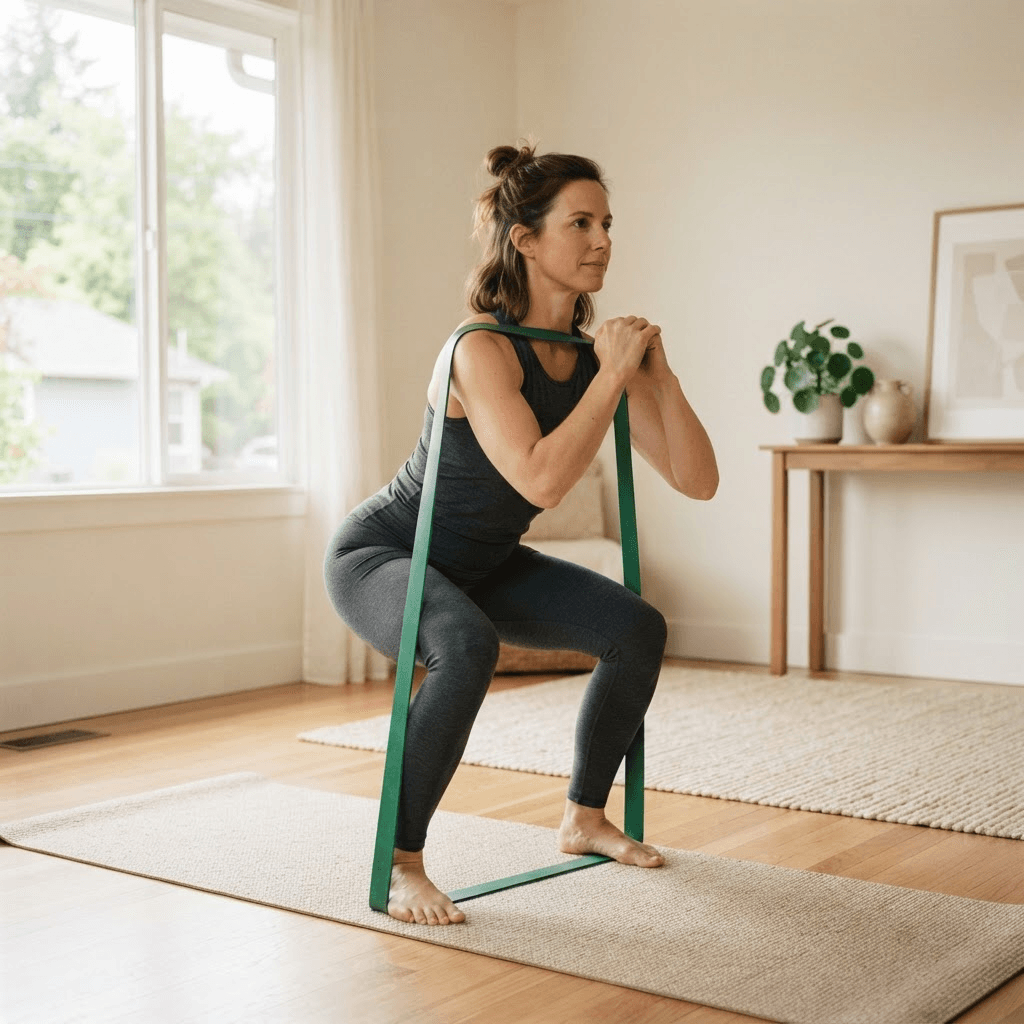
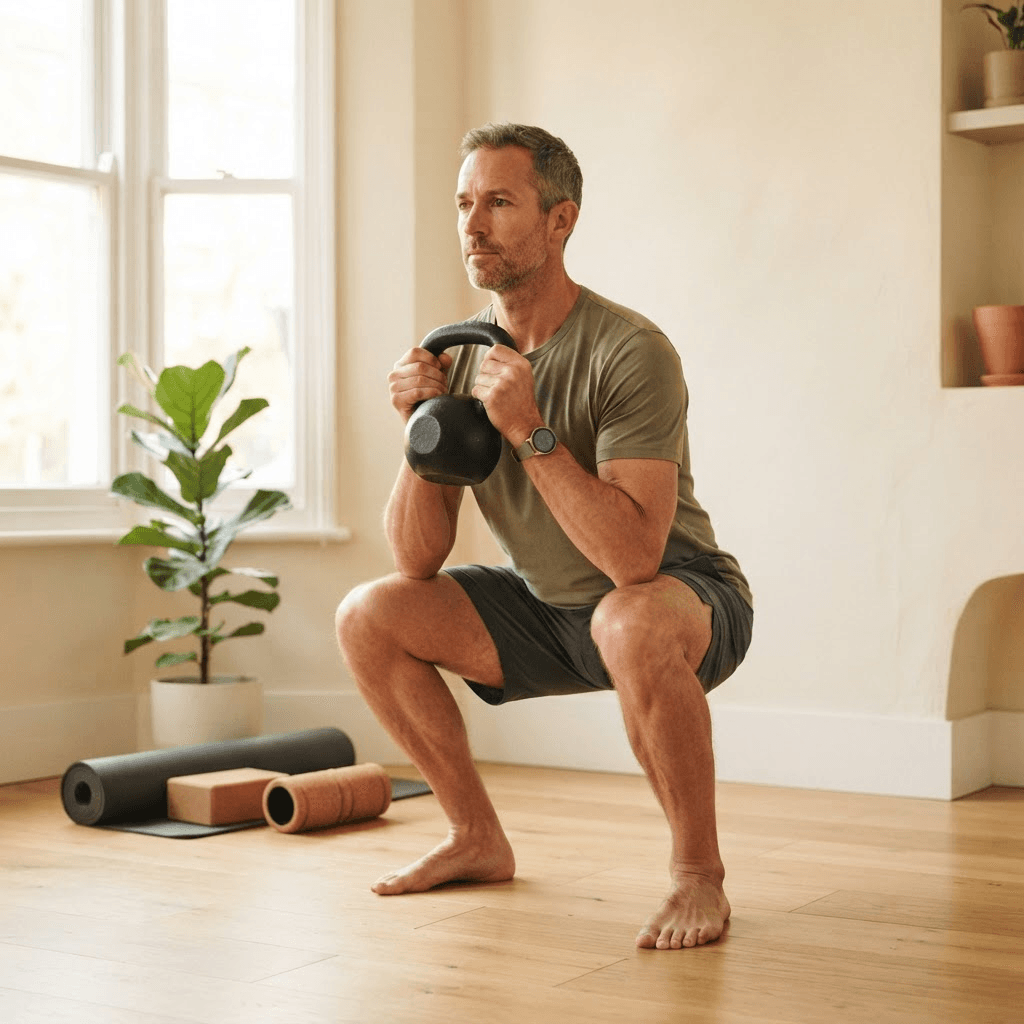
- Goblet squat — bell held by the horns against your chest, elbows tucked inside your knees at the bottom. This is a squat pattern and a core exercise simultaneously, because the load in front of you tries to fold you forward and your trunk refuses.
- Single-arm floor press or standing press — press one bell overhead or off the floor without letting your ribcage flare or your lower back arch. The overhead press is where most people discover their core is weaker than their shoulders.
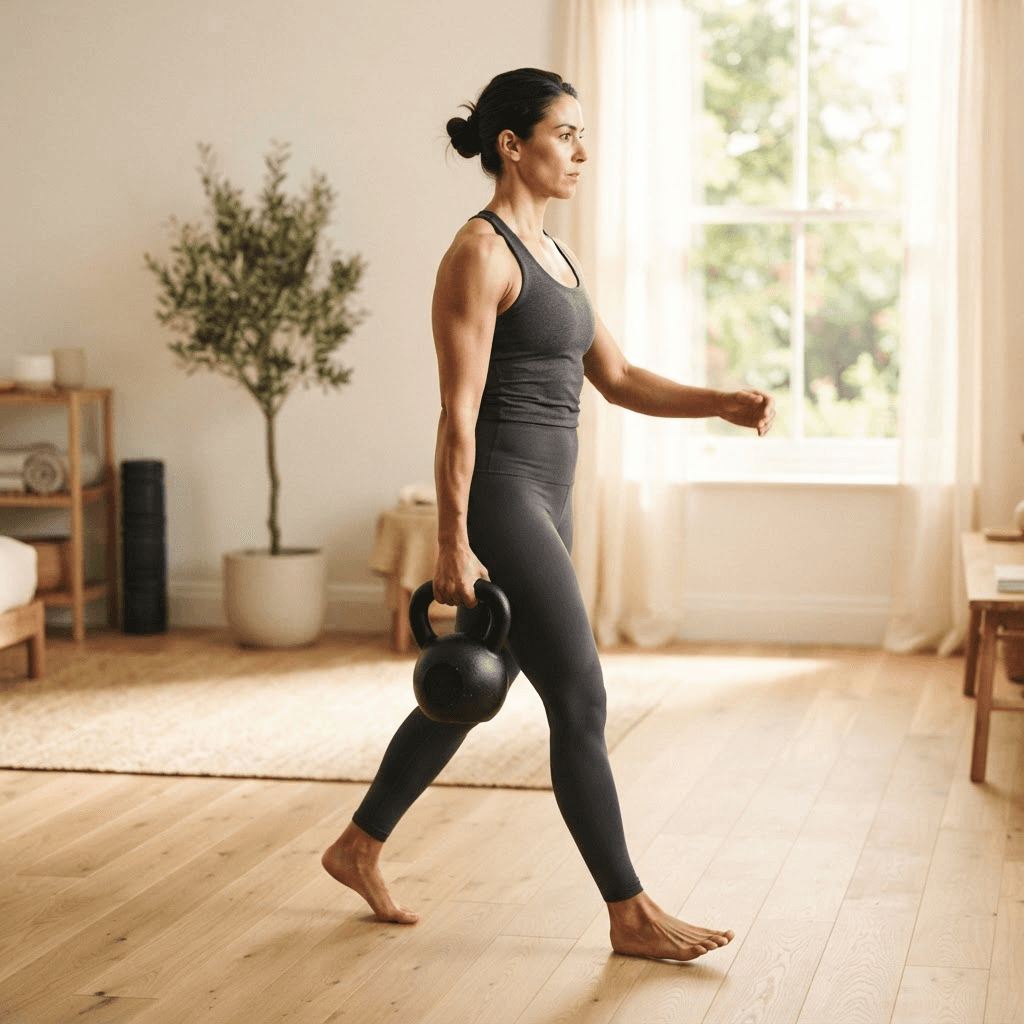
- Suitcase carry — hold the bell in one hand and walk, staying completely level. Your obliques on the opposite side are doing the work. It looks like nothing and it is one of the most honest core exercises that exists.
- Kettlebell row — hinge forward, brace one hand on a chair or your thigh, pull the bell towards your hip. Balances all the pressing and, if you sit at a desk, will do more for how your shoulders feel than any stretch.
The 20-minute full body kettlebell workout
Warm up first, properly, for four minutes — this is not optional with ballistic work. Thirty seconds each of: marching on the spot, hip circles, bodyweight hinges to the wall, bodyweight squats, arm circles, dead bugs, then ten easy swings with your bell at about half effort.
| Order | Movement | Work | What it is doing |
|---|---|---|---|
| 1 | Two-handed swing | 15 reps | Raises heart rate immediately, trains the hinge, hits glutes and hamstrings |
| 2 | Goblet squat | 10 reps | Quads and glutes under load, anti-flexion core work |
| 3 | Single-arm press | 6 reps per side | Shoulders and triceps, teaches ribs-down trunk bracing |
| 4 | Kettlebell row | 8 reps per side | Mid-back and lats, balances the pressing, protects posture |
| 5 | Suitcase carry | 20 steps per side | Obliques and grip, pure anti-lateral-flexion core strength |
| 6 | Dead-stop swing | 10 reps | Finishes the round, reinforces power from a static start |
Rest 60 to 90 seconds between rounds and take 15 seconds between movements — just long enough to reposition. If you are gasping so hard that your form is falling apart, take the longer rest. Sloppy swings under fatigue are where people get hurt, and a round completed badly is worth less than a round completed slowly.
Run this two or three times a week on non-consecutive days. On the days in between, walk. That is the whole programme, and if it sounds too simple to work, that is largely the point — the people who get results with kettlebells are not doing something clever, they are doing this on a Tuesday and a Thursday for nine months.
Nobody has ever failed at kettlebell training because the circuit was not creative enough. They failed because they stopped doing it in week three.
What weight kettlebell should you actually buy?
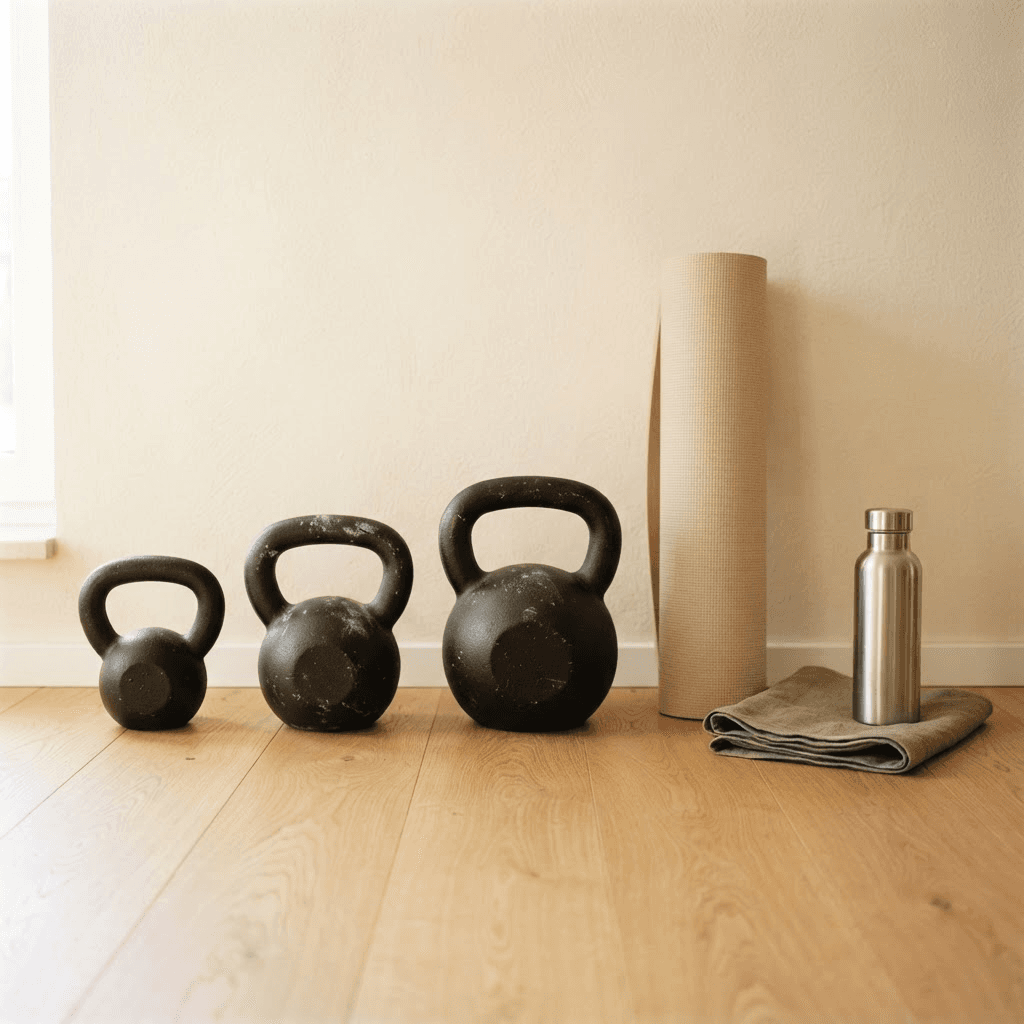
This is the question I get most often, and almost everyone guesses too light for swings and too heavy for presses. The confusing part is that one bell has to do both jobs, so you are choosing a compromise. Buy for the swing, because that is where the fat loss lives, and scale the presses by doing fewer reps.
For most untrained women, 8kg is a reasonable place to learn the pattern and 12kg is where swings start to feel like real training. For most untrained men, 12kg to learn and 16kg to train. If you are already strong from other lifting, go up a size. A bell that is too light is genuinely harder to swing correctly, because there is not enough weight to force the hinge and your arms will happily take over.
- Choose cast iron over vinyl-coated or plastic-filled bells. The handle finish and the balance are noticeably better, and it will outlive your house.
- Check the handle width fits two hands comfortably side by side, since every swing in this workout is two-handed to begin with.
- One bell is enough for at least six months. When you outgrow it, buy the next size up rather than a pair — a single heavier bell opens more progressions than two light ones.
- Avoid adjustable kettlebells for ballistic work. The shifting internal plates change the balance mid-swing and the handles are usually too thick.
How kettlebells build real core strength (without a single crunch)
There is not one abdominal exercise in this workout, and it will do more for your midsection than the ab routine you have bookmarked. That is not a paradox once you understand what your trunk is for. Your core is not primarily a muscle that bends you forward. It is a bracing system whose main job is to stop your spine moving when something tries to move it.
Every movement in the circuit attacks that job from a different angle. The goblet squat loads you from the front, so your abdominals resist being folded forward. The overhead press loads you from above, so your obliques and deep trunk muscles stop your lower back arching. The suitcase carry loads one side only, so the opposite side works hard to keep you upright. And the swing asks your whole midsection to snap rigid a hundred times in twenty minutes.
I want to be direct about one thing, because it is the most common reason people are disappointed. This kind of training builds a genuinely strong and more defined midsection, and it does not spot-reduce fat from your stomach. Nothing does. Swings burn calories, and where your body draws that fat from is decided by genetics and hormones, not by which muscle you worked. The visible outcome comes from the calorie deficit and the muscle underneath, over months.
Your first four weeks, week by week
Do not start with three full rounds. The hinge is a skill, and skills degrade under fatigue long before your muscles give out. This progression front-loads technique so that by the time you are working hard, your body knows what it is doing.
- Week 1 — Technique. Two sessions. Two rounds only, and replace every swing with ten dead-stop swings. Film one set from the side and compare it to the hinge photograph above. Expect to feel this in your glutes and forearms, not your lower back.
- Week 2 — Volume. Two or three sessions. Three full rounds at the prescribed reps, still using the same bell. Keep the rests generous. This is the week that tells you whether your conditioning or your technique is the limiting factor.
- Week 3 — Density. Three sessions. Same three rounds, but cut the rest between rounds to 45 seconds. Nothing else changes. You will notice this immediately, and this is the single most effective lever for fat loss in the whole plan.
- Week 4 — Load or reps. Three sessions. Either add a fourth round, or add five reps to each swing set, or move to the next bell size for swings only while keeping the old bell for pressing. Pick one. Not all three.
After four weeks, repeat the cycle from week two with your new baseline. You do not need a different programme. You need this one to get heavier and denser while your technique stays clean, which is what progressive overload means when you own a single kettlebell.
- Squatting the swing. Knees travel forward, chest drops, bell goes up on arm strength. Go back to the wall drill for five minutes; it fixes faster than any explanation.
- Leaning back at the top. The bell reaches chest height because you hyperextended your lower back rather than because your hips snapped. This is the mechanism behind most kettlebell back complaints.
- Letting the bell drop below the knees on the backswing. It should pass high between the thighs. A low backswing turns every rep into a rounded-back deadlift.
- Gripping the handle like a life raft. Hold it firmly but let it rotate in your hand at the top. White knuckles for fifteen reps will shred your palms and tire your forearms before your glutes are done.
- Holding your breath through the set. Sharp exhale at the top of each swing, inhale on the backswing. Bracing without breathing is how people finish a round light-headed.
- Adding a heavier bell before the hinge is automatic. Load a broken pattern and you have simply made the pattern more expensive. Technique first, always, in that order.
What to realistically expect, and when
In the first week or two, the main thing you will notice is your forearms and your breathing, and possibly some soreness in your hamstrings and glutes that surprises you on the second morning rather than the first. Nothing visible is happening yet. This is the stage where your body is learning the movement, and it is the stage where most people quit because it does not feel like enough.
By weeks three and four, the twenty minutes stops feeling like survival. Students usually report this as the circuit "getting shorter", which is really their conditioning improving. Around here you will also notice the hinge appearing outside training — picking a bag off the floor without thinking about it, standing up from a low sofa more easily.
Between weeks six and twelve is where the changes people actually came for show up: a firmer midsection, more defined shoulders and arms, and, if your food supports a modest calorie deficit, steady fat loss in the region of 0.4 to 0.7kg per week. I am deliberately not promising more than that. Twenty minutes of swings does not override a diet, and any programme that claims to is selling something.
The thing I would most like you to take away is how small the required commitment is. Two or three sessions of twenty minutes, one bell, two metres of floor. My longest-standing students are not the ones with the best technique or the heaviest bells. They are the ones for whom this became as unremarkable as brushing their teeth, and eleven years in, I still think that is the only real secret in any of it.
References and further reading
The calorie, safety and core-function claims in this guide come from peer-reviewed research on kettlebell training and from national activity guidance. These are the primary sources.
- Farrar RE, Mayhew JL, Koch AJ. Oxygen cost of kettlebell swings — energy expenditure during continuous swing protocolsJournal of Strength and Conditioning Research (PubMed)
- Lake JP, Lauder MA. Mechanical demands of kettlebell swing exerciseJournal of Strength and Conditioning Research (PubMed)
- Meigh NJ et al. Kettlebell training in clinical practice: a scoping review of safety and effectivenessBMC Sports Science, Medicine and Rehabilitation, PubMed Central
- McGill SM, Marshall LW. Kettlebell swing, snatch and bottoms-up carry — back and hip muscle activation and spine loadingJournal of Strength and Conditioning Research (PubMed)
- Physical Activity Guidelines for Americans, 2nd edition — combining aerobic and muscle-strengthening activityU.S. Department of Health and Human Services
- WHO guidelines on physical activity and sedentary behaviourWorld Health Organization
- Hall KD et al. Energy balance and its components — implications for body weight regulationAmerican Journal of Clinical Nutrition, PubMed Central
- Exercise guidance for adults, including how to start safelyNHS (United Kingdom)
Common kettlebell questions
Is a kettlebell workout good for fat loss?
Yes. Kettlebell circuits combine large-muscle ballistic movements with short rest periods, which produces energy expenditure comparable to moderate running while also building muscle. Research on kettlebell swing circuits has repeatedly found high calorie burn for the time invested. Fat loss still requires a modest calorie deficit — the workout creates the demand, your diet decides the outcome.
What weight kettlebell should a beginner start with?
Most untrained women do well learning with 8kg and training with 12kg; most untrained men learn with 12kg and train with 16kg. Buy for the swing rather than the press, because a bell that is too light makes the hip hinge harder to learn — there is not enough weight to force the hips to do the work, so the arms take over.
Are kettlebell swings bad for your lower back?
Swings are safe when performed as a hip hinge and genuinely risky when performed as a squat with a lean-back at the top. The two most common faults are letting the knees travel forward instead of pushing the hips back, and hyperextending the lower back to get the bell to chest height. Learn the hinge against a wall without a bell first, and brace your glutes and abdominals hard at the top of every rep.
How many times a week should I do a kettlebell workout?
Two or three sessions a week on non-consecutive days is ideal for a 20-minute full body circuit. Ballistic work is demanding on the posterior chain and grip, so at least one rest day between sessions matters. Walking on the days in between supports recovery and adds to your weekly energy expenditure without interfering.
Can kettlebell exercises build core strength without crunches?
Yes, and often better. Your core’s primary job is resisting movement rather than creating it, so exercises that load you asymmetrically or from awkward angles — suitcase carries, single-arm overhead presses, goblet squats and the swing itself — train the bracing function directly. That kind of strength transfers to carrying, lifting and protecting your spine in daily life.
Do kettlebell swings burn belly fat specifically?
No exercise targets fat from a specific area, including the abdomen. Swings burn a significant number of calories and build the muscle underneath, but where your body draws stored fat from is determined by genetics and hormones. A visibly leaner midsection comes from an overall calorie deficit sustained over months, combined with the muscle this workout builds.
Can I do this kettlebell workout in a small apartment?
Yes. Every movement here fits in roughly two metres square, and the swing needs clearance in front of you rather than overhead. The suitcase carry can be done as slow paces back and forth across a room. Ballistic work is quiet if you avoid dropping the bell — use a mat and set it down deliberately if you have neighbours below.
Should I do cardio as well as kettlebell training?
The circuit already delivers a substantial cardiovascular stimulus, so you do not need separate cardio sessions for fitness. Daily walking is still worth keeping for recovery, joint health and total weekly energy expenditure. If you enjoy running or cycling, place it on non-kettlebell days or after the circuit rather than before it.
Vitality Editorial Team
Vitality publishes practical fitness guidance based on cited sources and established public-health recommendations.
Medical disclaimer: This article is educational and general in nature. It is not a diagnosis, prescription or personalised training plan. Speak with a qualified healthcare professional before starting a new exercise programme, particularly if you have an existing condition, injury or are pregnant.