Low Impact Workouts for Bad Knees: Strengthen Joints Without Pain
Joint-friendly exercises and knee strengthening moves that improve mobility and stability if running or jumping leaves you sore the next day — plus a four-week plan and the pain rules that tell you when to push and when to stop.
Key takeaways
- Low impact means low force through the joint, not low effort — you can work extremely hard without ever leaving the ground.
- Weak quadriceps and hip muscles are the most common reason a knee hurts, so strengthening usually beats resting.
- Isometric holds like wall sits and Spanish squats let you load a painful knee when movement still feels sharp.
- Use the 24-hour rule: if the joint is no worse the next morning, the session was appropriate.
- Pain during exercise up to about 3 out of 10 is acceptable and does not mean you are causing damage.
- Most people notice meaningful change between weeks four and eight, not in the first fortnight.
Why your knees hurt during exercise — and why rest rarely fixes it
Your knee is a hinge caught between two much more powerful neighbours. The hip above it and the ankle below it both control where your knee ends up during every step, squat and landing. When the glutes and quadriceps are strong and switch on at the right moment, they behave like the suspension on a car — force arrives, tissue absorbs it, the joint barely notices. When those muscles are underpowered or slow, the force still has to go somewhere, and cartilage, tendon and the joint capsule are what is left to take it.
This is why so much knee pain shows up in situations that involve controlled lowering rather than pushing up. Walking downstairs, sitting into a low chair, descending a hill ��� these are the moments where the quadriceps has to lengthen under load, and a weak quadriceps handles that badly. Patients often tell me their knee is "fine going up, awful coming down". That pattern is almost a diagnostic clue in itself, and it points towards strength, not damage.
The other thing worth saying plainly: pain and damage are not the same thing. Knee pain is produced by the nervous system based on many inputs — tissue irritation, yes, but also sleep, stress, how sensitised the area has become and what you believe is happening inside the joint. Two people can have identical imaging and completely different experiences. That is genuinely good news, because it means a painful knee is often far more changeable than an X-ray report makes it sound.
What "low impact" actually means (it does not mean easy)
Low impact is one of the most misunderstood phrases in fitness. It does not mean gentle, light or unchallenging. It describes how much force travels through the joint per repetition — not how hard you are working. A heavy leg press is low impact. A skipping rope is high impact. You can be thoroughly out of breath and working at the top of your capacity without either foot ever leaving the floor.
It helps to know roughly what different activities ask of a knee. These figures are approximations from biomechanics research and vary considerably between individuals, but the relative order is what matters when you are choosing what to do this week.
Read that list again and notice what it implies. If you have been avoiding all exercise because running hurts, you have been treating a seven-times-body-weight activity as though it were the only option, when there is an enormous range of loading between doing nothing and running. Almost all useful knee rehabilitation lives in that range.
Seven low impact knee strengthening exercises that work
1. Isometric wall sit
Stand with your back against a wall, walk your feet forward and slide down until your knees are bent somewhere between 30 and 60 degrees — whichever angle feels least provocative. Hold. Isometric holds are the single most useful tool for an irritable knee, because the joint angle never changes, and they have a genuine short-term pain-dampening effect that makes the rest of a session feel more manageable. Build to five holds of 45 seconds with a minute of rest between.
2. Glute bridge
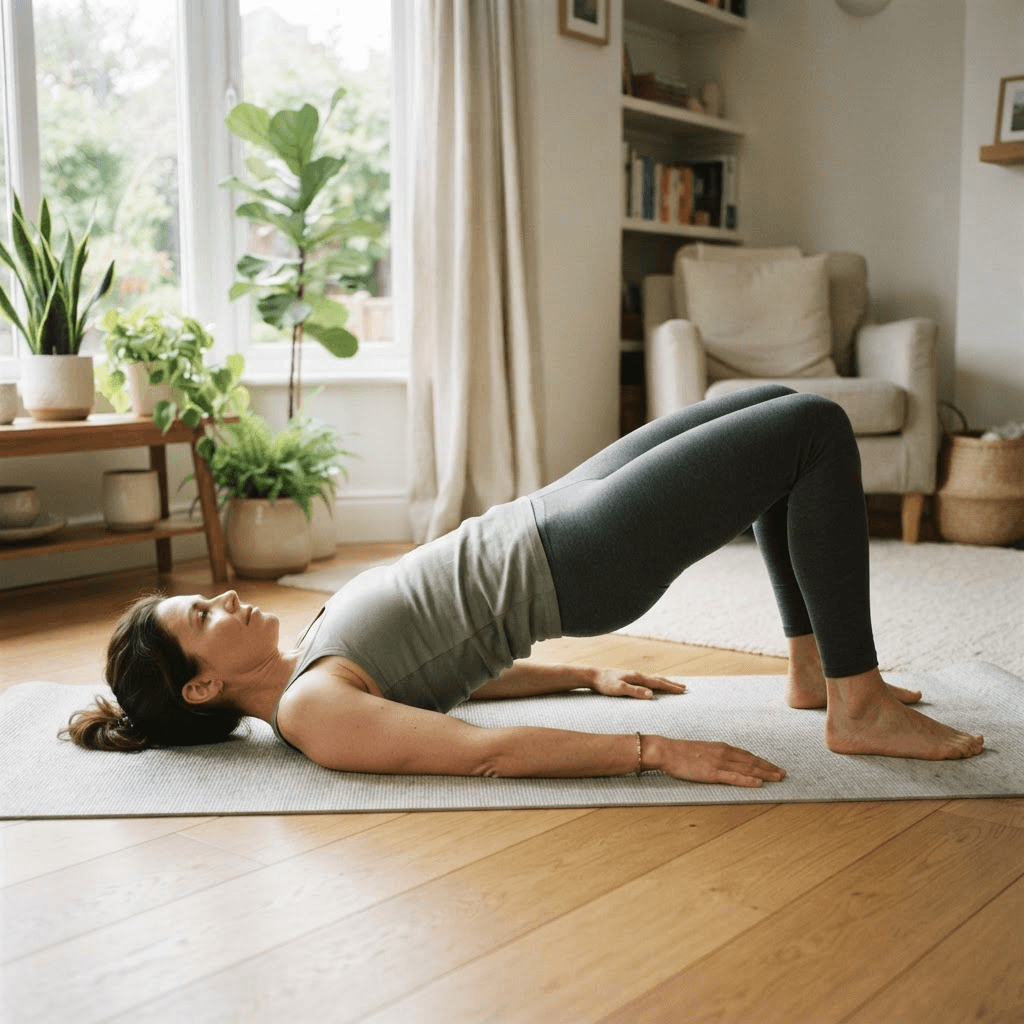
Lie on your back, feet flat and hip-width, heels roughly a hand-span from your backside. Push through your heels and lift your hips until your body forms a straight line from knee to shoulder, then lower slowly. This trains the hip extensors that share load with the knee, and it is one of the very few exercises that almost nobody finds provocative. Three sets of 12, then progress to one leg at a time.
3. Straight leg raise
4. Sit to stand
Sit on a chair, cross your arms, stand up and sit down slowly, taking three full seconds on the way down. This is functional, measurable and directly rehearses the movement most people struggle with. If it hurts, raise the seat with a cushion to reduce the range; as it gets easier, lower it. Three sets of 8 to 10, controlled rather than fast.
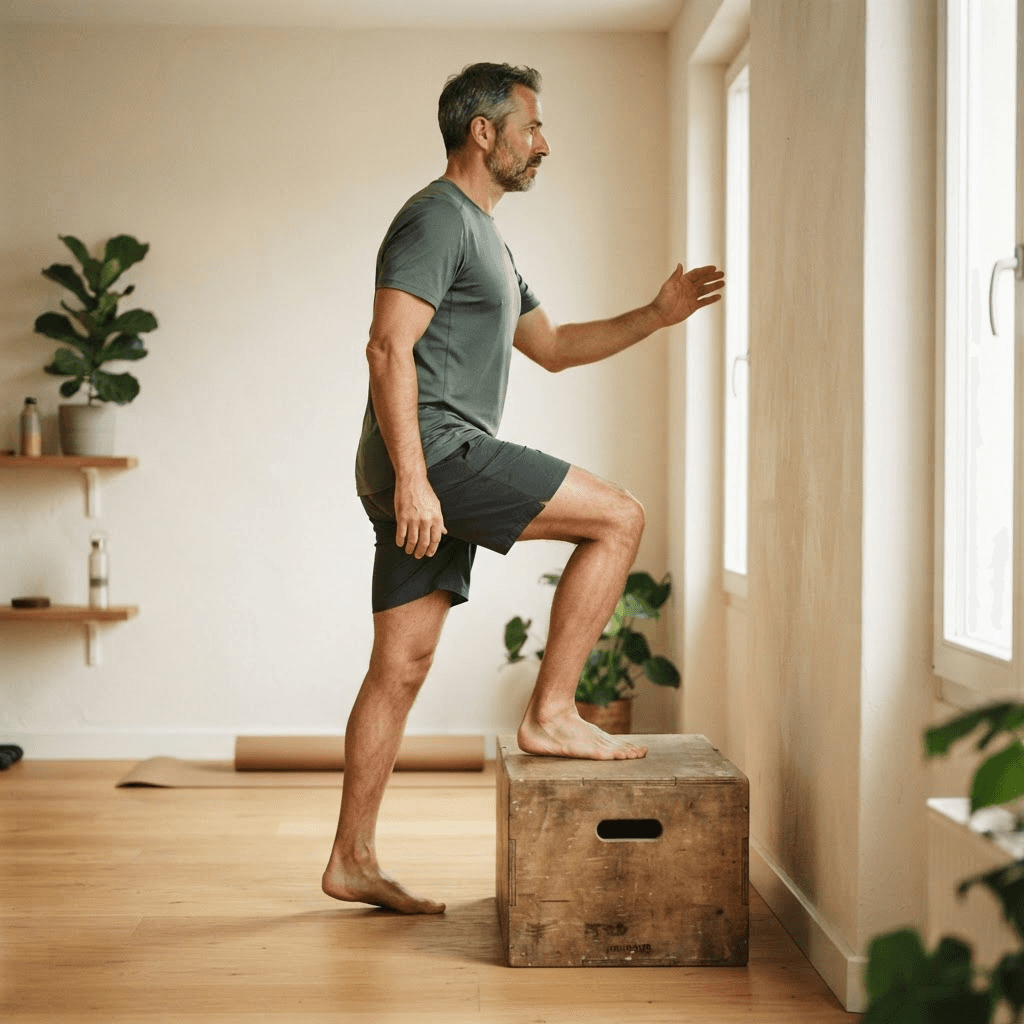
5. Step-up
Use a low step — 15 centimetres is plenty to begin with. Step up, keeping your kneecap tracking over the middle of your foot rather than drifting inwards, then lower yourself back down under control rather than dropping. The lowering half is the point. Hold a rail or wall for balance so you can concentrate on the leg instead of not falling. Three sets of 8 per side.
6. Spanish squat
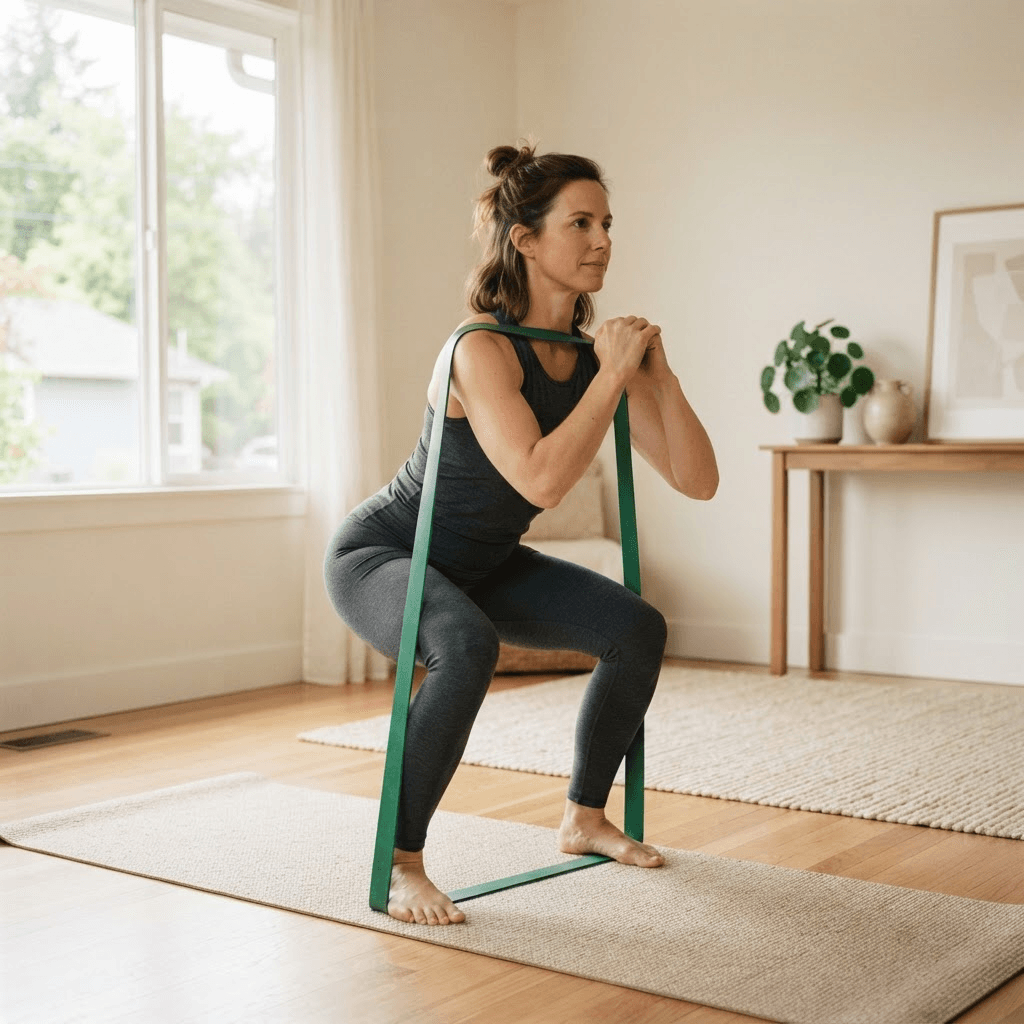
Loop a sturdy resistance band around a fixed post at knee height and around the back of both knees, then step back until the band is taut and sit backwards into a squat, keeping your shins vertical. The band pulls your knees backwards, which lets you load the quadriceps hard while keeping shear force through the joint low. It is my favourite exercise for a knee that is strong enough to work but not yet happy with a normal squat. Four sets of 20 to 45-second holds.
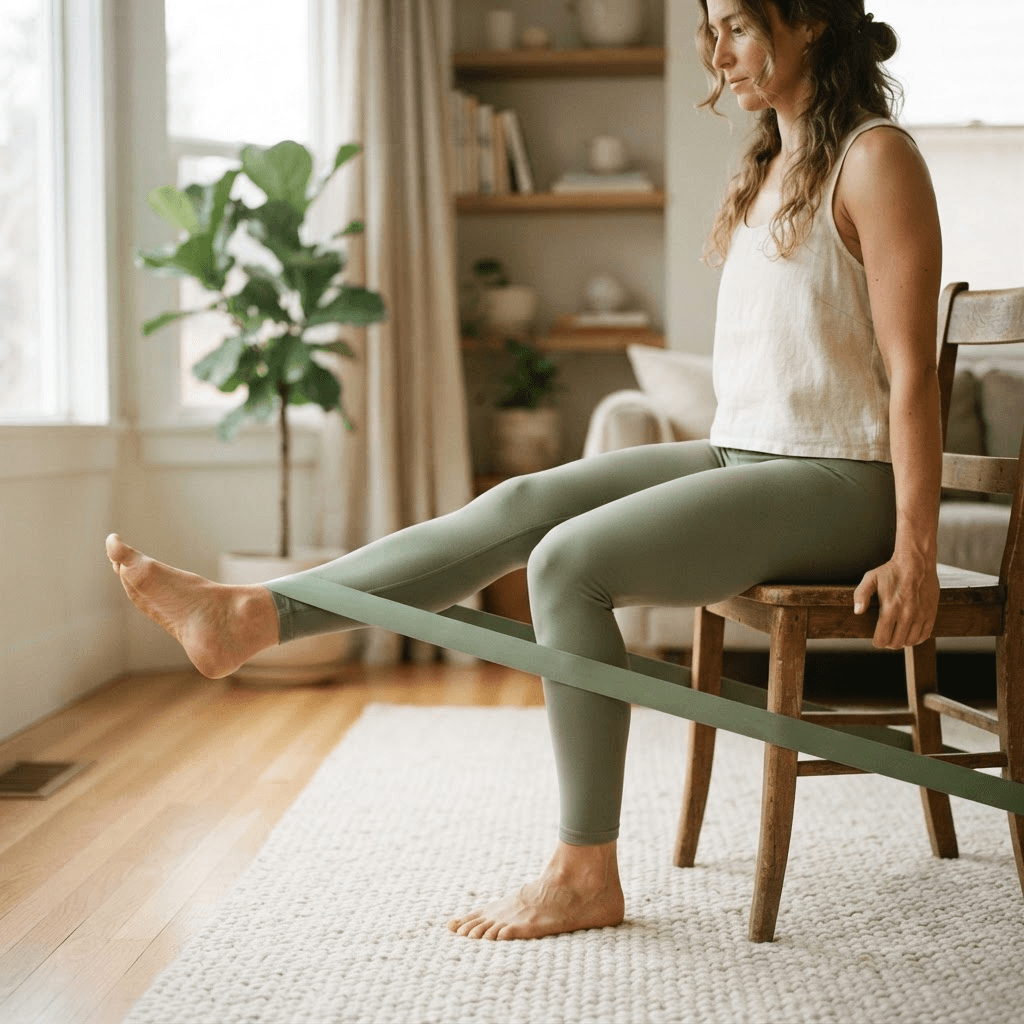
7. Seated leg extension with a band
Sit on a chair with a resistance band anchored behind you and looped around one ankle. Straighten the knee against the band, pause for a second at the top and lower slowly. Long dismissed as a "bad" exercise, controlled leg extension through a comfortable range is one of the most reliable ways to load the quadriceps specifically. Work in whatever range is comfortable — often 90 to 45 degrees rather than full extension. Three sets of 12.
Two or three sessions a week is enough. Muscles adapt during the days between sessions, and an irritable joint often needs a full 48 hours before it is ready to be asked again. Doing this daily is one of the most common ways people stall.
Low impact cardio that does not aggravate your knees
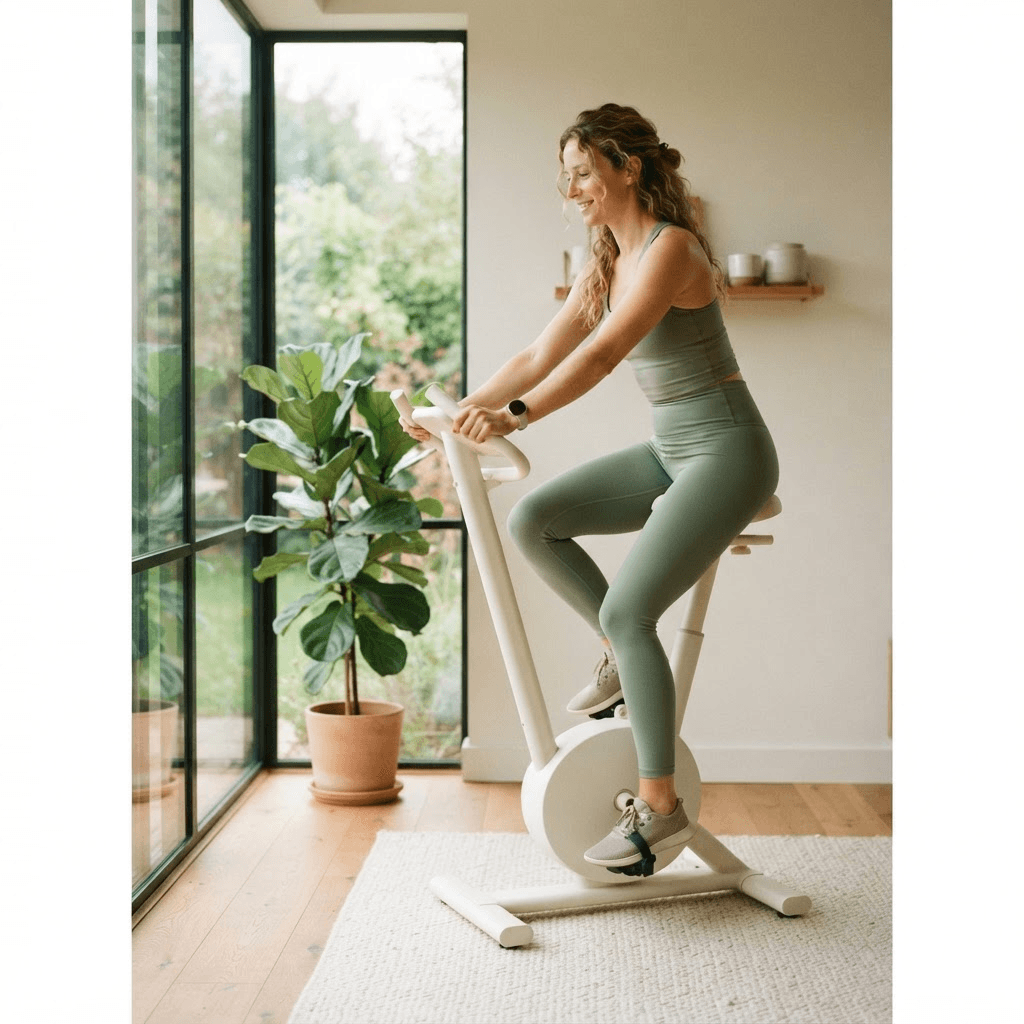
Strength work protects the joint, but you still need something that raises your heart rate — for cardiovascular health, for mood, and because body weight matters to a knee in a very direct mechanical sense. Every kilogram lost removes roughly three to four kilograms of force from the joint with each step, which is one of the few interventions with an effect size large enough that patients feel it within weeks.
| Activity | Joint load | Best for | Watch out for |
|---|---|---|---|
| Stationary cycling | Very low | Almost any knee, including early post-surgical | A saddle set too low forces deep knee bend — raise it until your knee stays slightly bent at the bottom |
| Water walking | Very low | Painful, swollen or arthritic knees | Cold pools can increase stiffness; chest-deep water offloads more than waist-deep |
| Swimming | Very low | Building fitness while the knee settles | Breaststroke kick loads the inside of the knee — use front crawl or a pull buoy |
| Elliptical trainer | Low | People who miss the feeling of running | Keep the stride shallow at first; long strides increase knee flexion angle |
| Level walking | Low to moderate | Daily baseline activity for nearly everyone | Hills and stairs, not distance, are usually what irritates a knee |
| Rowing machine | Moderate | Full body conditioning once strength has improved | The catch position is a deep knee bend — shorten the slide if it pinches |
Water walking deserves a specific mention because it is consistently underused. In chest-deep water you carry roughly a quarter of your body weight, which means you can accumulate 30 minutes of continuous movement that would be impossible on land. For patients with knee osteoarthritis who have lost confidence in walking, it is often the first thing that gives them back a sense of capability — and confidence is not a soft outcome, it is frequently the thing that unlocks everything else.

A four-week low impact plan you can start this week
Run strength work on three non-consecutive days and cardio on most days, including strength days if you have the energy. Nothing here requires a gym. The point of writing it as four weeks is not that you finish in four weeks — it is that four weeks is long enough to see whether the direction is right.
| Week | Strength (3 days) | Cardio | Goal |
|---|---|---|---|
| Week 1 | Wall sit, glute bridge, straight leg raise | 10–15 minutes cycling or water walking daily | Prove to yourself that loading the knee does not make it worse |
| Week 2 | Add sit to stand and low step-ups | 15–20 minutes, add one flat 20-minute walk | Introduce controlled lowering under body weight |
| Week 3 | Add Spanish squats or banded leg extension | 20–25 minutes, increase pace rather than duration | Load the quadriceps harder without adding impact |
| Week 4 | Progress to single-leg bridges and a higher step | 25–30 minutes, add gentle inclines if pain-free | Reintroduce the exact tasks that used to hurt, in small doses |
Week four is the important one and the one people skip. Strengthening in isolation is not the goal — the goal is being able to descend stairs, walk a hill and get off a low sofa without negotiating with yourself first. At some point you have to reintroduce those specific tasks deliberately and in small amounts, rather than waiting until you feel completely fixed and then testing it accidentally on a stairwell.
The pain rules: how much discomfort is acceptable
- The 3 out of 10 rule. On a scale where 0 is nothing and 10 is the worst pain imaginable, discomfort up to about 3 during exercise is acceptable. Working into mild pain does not damage the joint, and insisting on zero discomfort usually means loading too little to change anything.
- The 24-hour rule. What matters far more than how it feels during the set is how it feels the next morning. If your knee is the same or better 24 hours later, the session was appropriate — keep going. If it is clearly worse, reduce the load or range by about 20 percent next time. Not stop. Reduce.
- The trend rule. Judge progress over four weeks, never over one session. Knee pain is naturally variable, and a single bad Tuesday tells you almost nothing. What matters is whether the four-week average is heading in the right direction.
The question is never "did it hurt?" It is "was it worse tomorrow?" Those two questions lead to completely different lives.
Swelling is the one exception worth treating seriously. A joint that visibly swells after a session is telling you something more definite than pain is, and warm, puffy knees deserve a genuine reduction in load and a conversation with a clinician if it keeps happening.
Six mistakes that keep sore knees sore
- Waiting for the pain to go before starting to strengthen. In most cases the strengthening is what reduces the pain, not the other way around, so waiting is simply a longer route to the same work.
- Stretching a knee that needs strength. Stretching feels productive and gives 20 minutes of relief. If the problem is load tolerance, it changes nothing by next week.
- Doing the programme every single day. Adaptation happens between sessions. Daily loading of an irritable joint is how enthusiastic people manufacture a plateau.
- Only training the knee. The hip is at least half the story — weak glutes let the thigh rotate inwards and change how the kneecap tracks. Bridges and side-lying hip work are knee exercises.
- Assuming an arthritis diagnosis means exercise is off the table. Supervised exercise is a first-line treatment for knee osteoarthritis in essentially every clinical guideline published, and it works. Joint changes on a scan do not determine your capability.
- Buying a brace or insole and stopping there. They can be useful short-term for confidence and symptom management, but nothing you wear builds a quadriceps.
What realistic progress looks like
The first two weeks are usually unglamorous. You may feel a little more aware of the knee, not less, as tissue that has not been asked to work in a while starts getting used again. Nothing visible happens, and this is where most people quietly stop. If you can stay with it through this stage without judging the outcome, you have already done the hardest part.
Between weeks three and six, the changes tend to be functional before they are symptomatic. Patients often report that stairs feel less like a decision, or that they got out of the car without thinking about it — while still saying the knee "hurts about the same". That gap is normal, and it is a reliable early sign that things are moving. Strength improves before pain resolves, almost every time.
From weeks six to twelve is where most people get the outcome they actually came for. In the research on exercise therapy for knee pain, meaningful improvements in both pain and function typically show up somewhere in the eight to twelve week window, and the strongest predictor of who improves is not age, weight or scan findings — it is whether the person kept doing the programme. That is an unromantic answer, and it is also the most hopeful one, because unlike your imaging, it is entirely within your control.
References and further reading
The clinical claims above — including the load figures, the pain rules and the treatment timelines — come from published guidelines and peer-reviewed research. These are the primary sources.
- Osteoarthritis in over 16s: diagnosis and management (NG226) — exercise as a core first-line treatmentNational Institute for Health and Care Excellence (NICE)
- ACR/AF guideline for the management of osteoarthritis of the hand, hip and kneeAmerican College of Rheumatology (PubMed)
- Fransen M et al. Exercise for osteoarthritis of the knee — Cochrane systematic reviewCochrane Database of Systematic Reviews (PubMed)
- Smith BE et al. Should exercises be painful? A systematic review and meta-analysis of the acceptability of painful exerciseBritish Journal of Sports Medicine (PubMed)
- Messier SP et al. Weight loss reduces knee-joint loads in overweight and obese older adults with knee osteoarthritisArthritis & Rheumatism (PubMed)
- Osteoarthritis: causes, symptoms and the evidence for exercise therapyNIH National Institute of Arthritis and Musculoskeletal and Skin Diseases
- Patellofemoral pain: consensus statement on exercise therapy and loadingBritish Journal of Sports Medicine (PubMed)
- Knee pain: self-care, red flags and when to seek assessmentNHS (United Kingdom)
Knee pain and exercise common questions answered
What are the best low impact exercises for bad knees?
Start with isometric wall sits, glute bridges and straight leg raises, because they load the muscles around the knee while keeping force through the joint very low. Progress to sit-to-stands, low step-ups and Spanish squats as tolerance improves. Pair them with stationary cycling or water walking for cardiovascular fitness.
Is walking good or bad for knee pain?
Walking on level ground is generally good for knee pain and is one of the most protective habits you can keep. It puts roughly two to three times body weight through the joint, which is well within what a healthy knee tolerates. Hills, stairs and long descents are what typically aggravate symptoms, so manage those rather than reducing your total walking.
Can I strengthen my knees without squats or lunges?
Yes. Straight leg raises, banded leg extensions, glute bridges, wall sits and step-ups all build the quadriceps and hip muscles that protect the knee, and none of them require a deep knee bend. Squats are useful but not essential, and partial-range variations often work well once symptoms settle.
Should I exercise if my knee hurts during the workout?
Discomfort up to about 3 out of 10 during exercise is acceptable and does not indicate damage. The more important signal is the next 24 hours: if your knee feels the same or better the following morning, the session was appropriate. If it is clearly worse, reduce your load or range by around 20 percent rather than stopping altogether.
How long until low impact workouts reduce my knee pain?
Most people notice functional improvements — stairs, getting out of a car, standing from a low chair — between weeks three and six, with meaningful reductions in pain usually appearing between weeks eight and twelve. Strength almost always improves before pain resolves, so early progress can feel invisible.
Is exercise safe with knee osteoarthritis?
Supervised exercise is recommended as a first-line treatment for knee osteoarthritis in current clinical guidelines. It does not accelerate joint wear, and strengthening plus low impact cardio reliably improves pain and function. Scan findings correlate poorly with symptoms, so an arthritis diagnosis is not a reason to stop moving — though it is worth having your programme checked by a physiotherapist.
What exercises should I avoid with bad knees?
Early on, limit deep squatting past roughly 90 degrees, jumping and landing, running on hills or downhill, breaststroke kick and fast unsupported stair descents. None of these are permanently off-limits — they are simply high-load tasks to reintroduce gradually once strength and tolerance have improved.
Vitality Editorial Team
Vitality publishes practical fitness guidance based on cited sources and established public-health recommendations.
Medical disclaimer: This article is educational and general in nature. It is not a diagnosis, prescription or personalised training plan. Speak with a qualified healthcare professional before starting a new exercise programme, particularly if you have an existing condition, injury or are pregnant.