Morning Stretch Routine for Flexibility and Stiff Joints: A 5-Minute Daily Mobility Flow
A five-minute morning mobility flow that loosens tight hips, hamstrings and shoulders before you sit down at a desk for the day — six movements, in order, with the form cues an osteopath actually gives patients.
Key takeaways
- Morning stiffness is usually normal fluid behaviour in your joints, not damage — it should ease within about 30 minutes of moving.
- Move joints through range rather than hanging in long held stretches; before a desk day, motion beats duration.
- Six movements in five minutes cover the spine, hips, hamstrings and shoulders — the four areas sitting punishes most.
- Consistency is what changes range. Five minutes daily outperforms forty minutes on a Sunday, every time.
- Expect easier mornings within about two weeks and measurable range gains between weeks four and eight.
What he actually had was a set of joints that spent twenty-two hours a day in roughly three positions: seated at a desk, seated in a car, and curled on his side in bed. Nothing was damaged. Nothing was inflamed. His hips simply had not been asked to reach full extension in about four years, and his mid-back had not rotated meaningfully since he stopped playing hurling at twenty-four. The stiffness was not a disease. It was a habit his body had learned.
This guide gives you that morning stretch routine in full: what to do, in what order, for how long, and — more importantly — what each movement is actually for. You will also find the mistakes that keep people stiff despite stretching daily, a four-week progression, and clear guidance on when morning stiffness is worth taking to a clinician rather than a yoga mat.
Why you wake up stiff, and why it usually is not arthritis
Your joints are lubricated by synovial fluid, and that fluid behaves a little like honey — it thickens when it sits still and thins when it is moved. Overnight, lying more or less motionless for seven or eight hours, that fluid becomes more viscous and the soft tissue around each joint settles into whatever shape you slept in. When you stand up, your nervous system reads that resistance as stiffness. Move for a few minutes and the fluid thins, the tissues rehydrate slightly, and the sensation fades. This is ordinary physiology, not decline.
Sitting compounds it in a specific and predictable way. When you sit, your hip flexors sit shortened, your hamstrings sit slackened at one end and loaded at the other, your thoracic spine rounds forward, and your shoulders drift into internal rotation. Hold those four positions for eight hours a day, five days a week, and your nervous system quietly reclassifies the outer edges of your range as unfamiliar territory. Ranges you do not visit start to feel unavailable — and a range that feels unavailable is one your brain will resist letting you into.
That distinction matters enormously, because it changes the treatment. If stiffness were purely a length problem in the muscle, hanging in a long static stretch would fix it. In practice, a great deal of what people call tightness is a protective response — the nervous system limiting a range it has not been reassured about lately. This is why gently moving through a range often produces more immediate freedom than gritting your teeth in a two-minute hold, and it is the principle the routine below is built on.
There is also a genuinely mechanical component in people over about forty-five, and it deserves respect rather than alarm. Cartilage becomes slightly less resilient, tendons a fraction less elastic, and connective tissue takes marginally longer to respond. None of that makes you fragile, and none of it is a reason to stop moving. If anything, the research on osteoarthritis has been unusually consistent for two decades now: regular movement improves joint pain and function, while rest reliably makes both worse over time.
Flexibility, mobility and what five minutes can realistically change
A morning routine is aimed squarely at mobility. You are not trying to lengthen tissue at seven in the morning — tissue length changes slowly, over months, in response to loaded stretching at longer ranges. What you are doing is reminding your joints and nervous system that their full range exists, redistributing fluid, and raising tissue temperature slightly so the first hours of your day are not spent moving through treacle.
This is also why I do not ask patients to hold long static stretches first thing. The evidence on stretching before activity is nuanced but broadly consistent: prolonged static holds can temporarily reduce force output and do not reduce injury risk on their own, whereas dynamic movement through range improves subsequent performance and how ready you feel. In the morning, motion is the medicine. Save the longer, more determined holds for the evening, when your tissues are warm and your goal is genuine length change.
Be clear-eyed about the ceiling, too. Five minutes a day will not give you the splits, will not resolve a disc problem, and will not compensate for a total absence of strength work. What it will reliably do is make mornings easier within a couple of weeks, restore ranges you have stopped using, and — in my experience of following patients up — meaningfully reduce the low-grade background aching that desk workers accept as normal. That is a very good return on three hundred seconds.

Five rules that make a five-minute routine actually work
- Move, do not hang. Aim for slow, controlled repetitions or gentle 20 to 30 second holds where you keep breathing and keep exploring the range. If you are gripping, holding your breath and waiting for a stretch to break, you have gone too far and your nervous system will push back.
- Stay at about a four out of ten. You should feel a clear pull and no sharpness at all. Pain in the morning teaches your body that the range is dangerous, which is the exact opposite of what you are trying to communicate.
- Breathe out into the range. A slow exhale genuinely reduces protective muscle tone. Inhale in the neutral position, exhale as you move deeper ��� it is the cheapest mobility technique there is and most people skip it entirely.
- Do it before you sit down, not after. The routine works because it interrupts the transition from eight hours of stillness to eight hours of sitting. Done after your commute, it is worth far less.
- Never negotiate the five minutes down to nothing. On a bad morning, do two of the six movements. A very short routine performed daily outperforms a thorough routine performed on alternate Sundays, and it is not a close contest.
The five-minute morning mobility flow, movement by movement
The order is deliberate. You begin lying down, where your joints are least loaded and your nervous system is least defensive, then progress to all fours, then half-kneeling, then standing. By the time you are upright and folding forward, everything below has already been prepared. Do not rearrange it on the first few mornings — the sequence is doing work you cannot feel.
1. Supine breathing and single knee hug (40 seconds)
How to do it
Stay in bed or lie on the floor with knees bent and feet flat. Take three slow breaths, letting your lower ribs widen sideways rather than your chest rising towards your chin. Then draw one knee gently towards your chest with both hands, hold for two breaths, and lower it. Alternate for four repetitions each side, moving slowly.
What it should feel like
A mild broadening across the lower back and a gentle pull deep in the buttock of the hugged leg. Nothing sharp, and no pinching at the front of the hip. If the front of the hip pinches, you are pulling the knee too far towards the shoulder — steer it slightly wider, towards the same-side armpit instead.
Make it easier
Hold behind the thigh rather than over the shin, especially if you have any knee sensitivity. If reaching the leg at all is a stretch, loop a dressing gown belt around the thigh and hold that.
2. Cat-cow spinal waves (45 seconds)
How to do it
Come onto hands and knees, wrists under shoulders, knees under hips. Exhale and round your spine upward, starting at the tailbone and letting the movement travel segment by segment up towards your head. Inhale and reverse it, arching gently and lifting the breastbone. Eight to ten slow repetitions, taking about four seconds each way.
What it should feel like
A travelling wave rather than a hinge at one spot. Most stiff people move almost entirely from the lower back and barely at all through the mid-back — the whole point is to reclaim the section between the shoulder blades that sitting shuts down. Go slowly enough that you can feel individual vertebrae joining in.
Make it easier
Sore wrists are common in the morning. Make fists and rest on your knuckles, or do the same movement seated on the edge of the bed with hands on your thighs. Painful knees on the floor take a folded towel or a pillow.
3. Thread the needle for thoracic rotation (60 seconds, both sides)
How to do it
From hands and knees, slide your right arm underneath your body along the floor, palm up, letting your right shoulder and the side of your head come towards the ground. Pause for a breath, then reverse the motion and reach the same arm up towards the ceiling, opening the chest and following the hand with your eyes. Five repetitions each side.
What it should feel like
Rotation across the upper and mid-back, and often an unexpectedly satisfying release between the shoulder blades. Keep your hips square and stacked over your knees — if your pelvis swings, you are stealing rotation from the lower back, which already has plenty and needs none of it.
Make it easier
If the floor is unmanageable, do the open-book version instead: lie on your side, knees bent and stacked, arms extended together in front of you, then sweep the top arm in a wide arc across to the other side and let the chest follow. Same effect, no weight through the shoulders.
4. Half-kneeling hip flexor stretch with a posterior tilt (60 seconds, both sides)
How to do it
Kneel on your right knee with your left foot planted well forward, torso tall. Before you move anywhere, tuck your tailbone underneath you — imagine shortening the distance between your pubic bone and your breastbone. Now shift your weight forward two or three centimetres, no more. Hold for four slow breaths, then swap. This is the single most valuable movement in the routine for anyone who sits for a living.
What it should feel like
A strong pull across the front of the right hip and often the front of the thigh. The tailbone tuck is what makes it work: without it, most people simply extend their lumbar spine and feel a satisfying stretch that is happening in the wrong place entirely. If you feel it in your lower back, you have lost the tuck.
Make it easier
Cushion the down knee generously. If kneeling is not an option, stand in a short split stance with your back heel down, tuck the tailbone, and press the hip of the rear leg gently forward — the same joint, worked standing.
5. Standing hamstring sweeps and hinge (45 seconds)
How to do it
Stand with feet hip-width. Push your hips back with a long spine, letting your hands slide down the front of your thighs until you feel your hamstrings engage, then drive the hips forward to stand tall. Six repetitions. Then place one heel slightly forward with a soft knee and sweep your hands towards that foot four times, letting the range grow with each repetition.
What it should feel like
A broad pull along the backs of the thighs that eases as you repeat it. Keep a genuine bend in the knee of the sweeping leg — locking it out turns a hamstring mobilisation into a sciatic nerve tug, which feels sharp, electrical or tingly rather than stretchy. If you feel anything electrical, back off immediately.
Make it easier
Rest your hands on a chair back or the edge of a table and hinge from there. If your lower back is stiff first thing, keep the range small for the first minute and let it open as you warm.
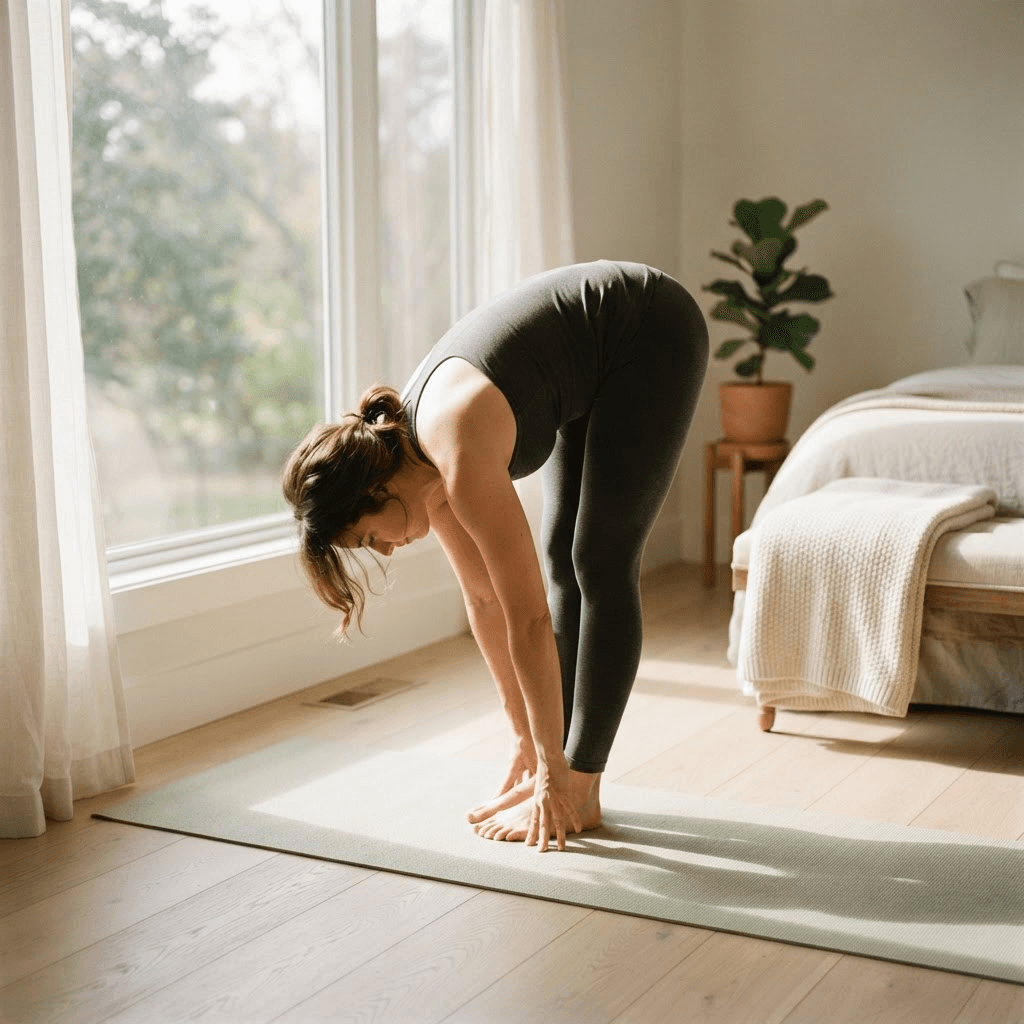
6. Standing chest opener and roll down (50 seconds)
How to do it
Interlace your fingers behind your back, or hold a doorframe at shoulder height, and draw the shoulder blades gently together while lifting the breastbone. Three slow breaths. Then release, reach both arms overhead, and roll slowly down towards the floor one vertebra at a time, letting the head hang and the knees soften. Pause for two breaths at the bottom and roll back up just as slowly.
What it should feel like
An opening across the collarbones and front of the shoulders, then a long, even decompression down the whole back of the body. The roll down is your check on everything you have just done — on a morning when it feels dramatically easier than usual, that is your five minutes working.
Make it easier
Bend the knees generously in the roll down; there is no prize for straight legs. Anyone with dizziness on standing, uncontrolled blood pressure or a history of fainting should skip the head-below-heart position and simply hinge to horizontal instead.
| Order | Movement | Time | Primary target |
|---|---|---|---|
| 1 | Supine breathing and single knee hug | 40 sec | Lower back, glutes, breathing mechanics |
| 2 | Cat-cow spinal waves | 45 sec | Whole spine, especially mid-back |
| 3 | Thread the needle | 60 sec | Thoracic rotation, shoulder blades |
| 4 | Half-kneeling hip flexor stretch | 60 sec | Hip flexors, front of thigh |
| 5 | Standing hamstring sweeps and hinge | 45 sec | Hamstrings, posterior chain |
| 6 | Chest opener and slow roll down | 50 sec | Chest, shoulders, full posterior chain |

Adapting the flow for your worst area
The routine as written is deliberately balanced, but almost nobody is stiff everywhere equally. Once you have run it for a fortnight and know the movements, spend an extra thirty to sixty seconds on whichever section below matches your own particular complaint. Do not add to all of them at once — a nine-minute routine has a much higher desertion rate than a six-minute one.
If tight hips are your main problem
Add a second round of the half-kneeling hip flexor stretch, and this time, once the tailbone is tucked, gently squeeze the glute on the kneeling side. Contracting the muscle opposite the one you are stretching reliably buys extra range, and it also starts teaching your hip to be strong in the position rather than just tolerant of it. A seated figure-four — ankle crossed over the opposite knee, chest leaning forward with a long spine — is worth adding for anyone whose stiffness sits deep in the buttock rather than the front of the hip.
If tight hamstrings are your main problem
Resist the urge to hold longer, and add repetitions instead. Hamstrings in desk workers are usually not short — they are held under low-grade tension all day and they respond far better to repeated movement through range than to determined hanging. Six more sweeps per side, with the knee genuinely soft, will do more in two weeks than a two-minute hold ever does. If your hamstring stiffness comes with tingling, numbness or a line of sharpness down the back of the leg, stop and get it assessed; that is nerve behaviour, not muscle behaviour.
If stiff shoulders and neck are your main problem
Double the thread the needle repetitions and add wall slides: stand with your back to a wall, forearms against it, and slide them slowly up overhead while keeping your ribs down and your lower back from arching. Most desk-related neck stiffness is a mid-back and shoulder-blade problem wearing a neck costume — the neck is simply where you feel the consequences of a thoracic spine that has stopped moving.
If your lower back is the stiffest part
Spend longer at stage one and go gently. Add a supine knee rock — knees bent and together, rocking them slowly side to side a small distance while your shoulders stay down — for thirty seconds before you get onto all fours. Counterintuitively, most people with stiff lower backs need less lumbar movement and more hip and thoracic movement, because the lumbar spine is usually working overtime to compensate for the two regions either side of it. For persistent or recurring lower back pain, the daily mobility work in our guide to low impact workouts for bad knees uses the same principle: address the joints above and below the sore one.

Common mistakes that keep people stiff despite stretching daily
- Stretching into real pain. Discomfort at four out of ten opens range; pain at eight closes it. Pushing into pain triggers a protective contraction, so you finish the stretch tighter than you started and you have taught your nervous system that the range is a threat.
- Holding the breath. Almost everyone does this without noticing. Breath-holding raises muscle tone throughout the body, which means you are actively fighting your own stretch. Long exhales are the mechanism, not a wellness flourish.
- Bouncing at end range. Rapid ballistic bouncing at the very end of your range provokes a reflex contraction and is the one stretching style with a genuine injury record. Controlled movement through range is not the same thing as bouncing.
- Stretching only what already feels tight. The sensation of tightness often appears in muscles that are overworked and lengthened rather than short — upper back and hamstrings are the classic examples. Stretching them feels wonderful and changes nothing, because the actual restriction is somewhere else.
- Never adding strength. Range you cannot control does not stay. Mobility gains hold when you own the new position under load, which is why a couple of strength sessions a week make a stretching routine work far better than more stretching does.
- Chasing novelty. Patients who swap routines every fortnight after seeing a new video make almost no progress. Six movements, every morning, for eight weeks beats sixty movements attempted once each. Boring consistency is the entire mechanism.
- Expecting mobility to fix a strength or posture problem. If you slump because your back gets tired by 3pm, stretching does not address the cause. That is an endurance issue in the postural muscles and it needs loading.
Range you cannot control under load is not mobility you own. It is range you are borrowing.
A four-week progression, and what to expect week by week
People abandon stretching routines because nothing appears to happen and there is no obvious way to progress. So here is a structure, with honest expectations attached. Progress in mobility is real but quiet, and knowing roughly when to expect what is often the difference between week three and week twelve.
| Week | What you do | Time | What you should notice |
|---|---|---|---|
| Week 1 | All six movements, small ranges, learning the cues. Do not chase depth | 5 min daily | Mostly just awkwardness and a sense that mornings are slightly less grim |
| Week 2 | Same six movements, more range, add the exhale deliberately to every rep | 5 min daily | Getting out of bed is noticeably easier. Cat-cow starts to feel smooth |
| Week 3 | Add 30–60 seconds on your stiffest area from the section above | 6 min daily | Real range change in one or two movements. Roll down goes further |
| Week 4 | Add a glute squeeze in the hip flexor stretch and a mid-day desk reset | 6 min daily | The afternoon stiffness that you assumed was permanent starts to lift |
Two measurements are worth taking now, so week eight is not guesswork. First, sit on the floor with legs straight and note where your fingertips reach relative to your toes. Second, sit on a chair with your feet flat and rotate your upper body as far as you can each way, noting the object in the room you can see past your shoulder. Retest both on the same morning of week eight, under the same conditions. Perceived flexibility is unreliable; landmarks are not.
Protecting your five minutes through a desk day
Here is the uncomfortable arithmetic. Five minutes of morning mobility against eight hours of sitting is a losing ratio, and no routine wins it outright. The morning flow makes the first hours of the day dramatically better and, over weeks, restores ranges you had stopped using — but if you then hold one shape until six in the evening, you will be undoing a portion of it daily.

Where mobility ends and the rest of your training begins
I want to be straight with you about the limits of what I have just given you, because the mobility corner of the internet is not always honest about this. A morning stretch routine is a maintenance habit. It restores access to range, it makes your first hours comfortable, and it interrupts the slow narrowing that sitting causes. It is not a training programme and it will not build a body that is resilient to the things that actually cause injuries.
For that you need load. Muscle, tendon and bone adapt to being challenged, and nothing about gentle morning movement challenges them. Two strength sessions a week is the intervention with the deepest evidence base behind it for joint health, bone density and staying capable into your sixties and seventies — and it is what makes mobility gains permanent, because a joint that is strong through a new range stops needing to be reminded that the range exists. If you have never lifted, our 12-week strength training plan for beginners is written for exactly that starting point.
Add walking, protect your sleep, and accept that some mornings will simply be stiffer than others for reasons you cannot identify — a poor night, a cold room, a hard session two days earlier, or a stressful week. Stiffness fluctuates. One bad morning is not a verdict on your progress and it is not a reason to abandon a habit that is working.
What I keep coming back to, after nineteen years and several thousand patients, is how modest the successful cases look from the outside. The people who are still moving well at sixty-five are almost never the ones who found the perfect routine. They are the ones who did something small, most days, for years, and stopped treating their own stiffness as an inevitability to be endured. Five minutes tomorrow morning is a genuinely good place to start.
References and further reading
The physiological and clinical claims in this guide are drawn from peer-reviewed research and national clinical guidance. These are the primary sources so you can read the original findings yourself.
- Physical Activity Guidelines for Americans, 2nd edition — flexibility, balance and muscle-strengthening recommendationsU.S. Department of Health and Human Services
- WHO guidelines on physical activity and sedentary behaviour — reducing and breaking up sedentary timeWorld Health Organization
- Behm DG, Blazevich AJ, Kay AD, McHugh M. Acute effects of muscle stretching on physical performance, range of motion and injury incidence in healthy active individualsApplied Physiology, Nutrition, and Metabolism (PubMed)
- Behm DG, Chaouachi A. A review of the acute effects of static and dynamic stretching on performanceEuropean Journal of Applied Physiology (PubMed)
- Weppler CH, Magnusson SP. Increasing muscle extensibility: a matter of increasing length or modifying sensation?Physical Therapy (PubMed)
- Fransen M et al. Exercise for osteoarthritis of the knee — Cochrane systematic reviewCochrane Database of Systematic Reviews (PubMed)
- Osteoarthritis in over 16s: diagnosis and management — exercise as a core treatment (NG226)National Institute for Health and Care Excellence (NICE)
- Rheumatoid arthritis symptoms, including morning stiffness lasting longer than 30 minutes as an early warning signNHS (United Kingdom)
- Aging changes in the bones, muscles and joints — connective tissue and joint stiffness with ageMedlinePlus, U.S. National Library of Medicine
- Exercise and physical activity guidance for adults, including flexibility and strength recommendationsNHS (United Kingdom)
Common morning stretching questions
How long should a morning stretch routine be?
Five minutes performed daily is the sweet spot for mobility and stiff joints, and it beats a longer routine done occasionally. The purpose of morning stretching is to move your joints through their available range and raise tissue temperature before you sit down, not to lengthen tissue — and that takes minutes, not half an hour. If you have more time, spend it on strength training rather than more stretching, because strength is what makes new range permanent.
Is it better to stretch in the morning or at night?
Both, for different reasons. Mornings suit dynamic movement through range, which relieves overnight stiffness and prepares you for the day. Evenings suit longer, more determined static holds of 45 to 60 seconds, because your tissues are warm and your goal is genuine length change rather than immediate readiness. If you only do one, do the morning routine — it addresses the stiffness you actually feel and it sets up the hours when you are most sedentary.
Why am I so stiff in the morning even though I stretch daily?
The most common reasons are stretching into pain, which triggers a protective contraction, holding your breath, which raises muscle tone throughout the body, and only stretching what already feels tight, which is frequently not where the actual restriction is. A fourth is missing strength work entirely — range you cannot control under load tends not to stay. Some overnight stiffness is also completely normal and simply reflects synovial fluid thickening while you sleep; it should ease within about 30 minutes of moving.
How long should you hold a stretch to improve flexibility?
For morning mobility, favour 8 to 10 controlled repetitions or gentle 20 to 30 second holds where you keep breathing. For genuine length change in the evening, 45 to 60 seconds per position accumulating a few minutes per muscle group per week is the range supported by the research. Holding longer than about 60 seconds in a single stretch offers diminishing returns, and holding until it hurts is counterproductive at any duration.
Should I stretch before or after strength training?
Do dynamic mobility work before lifting and save longer static holds for afterwards or a separate session. Prolonged static stretching immediately before heavy training can temporarily reduce force output, so it makes a poor warm-up on its own. The morning flow in this guide works well as a general warm-up if you train early, followed by a few specific movements for whatever you are about to lift.
How long does it take to become more flexible?
Mornings usually feel easier within about two weeks of daily practice, which is largely your nervous system becoming comfortable with ranges it had stopped visiting. Measurable range change generally appears between weeks four and eight. Take two landmarks at the start — how far your fingertips reach in a seated forward fold, and what you can see past your shoulder when you rotate in a chair — and retest at week eight, because perceived flexibility is unreliable.
Can stretching help stiff joints from arthritis?
Gentle daily movement is one of the core recommended treatments for osteoarthritis in both NICE guidance and Cochrane reviews, and it typically improves pain and function while rest makes both worse. Keep ranges comfortable, expect the first few minutes to be the stiffest, and pair mobility with progressive strengthening for the muscles around the affected joint. Speak to a clinician about your specific joints first, particularly if you have an inflammatory arthritis diagnosis.
When should morning stiffness be checked by a doctor?
See a clinician if stiffness routinely lasts longer than an hour, if joints are swollen, warm or red, if it wakes you in the second half of the night, if it comes with fever, fatigue or unexplained weight loss, or if it affects the small joints of both hands symmetrically. Prolonged morning stiffness is a recognised early sign of inflammatory arthritis, and outcomes are considerably better when it is identified and treated early.
Do I need a mat or any equipment for this routine?
No. The whole routine can be done on a bedroom rug or kitchen floor in whatever you slept in, and the moment a habit requires equipment it becomes negotiable. A folded towel under the knees for the kneeling movements is the only accommodation worth making, and a chair back or doorframe is useful if balance is a concern.
Vitality Editorial Team
Vitality publishes practical fitness guidance based on cited sources and established public-health recommendations.
Medical disclaimer: This article is educational and general in nature. It is not a diagnosis, prescription or personalised training plan. Speak with a qualified healthcare professional before starting a new exercise programme, particularly if you have an existing condition, injury or are pregnant.