How to Lose Weight After 40: What Actually Changes in Your Body — and the Protocol That Works With It
The advice that melted weight off at 30 quietly stops working somewhere in your forties — and almost everyone blames a "slowing metabolism." The data says otherwise. Here is what genuinely changes, decade by decade, and the order to fix it in.
My metabolism has crashed, so nothing works anymore.
Metabolism barely moves from 20 to 60. The real shifts are muscle, hormones and daily movement — all of which you can change.

The decade map
It is not your age that changed. It is these four things.
- 30sThe slow driftMuscle starts to slip and days get more sedentary. The old reset still works — just.
- 40sThe rules rewriteMuscle loss compounds, perimenopause begins for many women, and the two-week diet stops working.
- 50sThe redistributionEstrogen falls, fat moves to the middle, and protecting muscle becomes the whole game.
- 60s+The gradual declineOnly now does metabolism itself dip — about 0.7% a year. Strength keeps you independent.
Here is the moment almost everyone over 40 recognises. You have not changed a thing. Same portions, same weekend runs, the same "eat a bit lighter for two weeks" routine that used to flatten your stomach before a holiday. Except now the scale does not budge, your jeans fit differently around the middle, and the reset that worked like clockwork at 32 does absolutely nothing at 46. It is genuinely disorienting — like the rules were rewritten and nobody sent you the memo.
The memo exists, and it is more hopeful than the version you have probably been told. Losing weight after 40 is not about grinding harder against a metabolism that has "given up." It is about understanding the two or three things that quietly shifted, then changing your approach to match them. Do that, and a midlife body responds beautifully. Ignore it and keep using a 30-year-old's playbook, and you will spend years frustrated for reasons that have nothing to do with effort.
This guide is built as a reckoning followed by a protocol. First we retire the biggest myth. Then we map what actually changes across your forties, fifties and beyond. And then — the part that matters — we put the fixes in the exact order that works, because doing the right things in the wrong sequence is why so many midlife diets collapse.
First, the myth doing the most damage
"My metabolism has slowed down." It is the single most repeated explanation for midlife weight gain, and it is almost entirely wrong. In 2021 a landmark study in the journal Science measured the real energy expenditure of more than 6,400 people from infancy to age 95 using doubly labelled water — the gold-standard method that tracks how much energy a body actually burns as it goes about ordinary life. The finding upended decades of assumption: once you account for body size and muscle, metabolism stays remarkably steady from your twenties all the way to about 60. It does not lurch downward at 30, or 40, or even at menopause.
Read that again, because it reframes the entire problem. If your calorie-burning engine is not slowing in your forties, then the weight gain is coming from somewhere the myth conveniently ignores — and those somewheres are all things you can influence. The myth is comforting in a bleak way, because it hands you an excuse. The truth is better, because it hands you leverage.
So if not metabolism, what actually changed?
Three shifts, working together. None of them are dramatic on any single day, which is exactly why they sneak up on you over a decade.
You have been quietly losing muscle
From your thirties onward, adults shed somewhere between 3 and 8 percent of their lean muscle mass every decade unless they actively train against it — a slow drain that accelerates around menopause. Muscle is metabolically expensive tissue; it costs energy just to exist. So while your metabolism per kilo of muscle has not changed, you are carrying less of the tissue that does the burning. The result looks identical to a "slowing metabolism," but the fix is completely different. You do not need to rescue a broken engine. You need to rebuild the muscle you have been losing.

Your hormones redrew the map
For women, perimenopause and menopause bring a fall in estrogen that does two things at once: it nudges resting energy use down slightly and, more visibly, it redistributes fat away from the hips and thighs and toward the abdomen. This is why women who have never carried weight around the middle suddenly do, sometimes without the scale moving much at all. For men, a gentler, slower decline in testosterone chips away at the drive to maintain muscle. Neither of these is a moral failing or a sign you have "let yourself go." They are predictable biology — and biology responds to the right inputs.
Your day got stiller than you realise
Careers get more sedentary. Injuries accumulate. Kids stop needing to be chased around a garden. The incidental movement that used to burn hundreds of calories a day — the fidgeting, the standing, the walking between things — compresses without any decision on your part. This is called NEAT, and its decline is one of the most underrated drivers of midlife weight gain. The good news is that it is also one of the easiest to reverse.
| What actually shifts | Why it matters | Your lever |
|---|---|---|
| Muscle mass falls 3–8% per decade | Less calorie-burning tissue, weaker, more injury-prone | Resistance training 2–3x a week |
| Estrogen drops (women) | Fat moves to the abdomen; appetite and sleep disrupted | Strength, protein, and a clinician conversation |
| Testosterone declines slowly (men) | Harder to hold muscle and drive | Lifting, protein, adequate sleep |
| Daily movement (NEAT) shrinks | Hundreds of calories quietly disappear from your burn | Steps, standing, walking after meals |
| Recovery and sleep get worse | Higher hunger hormones, more cravings | Sleep protection as a weight-loss tool |
The protocol: fix these in this exact order
This is where most advice fails you. It hands you a diet and tells you to eat less, which for a midlife body is like bailing water without patching the hole. If you drop into an aggressive calorie deficit before you have protected your muscle, a large share of what you lose will be the very tissue keeping your metabolism up — and you will rebound heavier in composition than before. So the sequence below is not arbitrary. Work down it in order. You can layer the next step on before the last is perfect, but do not skip to the bottom.
1. Build and protect muscle before anything else
Two full-body resistance sessions a week is the non-negotiable foundation, and it does not require a gym membership or an hour. Squats, a hip hinge, a push, a pull and a carry — done with dumbbells, bands or your own bodyweight — cover almost everything. If you have never lifted, our strength training for beginners plan walks you through the five movements and a 12-week on-ramp. This single habit is what separates people who lose fat and look leaner from people who lose weight and look softer.
2. Raise your protein — it goes up after 40, not down
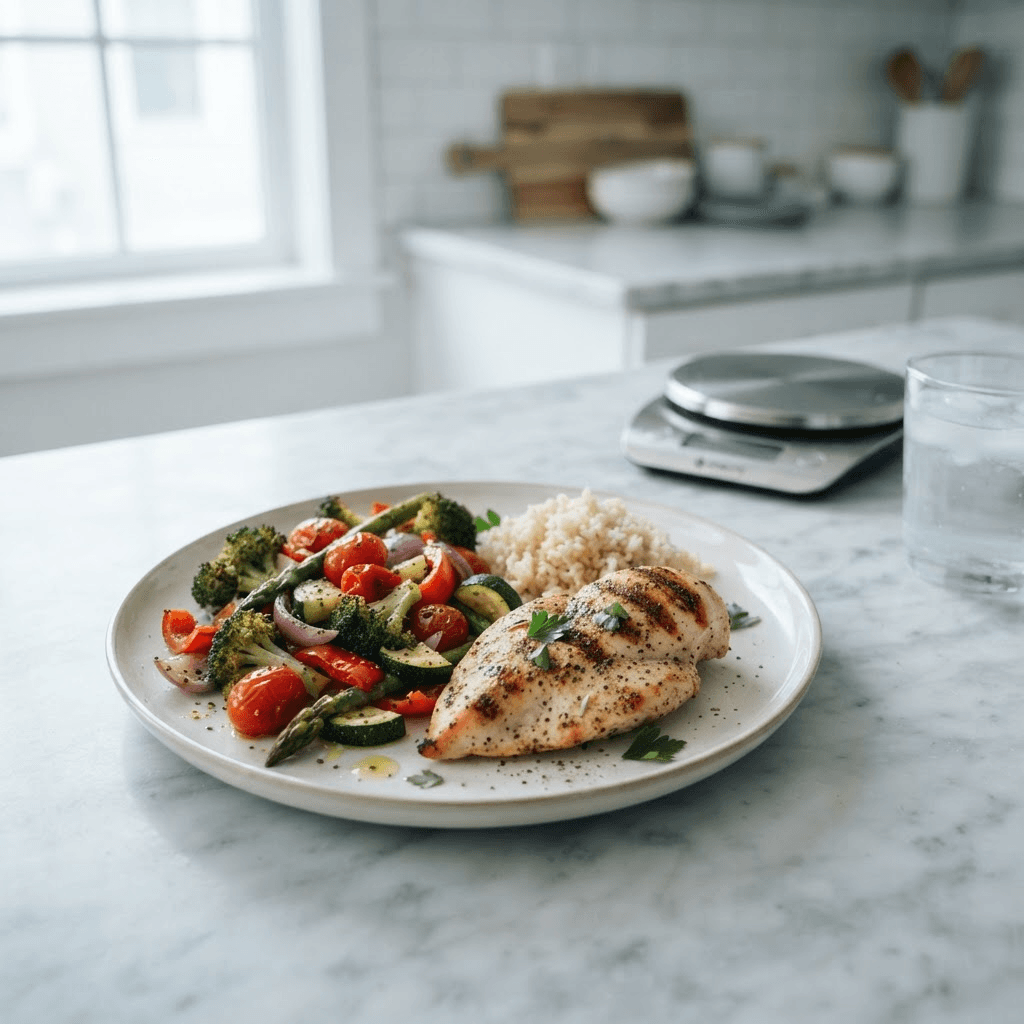
Ageing muscle suffers from what researchers call anabolic resistance: it takes a bigger protein signal to trigger the same muscle-building response you got for free at 25. That means your protein target should climb, not drift down with a shrinking appetite. Aim for roughly 1.6 grams per kilogram of body weight, spread across the day in 25-to-40-gram servings rather than dumped into one dinner. Protein also has the highest satiety of any macronutrient, so it does double duty — it defends your muscle and it makes a modest deficit feel far less punishing. Our high-protein foods list shows how to hit the number without living on chicken breast.

3. Rebuild your daily movement (not just workouts)
This is the cheapest win on the list. Before you add a single workout, reclaim the movement your day quietly lost. A daily step target you can actually hit — most people do well building toward 7,000 to 9,000 — plus a 10-to-15-minute walk after your largest meal will do more for your waistline and your blood sugar than any HIIT class you dread. If your schedule or joints make structured exercise hard, read our guide to walking for weight loss and the steps that matter and build from there.

4. Protect sleep and manage stress — they are weight tools
Skimp on sleep and your hunger hormones tilt against you the very next day: ghrelin (which says eat) rises, leptin (which says stop) falls, and your resolve to skip the biscuit tin evaporates. Midlife is precisely when sleep gets harder — hot flushes, a busier mind, teenagers, ageing parents — so treating sleep as a genuine part of your plan rather than an optional extra is not indulgent. It is strategic. The same goes for chronic stress, which keeps cortisol elevated and steers appetite toward exactly the abdominal fat you are trying to lose.

5. Only now, set a modest, patient deficit
With muscle protected, protein high, movement restored and sleep defended, a calorie deficit finally does what you want it to: strip fat rather than muscle. Keep it gentle — a 300-to-400-calorie daily gap, not the crash cut you might have gotten away with at 25. If the idea of counting feels grim, you do not have to; anchoring each meal around protein and vegetables usually creates the gap on its own. For the arithmetic behind it, our calorie deficit guide explains how to size one you can actually keep.
After 40, you are not fighting your metabolism. You are protecting your muscle. Get that one thing right and almost everything else falls into place.
Why the scale lies to you after 40
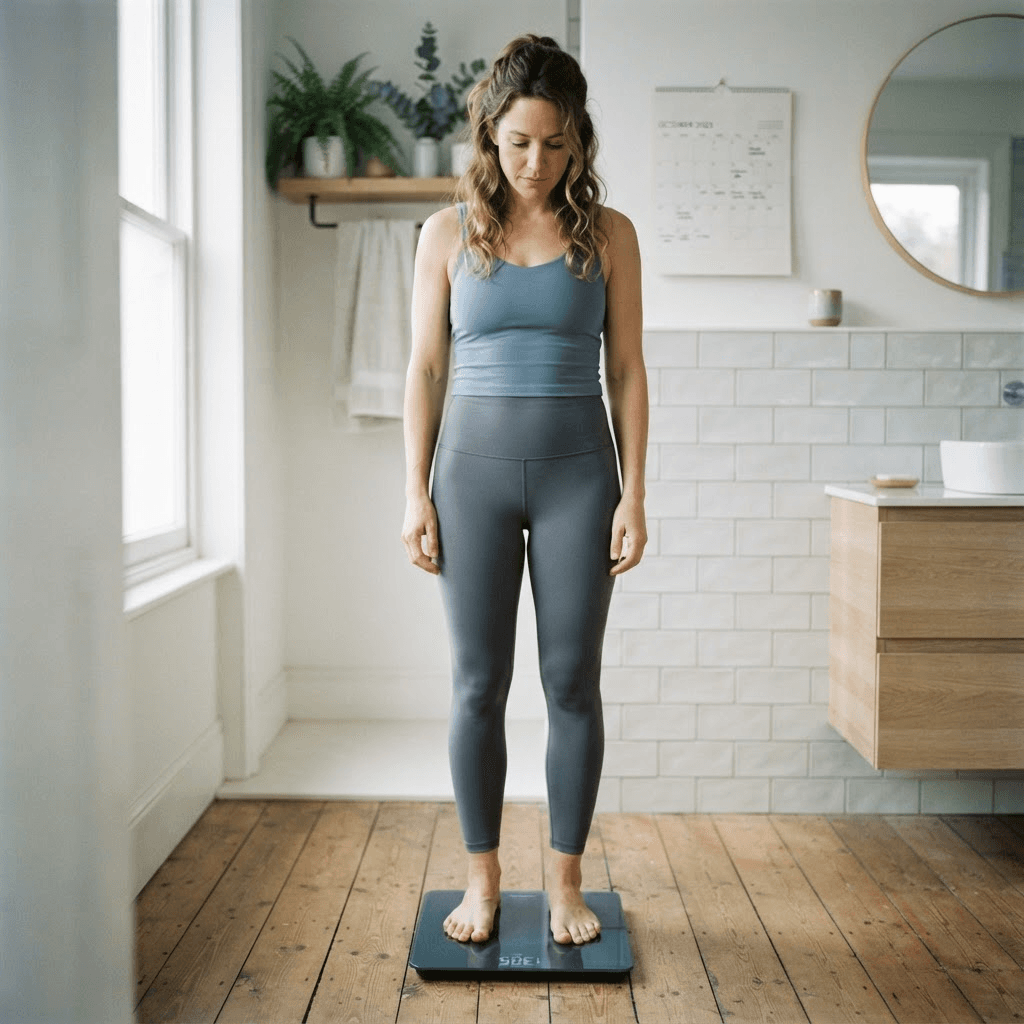
Here is the scenario that derails more midlife plans than any other. Six weeks in, you are lifting, eating well, walking daily — and the scale has barely moved. You conclude it is not working and quit. In reality, something quietly excellent is happening: you are losing fat and gaining a little muscle at the same time, a process called recomposition, and the scale cannot see it. Muscle is denser than fat, so your body can be visibly leaner and firmer while the number stalls or even ticks up.

So stop letting a single number referee your progress. Weigh yourself, if you must, at the same time weekly and watch the four-week trend rather than the daily noise. But give more weight to a tape measure around your navel, to how your waistband fits, and to what you can lift compared with a month ago. If the scale genuinely has not moved in four weeks and your measurements have not either, then — and only then — you have a real plateau to solve, and our guide to breaking a weight-loss plateau covers the fixes in order.
One last reframe worth carrying with you. The habits in this guide are not a temporary diet you endure until a target, after which you go back to normal. They are the new normal — and unlike a crash diet, they get easier, not harder, the longer you hold them. The muscle you build at 45 is the independence you keep at 75. That is a far better reason to lift than any number on a scale.
Sources and further reading
The claims in this guide are grounded in peer-reviewed research and established public-health guidance. Follow the links to read the originals.
- Pontzer et al. (2021), "Daily energy expenditure through the human life course", ScienceScience / AAAS
- Sarcopenia and age-related loss of muscle mass and functionNational Institutes of Health (NIH)
- The menopause transition and changes in body composition and fat distributionNational Institutes of Health (NIH)
- Protein requirements and anabolic resistance in older adultsNational Institutes of Health (NIH)
- Physical activity guidelines for adults aged 19 to 64NHS
Work from the bottom up
The order matters more than the effort
Never skip to the deficit. Each rung rests on the one beneath it — muscle first, the calorie cut last.
- 1Build muscleTwo full-body strength sessions a week. The non-negotiable base.
- 2Raise proteinAround 1.6 g per kg, in 25–40 g servings across the day.
- 3Move all day7,000–9,000 steps and a short walk after your biggest meal.
- 4Protect sleepGuard sleep and stress — they steer hunger the next day.
- 5Then, a gentle deficitOnly now: a modest 300–400 kcal gap. Never before the rest.
Worth remembering
What this comes down to
- Your metabolism is not the villain. Large studies tracking real energy expenditure show it barely moves between 20 and 60 — the honest culprit is what happens to your muscle, hormones and daily movement.
- Muscle is the lever. Adults lose roughly 3 to 8 percent of lean mass per decade after 30, and that loss — not age itself — is what drags your calorie burn down. Protecting it changes everything.
- Fix things in order: build muscle, raise protein, add daily movement, protect sleep, and only then set a modest deficit. Skipping to the deficit is why most midlife diets backfire.
- Protein needs go up, not down. Aim for around 1.6 g per kilogram of body weight to counter the "anabolic resistance" that makes older muscle harder to build.
- For women, perimenopause redistributes fat toward the abdomen even when weight is stable. That is a hormonal shift, not a personal failure, and it responds to strength and protein.
- Go slower on purpose. Aggressive cuts cost you muscle you can no longer easily rebuild, so 0.25 to 0.5 kg a week is the sustainable midlife pace.
Straight answers
Questions people over 40 ask us most about losing weight
Why is it so hard to lose weight after 40?
Not because your metabolism has crashed — large studies show it stays steady until about 60. The real reasons are gradual muscle loss (3 to 8 percent per decade), hormonal changes that shift fat toward the abdomen, and a quiet drop in daily movement. All three respond to strength training, more protein and more everyday activity.
How much protein should I eat to lose weight after 40?
Aim for roughly 1.6 grams per kilogram of body weight per day, spread across the day in servings of 25 to 40 grams. Older muscle is "anabolically resistant," meaning it needs a stronger protein signal to rebuild, so protein needs go up after 40 rather than down.
Is cardio or weights better for weight loss after 40?
Weights come first. Resistance training protects the muscle that keeps your metabolic rate up, which is exactly what is at risk during a midlife deficit. Cardio and daily walking are valuable additions for heart health and extra calorie burn, but if you only have time for one, lift.
How do I lose belly fat after 40, especially during menopause?
Central fat gain in perimenopause is driven largely by falling estrogen, and there is no exercise that spot-reduces it. The effective levers are strength training, higher protein, a modest overall calorie deficit, good sleep and stress management. If symptoms are significant, ask your GP whether hormone therapy is right for you.
How fast should I expect to lose weight after 40?
Slower than in your twenties, and that is intentional. Aim for 0.25 to 0.5 kg a week. Aggressive cuts cost you muscle that is much harder to rebuild at this age, so a patient pace actually produces a better body composition and is far easier to maintain.
The scale is not moving even though I am doing everything right. What is going on?
You are very likely losing fat and gaining muscle at the same time — recomposition — which the scale cannot detect because muscle is denser than fat. Track your waist measurement, how your clothes fit and a monthly photo. Only if those have not changed in four weeks are you looking at a genuine plateau.
Keep reading