Dumbbell Workout Plan at Home: A 6-Week Full Body Routine With Just Two Dumbbells
A practical dumbbell workout plan for training at home with one pair of dumbbells: how to pick the right weight, the six lifts that cover your entire body, six weeks of written progression, and what to do when the only pair you own suddenly feels too light.
Key takeaways
- One pair of dumbbells and a floor is enough to train every major muscle group properly for six months or more.
- Six lifts — a squat, a hinge, a horizontal press, a horizontal pull, an overhead press and a carry — cover your whole body.
- Buy for your weakest lift, not your strongest: most beginners are best served by adjustable dumbbells rather than one fixed pair.
- When the weight stops being heavy, add reps, then slow the lowering, then move to one limb at a time. Do not just do more sets.
- Three sessions a week for six weeks, with the numbers written down, beats any amount of enthusiasm without a record.
That gap is the reason this guide exists. A dumbbell workout plan written for a commercial gym does not survive contact with a spare bedroom, because the entire logic of gym programming is that when a weight gets easy you walk five steps and pick up a heavier one. At home you cannot do that. So the plan has to be built around a different engine, and once it is, a single pair of dumbbells becomes one of the most productive pieces of equipment a person can own.
What follows is the plan I have run with roughly 300 people training in flats, garages, box rooms and one memorable converted garden shed. You will find honest guidance on what weight to actually buy, the six lifts that cover your whole body, a complete six-week programme with the progression written down in advance, and a section on what to do in the very likely event that your dumbbells start feeling light before week six is over. You need two dumbbells, a floor, a wall and a sturdy chair.
Why two dumbbells beat almost everything else at home
The reason is that dumbbells solve the single hardest problem in home training, which is loading your legs. Bodyweight training runs out of upper-body difficulty slowly and gracefully — there is always a harder push-up. Legs are different. Two-legged squats stop building strength for most people somewhere around fifteen or twenty reps, and the fixes involve single-leg balance skills that many beginners simply do not have yet. A pair of dumbbells held at your chest bypasses that entirely. You get to load a squat and a hinge from your very first session.
They also work independently, which matters more than people expect. Each arm and each leg has to produce its own force, so the stronger side cannot quietly carry the weaker one the way it does on a barbell. Almost everyone has a noticeably stronger side, and six weeks of single-arm rows and split squats tends to expose and then narrow that gap. And unlike almost every other option, they store under a bed.
The more common worry is whether relatively light dumbbells can build real muscle. They can. Research comparing lower-load training taken close to the point of failure with heavier, lower-repetition training has repeatedly found similar increases in muscle size when the effort and total work are matched. A 12kg dumbbell taken to a genuinely hard tenth repetition is a productive set. The same dumbbell moved casually for ten easy reps is not. Effort, not the number on the metal, is the variable that most beginners under-supply.
What weight dumbbells should you actually buy?
So if you have not bought anything yet, buy adjustable dumbbells. A pair that spans roughly 2kg to 20kg or 24kg per hand will cover every lift in this plan and most of what you will want to do for the next two years. They cost more than one fixed pair and considerably less than the four or five pairs you would otherwise eventually own, and they take up a fraction of the space.

| Lift | Typical female starting weight | Typical male starting weight | Target reps |
|---|---|---|---|
| Goblet squat (one dumbbell, both hands) | 8–12kg | 12–20kg | 10–12 |
| Romanian deadlift (two dumbbells) | 6–10kg each | 10–16kg each | 8–10 |
| Single-arm row | 6–10kg | 10–16kg | 10–12 |
| Floor press (two dumbbells) | 5–8kg each | 8–14kg each | 8–10 |
| Overhead press (two dumbbells) | 3–6kg each | 6–10kg each | 6–8 |
| Suitcase carry (one dumbbell) | 10–16kg | 16–24kg | 30–40 seconds |
Treat those numbers as a first guess to be corrected in session one, not a prescription. The only test that matters is this: at the last repetition of your first set, you should feel that you had two, perhaps three more in you before form broke down. More than three left over and the weight is too light. Fewer than one and it is too heavy. Adjust immediately rather than grinding through a badly chosen weight for a whole week out of stubbornness.
The six lifts that cover your entire body
Every credible full body dumbbell workout is a rearrangement of the same six jobs. Learn these and you can build your own programmes for the rest of your life. Ignore one and you will develop a hole that eventually shows up as an ache.
1. A knee-dominant squat — the goblet squat
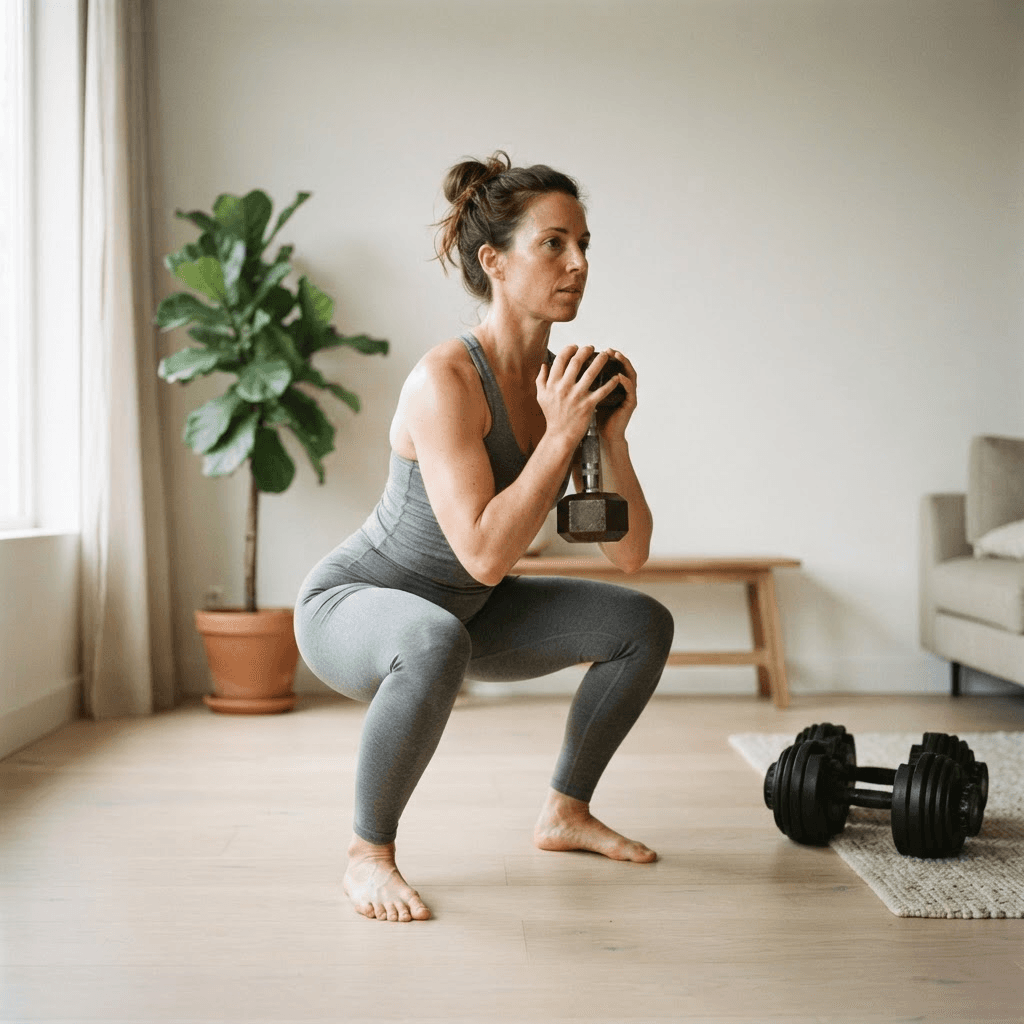
Hold one dumbbell vertically against your chest, elbows tucked under it, and squat as deep as you can while keeping your heels down and your lower back from rounding. The weight at your chest acts as a counterweight, which is why beginners almost always squat deeper and more upright with a dumbbell than without one. This trains your quadriceps, glutes and, quietly, your entire trunk.
2. A hip-dominant hinge — the Romanian deadlift
Holding a dumbbell in each hand in front of your thighs, push your hips backwards and let the weights travel down the front of your legs while your back stays completely flat. Your knees bend slightly and stop bending. Stop when you feel a strong stretch in your hamstrings, usually just below the knee, and drive your hips forward to stand. This is the most valuable and most butchered lift in the plan, which is why it gets its own technique section below.
3. A horizontal press — the floor press
Lie on your back with a dumbbell in each hand, press them up over your chest, then lower until your upper arms rest lightly on the floor. The floor stops you at a safe depth, which is exactly why I prefer it to a bench press for people training alone with no spotter. It trains your chest, front shoulders and triceps.
4. A horizontal pull — the single-arm row
Brace one hand on the seat of a sturdy chair, let your torso come roughly parallel to the floor, and row the dumbbell in your other hand back towards your hip. This is the lift that balances out all the pressing and all the hours you spend at a desk, and it is the one I most often find missing from self-made home routines.
5. A vertical press — the overhead press
Standing tall with a dumbbell at each shoulder, press them overhead until your arms are straight and your biceps are roughly beside your ears. Squeeze your glutes and brace your abdomen so your lower back does not arch to make up for tight shoulders. Expect this to be the lift where the numbers stay smallest and progress slowest. That is normal and not a sign of failure.
6. A loaded carry — the suitcase carry
Hold one dumbbell at your side and walk, resisting the pull that wants to bend you sideways. It looks like nothing. It is one of the most effective trunk exercises available and it transfers directly to carrying shopping, luggage and children. If your space is small, march on the spot or walk a tight figure of eight.
The 6-week dumbbell workout plan
Three sessions a week, alternating between two workouts, with at least one full day of rest between them. Monday, Wednesday and Friday works well, as does Tuesday, Thursday and Saturday. Each session takes 35 to 45 minutes including the warm-up. In week one the order is A, B, A. In week two it is B, A, B. Keep alternating and every lift will land roughly nine times over the six weeks.
Two sessions a week still works. It builds strength more slowly and takes about nine weeks to cover what three does in six, which is a perfectly reasonable trade if three genuinely will not fit your life. Four is unnecessary at this stage. National physical activity guidance asks adults for muscle-strengthening work on at least two days a week, and three full body sessions comfortably clears that bar.
Warm-up, every session (5 minutes)
- 45 seconds of marching on the spot, building to faster knee lifts
- 10 slow arm circles backwards, then 10 forwards
- 8 cat-cow repetitions on hands and knees
- 8 bodyweight squats to a comfortable depth
- 8 hip hinges holding a broom handle or no weight at all, focusing on pushing the hips back
- One set of 5 reps of your first lift with a noticeably lighter weight
Workout A
- Goblet squat — 3 sets of 10 reps, 3 seconds lowering, 90 seconds rest
- Single-arm row — 3 sets of 10 reps per arm, 75 seconds rest
- Romanian deadlift — 3 sets of 8 reps, 3 seconds lowering, 90 seconds rest
- Floor press — 3 sets of 8 reps, 75 seconds rest
- Suitcase carry — 3 sets of 30 seconds per side, 45 seconds rest
Workout B
- Split squat, rear foot on the floor — 3 sets of 8 reps per leg, 90 seconds rest
- Overhead press — 3 sets of 6 reps, 90 seconds rest
- Single-leg Romanian deadlift, one dumbbell — 3 sets of 8 reps per leg, 75 seconds rest
- Two-dumbbell bent-over row — 3 sets of 10 reps, 75 seconds rest
- Dead bug holding one light dumbbell overhead — 3 sets of 8 reps per side

| Week | Sets and reps | What changes | How it should feel |
|---|---|---|---|
| Week 1 | As written above | Nothing. Find your weights and record every one. | Two or three reps left in the tank on every set. |
| Week 2 | Add 1 rep per set to every lift | Reps only. Same weights. | Slightly harder. Form still clean. |
| Week 3 | Add 1 more rep per set | Reps only. Same weights. | The last two reps of each set are genuinely difficult. |
| Week 4 | Return to week 1 reps | Increase the weight on any lift where week 3 felt controlled. | Back to two or three reps in reserve at the new weight. |
| Week 5 | Add 1 rep per set | Reps only. Add a 4th set to the goblet squat and the row. | Working hard. Slightly longer sessions. |
| Week 6 | Add 1 more rep per set | Reps only, then retest your weights at the end of the week. | The hardest week. Then you start again from new numbers. |
Write down the weight, the sets and the reps you actually completed after every single session. Not what the plan said — what happened. This takes twenty seconds and it is the difference between a programme and a sequence of workouts. Progressive overload is invisible without a record, and people who train without one consistently overestimate how much they have progressed while accidentally lifting the same weight for months.
What to do when your dumbbells get too light
This is the specific problem that home training creates and gyms do not, and it arrives fastest on the goblet squat and the row. If you own a fixed pair, or you have reached the top of your adjustable set, you still have four levers before you need to buy anything. Pull one at a time and only after two consecutive sessions where you hit the top of your rep range with clean technique.
- Reps — climb from 10 to 20 on lower-body lifts and from 8 to 15 on upper-body lifts before considering anything else. Sets taken close to failure at higher repetitions build muscle comparably to heavier sets.
- Tempo — slow the lowering phase from 3 seconds to 4, then 5. A five-second lowering phase turns a comfortable goblet squat into a deeply unpleasant one without adding a gram.
- Leverage and limbs — move from two legs to one. A split squat, then a rear-foot-elevated split squat, then a step-up onto a chair each roughly double the load on the working leg with the same dumbbells.
- Range and position — squat to a deeper depth, press from a deeper floor press position, or hold the dumbbells in a front-rack position at your shoulders instead of by your sides during squats to shift the demand.
Density is a fifth option — the same work with shorter rest — and I list it last deliberately. It makes sessions harder and conditioning better, but it buys less strength than the other four. If you want a conditioning stimulus, get it from a separate session rather than by compressing your strength work. Two or three easy walks or zone-based rides a week do that job without interfering with recovery.
The honest ceiling: with a 20kg-per-hand adjustable set and disciplined use of the four levers, most beginners get twelve to eighteen productive months before equipment genuinely limits them. At that point the next purchase is usually a single heavier kettlebell or a barbell, and by then you will know exactly why you want it.
Technique notes on the two lifts that go wrong most
The Romanian deadlift
Roughly seven out of ten beginners turn this into a squat with straight arms, bending the knees and dropping the hips instead of pushing the hips backwards. The fix is a wall. Stand with your feet about fifteen centimetres from a wall, facing away from it, and hinge until your backside touches the wall. That backwards travel is the movement. Once you can find the wall consistently, step forward slightly and repeat until touching it requires a real effort to reach.
The second error is chasing depth. The dumbbells should stop where your hamstring stretch stops, which for most people with average flexibility is somewhere between mid-shin and just below the knee. Going lower does not train more muscle; it trains your lower back to round under load, which is the one thing worth being genuinely careful about here.

The floor press and the overhead press
On the floor press, keep your upper arms at roughly forty-five degrees from your torso rather than flared straight out to the sides. Flared elbows put the front of the shoulder in its least comfortable position and reduce how much your chest contributes. The floor gives you a consistent stopping point, so use it — touch down lightly, pause for a beat, then press.
On the overhead press, the tell-tale error is the lower back arching backwards into a small bridge as the weights go up. That almost always means the weight is too heavy or your shoulders lack the range to get overhead. Squeeze your glutes hard, brace as though you are about to be poked in the stomach, and if the arch still appears, drop the weight or press from a seated position on the floor with your back against a wall. Some daily shoulder and thoracic mobility work usually resolves the range problem inside a month.

- Buying one fixed pair. The weight that challenges your legs will bury your shoulders. Adjustable dumbbells solve this for roughly the price of two fixed pairs.
- Training every day because the dumbbells are right there. Muscle is built during the 48 hours after a session, and removing that window removes most of the benefit.
- Skipping the hinge because it feels awkward. The Romanian deadlift trains the entire back of your body and nothing else in this plan replaces it. Learn it against a wall.
- Adding sets instead of difficulty. Six sets of an easy weight is a long, tiring way to achieve less than three hard sets. Pull the reps, tempo and leverage levers first.
- Never writing anything down. Almost everyone who tells me they have stalled turns out to have been lifting the same weight for eleven weeks without realising it.
- Ending every set breathless from short rest. That is conditioning wearing a strength training costume. Take the full 75 to 90 seconds.
- Under-eating protein and then blaming the programme. Around 1.6g per kilogram of body weight per day is the point where the research shows added benefit levelling off, and most beginners land well below it.
What to expect over six weeks
Weeks one and two feel deceptively easy on the lifts and unexpectedly hard the following morning. Some muscle soreness after your first two or three sessions is normal, particularly in your hamstrings and glutes after the hinges, and it should reduce substantially by the third session. Soreness that lasts more than four days, or any sharp pain during a lift rather than after it, means back off and reassess rather than push on.
By the end of week three most people are lifting noticeably more repetitions at the same weight, which is your nervous system becoming efficient rather than new tissue. That is a real and valuable adaptation, and it is why week four asks you to raise the weight instead. Visible change generally arrives somewhere between weeks five and ten, and it usually shows up first as shoulders and arms looking firmer and clothes fitting differently, rather than as a change on the scale.
References and further reading
The training and nutrition recommendations above draw on peer-reviewed research and national clinical guidance. These are the primary sources.
- Physical Activity Guidelines for Americans, 2nd edition — muscle-strengthening activity recommendations for adultsU.S. Department of Health and Human Services
- WHO guidelines on physical activity and sedentary behaviour — twice-weekly muscle-strengthening recommendationWorld Health Organization
- Schoenfeld BJ et al. Effects of low- versus high-load resistance training on muscle strength and hypertrophyJournal of Strength and Conditioning Research (PubMed)
- Schoenfeld BJ et al. Dose-response relationship between weekly resistance training volume and increases in muscle massJournal of Sports Sciences (PubMed)
- Morton RW et al. Systematic review and meta-analysis of protein supplementation on resistance training-induced gains in muscle mass and strengthBritish Journal of Sports Medicine (PubMed)
- ACSM position stand: progression models in resistance training for healthy adultsAmerican College of Sports Medicine (PubMed)
- Strength and flexibility exercise guidance for adults, including safe starting pointsNHS (United Kingdom)
- Adult physical activity basics — recommended weekly amountsCenters for Disease Control and Prevention
Common dumbbell training questions
What weight dumbbells should a beginner buy for home workouts?
Buy adjustable dumbbells spanning roughly 2kg to 20kg or 24kg per hand rather than one fixed pair. The weight that challenges your legs on a goblet squat is two to three times the weight you can press overhead, so a single fixed pair is either too light for your lower body or too heavy for your shoulders. If you must buy fixed, choose the heaviest weight you can press overhead for eight hard repetitions and use tempo and single-leg variations to make your leg work difficult.
Can you build muscle with only dumbbells at home?
Yes. Muscle responds to mechanical tension produced by sets taken close to failure through a challenging range of motion, and it does not care whether the resistance comes from a dumbbell, a barbell or a machine. Studies comparing lower-load and higher-load training with effort matched find broadly similar increases in muscle size. The real limitation at home is running out of load on lower-body lifts, which this plan addresses with single-leg variations, slower lowering phases and higher repetition ranges.
How many days a week should I do a full body dumbbell workout?
Three sessions a week with a rest day between them is the sweet spot for a beginner and comfortably exceeds the twice-weekly muscle-strengthening recommendation in national physical activity guidance. Two sessions a week still builds strength and takes roughly nine weeks to cover what three does in six. Training every day is the most common self-inflicted mistake, because the adaptation happens in the 48 hours after a session.
What do I do when my dumbbells become too light?
Pull four levers in order, one at a time. Add repetitions first, climbing to 20 on lower-body lifts and 15 on upper-body lifts. Then slow the lowering phase from three seconds to five. Then move from two limbs to one, using split squats, rear-foot-elevated split squats and step-ups. Then change range or position, such as holding the dumbbells at your shoulders instead of your sides. Only change one variable at a time, otherwise you cannot tell what worked.
Do I need a bench for a dumbbell workout at home?
No. This plan uses the floor press instead of a bench press, which is safer when you are training alone with no spotter because the floor sets a consistent depth and stops the weight travelling too far. A sturdy dining chair covers the single-arm row and step-ups. A bench is a nice addition later for incline pressing and rear-foot-elevated split squats, but it is an upgrade rather than a prerequisite.
Are dumbbells or kettlebells better for training at home?
Dumbbells are the better first purchase for most people because they cover pressing, rowing, squatting and hinging with straightforward technique, and a pair loads both sides evenly. Kettlebells excel at swings, cleans and snatches, which are outstanding for conditioning but demand a well-learned hip hinge first. A reasonable path is a pair of adjustable dumbbells now and one kettlebell later once your hinge is solid.
How long before I see results from a dumbbell workout plan?
Strength and repetition numbers usually improve within two to three weeks as your nervous system becomes more efficient at the movements. Visible change generally appears between weeks five and ten, most often as firmer shoulders and arms and clothes fitting differently rather than a change on the scale. A realistic first-year rate of muscle gain is roughly 0.25 to 0.5kg per month when protein sits near 1.6g per kilogram of body weight and you sleep seven to nine hours.
Is a full body dumbbell workout enough, or do I need cardio too?
You need both, and you should keep them separate. This plan covers strength. Add two or three easy walks, rides or low-impact interval sessions a week for cardiovascular health, on your non-lifting days where possible. Combining strength and conditioning into one breathless dumbbell circuit tends to compromise both, because you finish exhausted without having properly trained either system.
Vitality Editorial Team
Vitality publishes practical fitness guidance based on cited sources and established public-health recommendations.
Medical disclaimer: This article is educational and general in nature. It is not a diagnosis, prescription or personalised training plan. Speak with a qualified healthcare professional before starting a new exercise programme, particularly if you have an existing condition, injury or are pregnant.