Sheet-Pan Chicken and Vegetables: The One-Tray Healthy Family Dinner
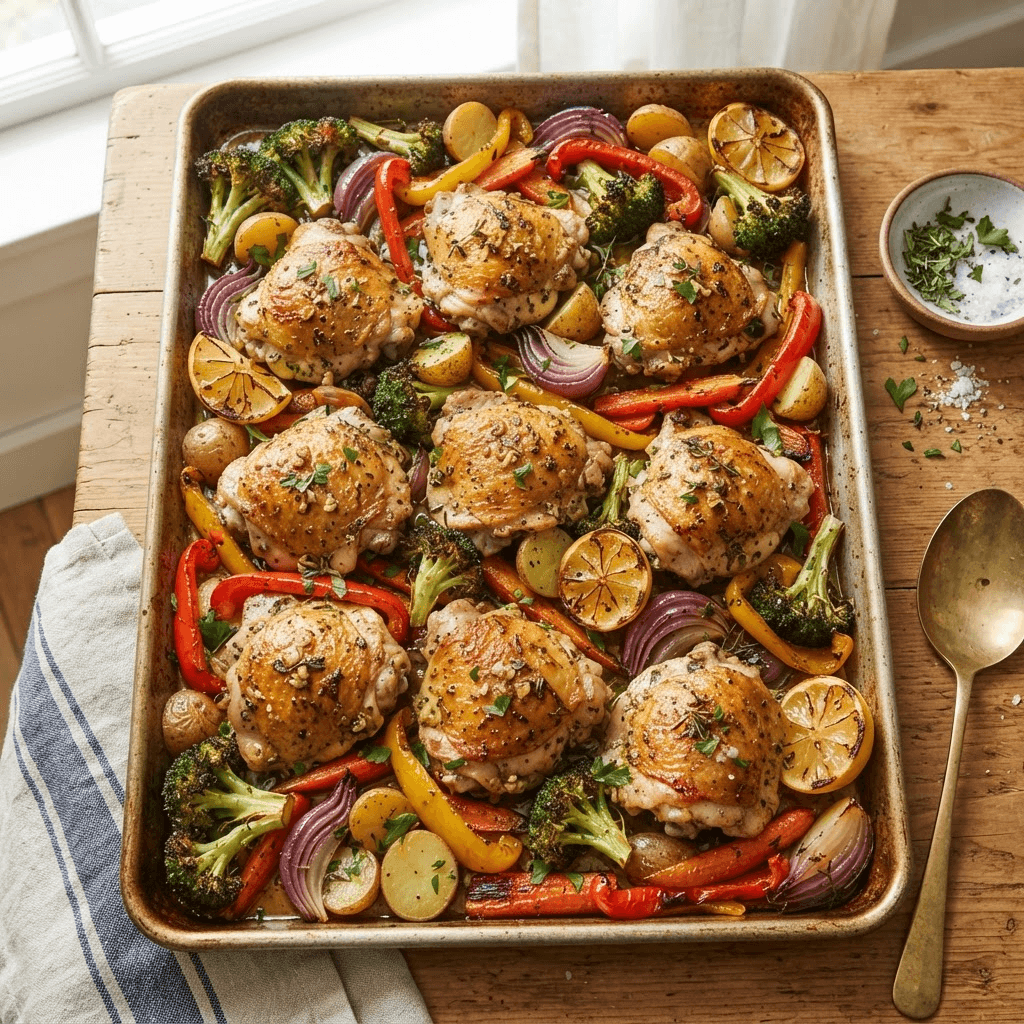
One tray, one hot oven, forty-five minutes: garlic-herb chicken and rainbow vegetables that feed a family of four without a separate kids menu—and without a sink full of pans.
- Total
- 45 minutes
- Oven
- 425°F (220°C)
- Feeds
- 4 servings (one large sheet pan)
- Protein
- about 38 g per serving
It is 6:02 p.m. Someone in your house has just announced they are "starving" for the third time, homework is half-finished on the kitchen table, and the last thing you have energy for is a recipe with a mise en place photo shoot and four dirty pans. This is the meal for that exact evening. You chop, you toss, you roast, and dinner arrives on a single tray that your family can actually agree on.
Sheet-pan chicken and vegetables works because it hides almost nothing. There is no sauce to split, no fussy technique, and no separate "kid version" simmering on the stove. Everything roasts together in one hot oven, then gets plated to suit each person at the table. Below is the full recipe, but more usefully, here is exactly how to make it turn out browned instead of soggy—and how to get a seven-year-old to eat a bell pepper without a negotiation.

The one rule that decides everything: heat the pan first
If you remember nothing else, remember this. Slide your empty sheet pan into the oven while it preheats to 425°F (220°C). When the vegetables hit metal that is already blazing, the surface sears on contact and the natural sugars caramelize. When they hit a cold pan, they release water, sit in it, and steam. That single choice is the line between vegetables kids fight over and vegetables that end up in the bin.
The second half of the same rule is space. Crowding traps steam just as effectively as a cold pan. Every piece of food needs a little bare metal around it. If your tray looks packed, it is packed—split the load across two pans on two racks and rotate them halfway. A slightly emptier tray always beats a beautiful, overloaded one.
The staggered roasting order (the part most recipes skip)
Think of the tray in two waves. Wave one is the slow, dense stuff—potatoes and carrots—which needs a head start. Wave two is the chicken and the quick vegetables, which all finish in about twenty minutes. Line up the two waves and everything crosses the finish line together, perfectly done at the same moment.

The oven schedule
Two waves, one finish line
Tape this to the inside of a cupboard. It is the entire recipe compressed into four moves.
| Timer | Do this | Why it matters |
|---|---|---|
| 0:00 | Potatoes + carrots go in alone The densest vegetables need a 10-minute head start or they stay hard in the middle. | The densest vegetables need a 10-minute head start or they stay hard in the middle. |
| 10:00 | Add chicken, peppers, broccoli, onion These cook in about 20 minutes, so they arrive on the same finish line as the potatoes. | These cook in about 20 minutes, so they arrive on the same finish line as the potatoes. |
| 30:00 | Pull the tray, check 165°F Broccoli edges should be crisp-brown and the chicken juices should run clear. | Broccoli edges should be crisp-brown and the chicken juices should run clear. |
| 35:00 | Rest, squeeze lemon, serve Five minutes of rest keeps the chicken juicy and lets you set the table. | Five minutes of rest keeps the chicken juicy and lets you set the table. |
How to make it kid-approved without cooking twice
A "healthy family dinner recipe kids will actually eat" is rarely about the food being magically irresistible. It is about lowering the friction. The two biggest wins are keeping components separate on the plate and letting the safe food (usually the potatoes or the chicken) be the anchor while new vegetables sit alongside in tiny, pressure-free amounts.
Research on child feeding is consistent and a little humbling: repeated, low-stakes exposure to a food does far more than pressure ever will. It can take many neutral encounters before a child accepts a new vegetable, so a single rejected floret is not failure—it is one data point in a long, boring, effective process. Keep serving it. Keep the pressure off. That is the whole strategy.
What they say vs. what you do
"The vegetables are touching my chicken."
Roast on the same tray, but plate separately. Same food, zero negotiation.
"It looks burnt."
Caramelized edges read as "burnt" to kids. Pull a few lighter pieces from the center of the tray for their plate.
"I only like the potatoes."
Let that be a win this week. Keep offering one new vegetable in a tiny, no-pressure portion next to the safe food.
"It is too spicy."
Skip the paprika on one corner of the tray and season that section with just salt and a little butter.
The recipe, step by step
The full ingredient list, quantities and method are in the recipe card below. Read the five steps once before you start so the ten-minute head start does not catch you mid-chop. Then it is genuinely hands-off—the oven does the cooking while you referee homework.

Garlic-herb sheet-pan chicken & veg
One tray, four servings, forty-five minutes from cutting board to table.
Ingredients
The protein
- 8 boneless, skinless chicken thighs (about 2 lb / 900 g)
- 2 tablespoons olive oil
- 3 garlic cloves, minced
- 1 teaspoon smoked or sweet paprika
- 1 teaspoon dried oregano
- 3/4 teaspoon fine salt, plus more to taste
- 1/2 teaspoon black pepper
The tray of vegetables
- 1 lb (450 g) baby potatoes, halved
- 2 carrots, cut into 1/2-inch coins
- 1 red bell pepper, cut into wide strips
- 1 yellow bell pepper, cut into wide strips
- 1 small head broccoli, cut into florets
- 1 red onion, cut into thick wedges
- 1 tablespoon olive oil
- 1 lemon, cut into wedges, for serving
Method
- 1
Heat the oven high, and heat the pan with it
Set the oven to 425°F (220°C) and slide the empty sheet pan onto the middle rack while it warms. A hot pan is the difference between roasted vegetables and steamed ones.
Look for: Wait for a true, fully preheated oven; the indicator light going off is your green light.
- 2
Season the chicken in the bowl you already dirtied
Toss the thighs with 2 tablespoons olive oil, garlic, paprika, oregano, salt and pepper until every piece is coated. Two minutes of hands-on work, no marinating required.
Look for: The thighs should look glossy and evenly flecked with seasoning, not dry in patches.
- 3
Start the slow vegetables first
Toss potatoes and carrots with 1 tablespoon oil and a pinch of salt. Carefully spread them on the hot pan and roast for 10 minutes before anything else joins them.
Look for: Listen for a sizzle when they hit the pan; silence means the pan was not hot enough.
- 4
Add the chicken and the rest of the vegetables
Pull the pan out, push the potatoes aside and nestle in the chicken, peppers, broccoli and onion in a single layer. Return to the oven for 20 to 22 minutes.
Look for: Everything needs breathing room; if the pan is crowded, split across two trays.
- 5
Check temperature, then rest and squeeze
The tray is done when the chicken reaches 165°F (74°C) at its thickest point and the vegetable edges are browned. Rest 5 minutes, then finish with a squeeze of lemon.
Look for: Use a thermometer, not color; thighs stay juicy well past the point where they look done.
calories
approximately 470 kcal
protein
approximately 38 g
carbohydrates
approximately 34 g
fiber
approximately 7 g
fat
approximately 20 g
Estimated per serving; values vary by cut, oil and what you serve alongside.
Change it every week without changing the method
The reason this earns a permanent slot in the rotation is that the technique stays identical while the ingredients rotate with the season and the sale rack. Learn the two-wave timing once and you can swap the protein and produce endlessly. The swap chart in the card keeps the timing honest: match each new ingredient to the wave it belongs in.
The swap chart
| Use this | Instead of | Timing note |
|---|---|---|
| Chicken breast or drumsticks instead of Chicken thighs | Chicken thighs | Breast cooks faster—add it with the second wave and pull at 165°F. Drumsticks need the full time. |
| Chickpeas or firm tofu instead of Chicken | Chicken | For a vegetarian tray: roast alongside the vegetables; pat tofu very dry first for browning. |
| Sweet potato, squash, green beans instead of Any listed vegetable | Any listed vegetable | Match the timing tier: dense roots with the potatoes, quick vegetables with the second wave. |
| Sausage, salmon, or shrimp instead of Chicken | Chicken | Salmon needs about 12 minutes and shrimp about 8, so add them near the end of roasting. |
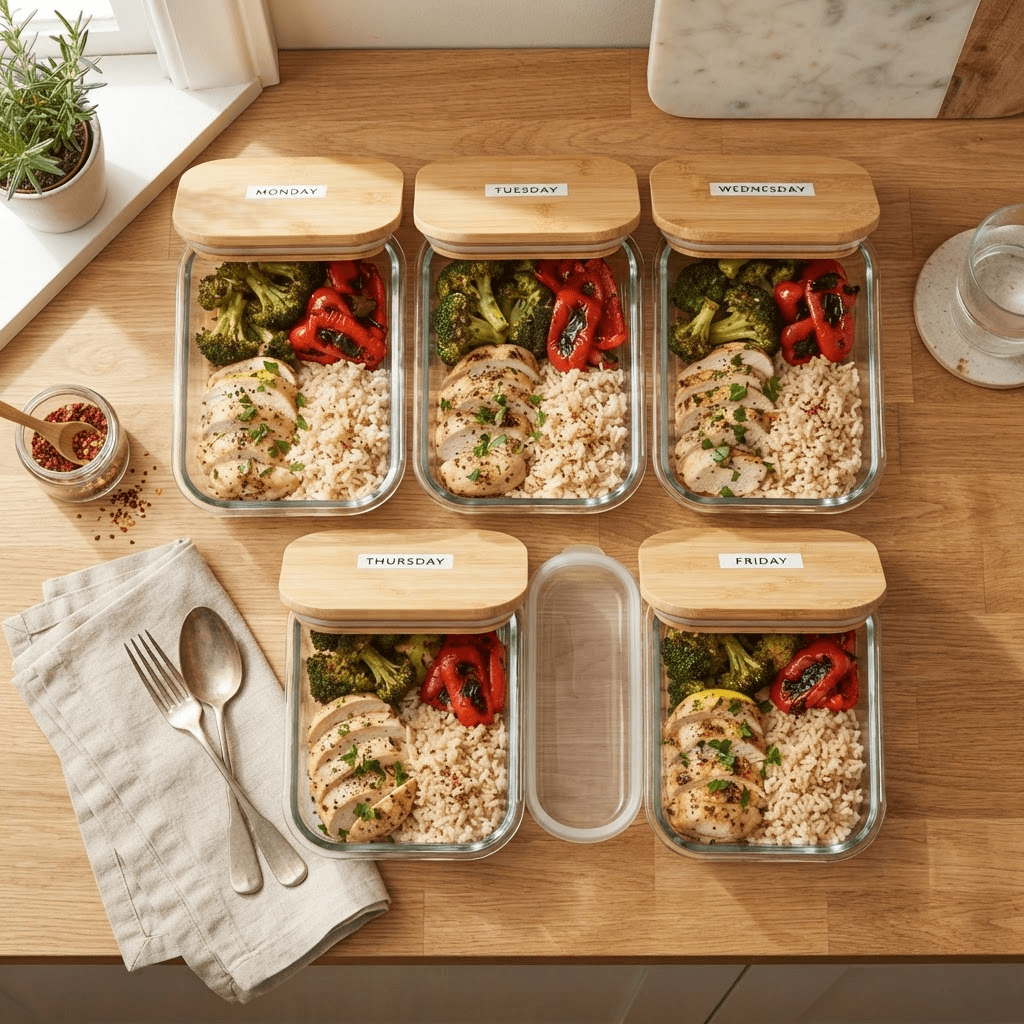
Serve it over rice, quinoa, or a split warm pita, or keep it exactly as is. If you like cooking once and eating twice, this tray reheats beautifully and slots neatly into a wider high-protein meal-prep routine—portion the leftovers into containers straight off the pan while it is still warm.

What is actually on the plate
Per serving, this tray lands at roughly 470 calories with about 38 grams of protein, 34 grams of carbohydrate, 7 grams of fiber and 20 grams of fat—one quarter of the pan with a modest grain on the side. That is an estimate, not a lab result: it shifts with the cut of chicken, how much oil clings to the vegetables and what you serve underneath. Treat the number as a guide, not a guarantee.
What matters more than the exact figures is the shape of the plate: a lean protein, a generous pile of vegetables in several colors, and a starch you can scale to each person's appetite. If you want to build more meals on that template, the rest of our Healthy Recipes collection is built the same way. For anyone managing a specific medical or dietary condition, use targets from your clinician or registered dietitian rather than a general recipe estimate.
Sources for food-safety and child-feeding context
These references support the general safety and feeding guidance above. They do not certify the exact nutrition of a home-cooked tray.
- Safe minimum internal cooking temperaturesFoodSafety.gov
- Offering new foods and repeated exposure for childrenAmerican Academy of Pediatrics — HealthyChildren.org
- Vegetables: nutrition and how cooking affects themHarvard T.H. Chan School of Public Health — The Nutrition Source
Reader questions
Quick answers before the oven beeps
How long do you roast chicken and vegetables on one sheet pan?
At 425°F (220°C), give dense vegetables like potatoes and carrots a 10-minute head start, then add the chicken thighs and quicker vegetables and roast for another 20 to 22 minutes. The chicken is done at an internal temperature of 165°F (74°C).
Why are my sheet-pan vegetables soggy instead of crispy?
Almost always one of two reasons: a cold pan or a crowded pan. Preheat the empty tray with the oven so vegetables sear on contact, and give every piece a little bare metal around it. If the tray is packed, split it across two pans.
Can I use chicken breast instead of thighs?
Yes. Breast cooks faster and dries out more easily, so add it with the second wave of vegetables and pull it the moment it reaches 165°F (74°C). Thighs are more forgiving, which is why the recipe defaults to them.
How do I get picky kids to eat this?
Cook it on one tray, but plate the components separately so nothing is "touching." Anchor the plate with a food they already like, and offer any new vegetable in a small, no-pressure portion. Repeated calm exposure works far better than pressure.
Can I make it vegetarian?
Swap the chicken for chickpeas or firm tofu. Pat tofu very dry for browning, and roast it alongside the vegetables. Add a little extra oil and seasoning since there is no chicken fat rendering onto the tray.
How should I store and reheat leftovers?
Refrigerate within two hours in a covered container and eat within three to four days. Reheat in a hot oven or air fryer to bring back some crispness; the microwave works but softens the vegetables.