Baker's blueprint/ Loaf no. 07
High-Protein Banana Bread That Bakes Up Moist, Not Dry (A Baker’s Blueprint)
Most protein banana bread turns out dry and squeaky because the recipe adds protein and forgets the moisture math. This blueprint balances the loaf so it stays tender for days—with 12–15g of protein a slice and no chalky aftertaste.
- Pan
- 9 x 5 in
- Bake
- 50–60 min
- Doneness
- 205–210°F
- Protein / slice
- 12–15 g
The one rule that fixes every dry loaf
Balance what dries against what moistens
Dries the crumb
- Protein powder
- Eggs
- Oat flour
- Oven time
Moistens the crumb
- Very ripe banana
- Greek yogurt
- Cottage cheese
- A little oil
Add anything to the left column and you must feed the right one back. Every gram of protein is thirsty — match it with moisture and dryness simply disappears.
There is a specific kind of disappointment that comes from a healthy banana bread. It looks right. It slices cleanly. Then you take a bite and it is dry, faintly squeaky and vaguely chalky—the taste of a good idea ruined by too much protein powder and not enough thought. That texture is not bad luck. It is chemistry, and once you see it, you can fix it in every loaf you bake from now on.
This is not a list of ten banana bread recipes. It is one blueprint, explained the way a baker would explain it: what each ingredient is doing, where dryness sneaks in, and the two numbers that decide whether your loaf is tender for days or stale by tomorrow. Follow it and you will get about 12 to 15 grams of protein a slice with a crumb that stays soft—no powder required, though you can use it if you like.
The moisture equation: why healthy banana bread goes dry
Ordinary banana bread is forgiving because it is mostly sugar, fat and refined flour, all of which hold water beautifully. The second you make it “healthier”—swapping in protein powder, cutting the oil, trading white flour for oat flour—you strip out the things that were keeping it moist and add ingredients that actively dry it out. The bread is not failing because it is healthy. It is failing because three moisture sources left at once and nothing replaced them.
Think of every loaf as a simple balance. On one side sits everything that dries: protein powder, egg, flour, and oven time. On the other side sits everything that moistens: ripe banana, yogurt, cottage cheese, oil and a touch of honey or maple. A tender loaf keeps those two sides roughly even. Most failed protein loaves are heavy on the dry side by design, which is exactly why they turn out the way they do.
| Ingredient | Its job | If you cut it |
|---|---|---|
| Very ripe banana | Sweetness, moisture and soft structure | Loaf turns bland, pale and dry—the single most common mistake |
| Greek yogurt | Protein plus tang and a tender crumb | Less protein and a drier, flatter texture |
| Blended cottage cheese | Big protein boost with almost no flavor | You lose ~8–10g protein per loaf; add yogurt to compensate |
| Eggs | Bind the loaf and add protein and lift | Crumbly slices that fall apart when cut |
| A little oil | Coats flour so the crumb stays soft for days | Bread stales fast—fine on day one, sad on day two |
| Oat flour | Fiber, structure and a nutty flavor | Swapping all-purpose in works but reduces fiber |
The blueprint: one loaf, eight slices, ~110g protein
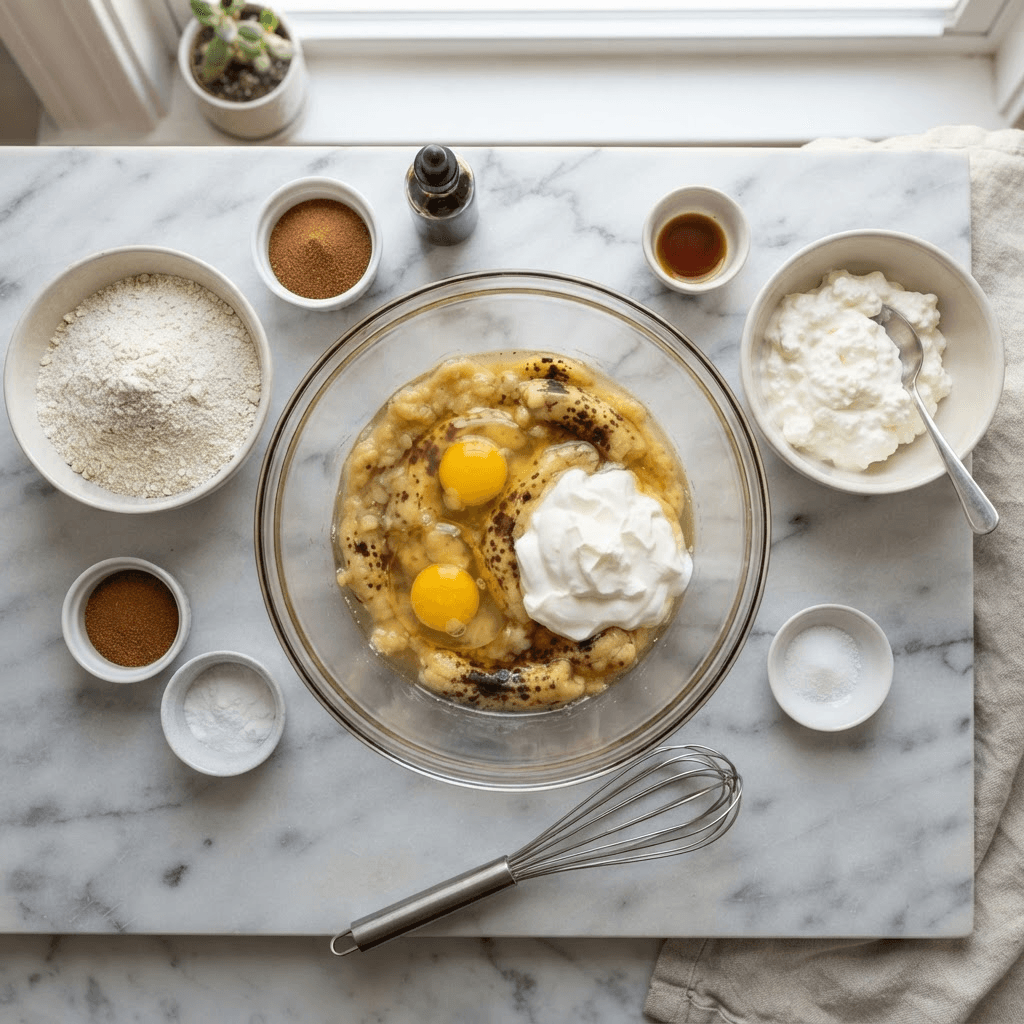
This makes a standard 9x5-inch loaf. It leans on food, not powder, for protein—but there is an optional scoop below if you want to push each slice higher. Measure the banana by weight if you can; “three bananas” can mean anything from 260 to 400 grams, and that swing is enough to change the whole loaf.
Wet ingredients
- 300g very ripe mashed banana (about 3 large, heavily spotted)
- 2 large eggs, room temperature
- 150g plain Greek yogurt (0% or 2%)
- 120g cottage cheese, blended smooth
- 3 tbsp neutral oil or melted butter
- 3 tbsp honey or maple syrup (bananas do most of the sweetening)
- 1 tsp vanilla extract
Dry ingredients
- 200g oat flour (or all-purpose, or a 50/50 mix)
- 1 scoop (~30g) vanilla whey or plant protein — optional, see note
- 1 tsp baking soda
- 1 tsp baking powder
- 1 tsp cinnamon
- 1/2 tsp fine salt
Method: the order that keeps the crumb tender
Banana bread is a quick bread, which means the enemy is overmixing. Once flour meets liquid, gluten starts forming, and the more you stir, the tougher and more tunnel-holed the loaf becomes. The whole method below is built to mix as little as possible.
- Heat the oven to 350°F (175°C) and line a 9x5 loaf pan with parchment, leaving an overhang so you can lift the loaf out later.
- Blend the cottage cheese until completely smooth—no visible curds. This one step is why the crumb reads as cake, not casserole.
- In a large bowl, whisk all the wet ingredients together until uniform: banana, eggs, yogurt, blended cottage cheese, oil, honey and vanilla.
- In a second bowl, whisk the dry ingredients so the leavening is evenly distributed. Lumps of baking soda leave metallic spots.
- Tip the dry into the wet and fold with a spatula just until no streaks of flour remain. Stop while it still looks a little rough. Fewer than 15 folds is the goal.
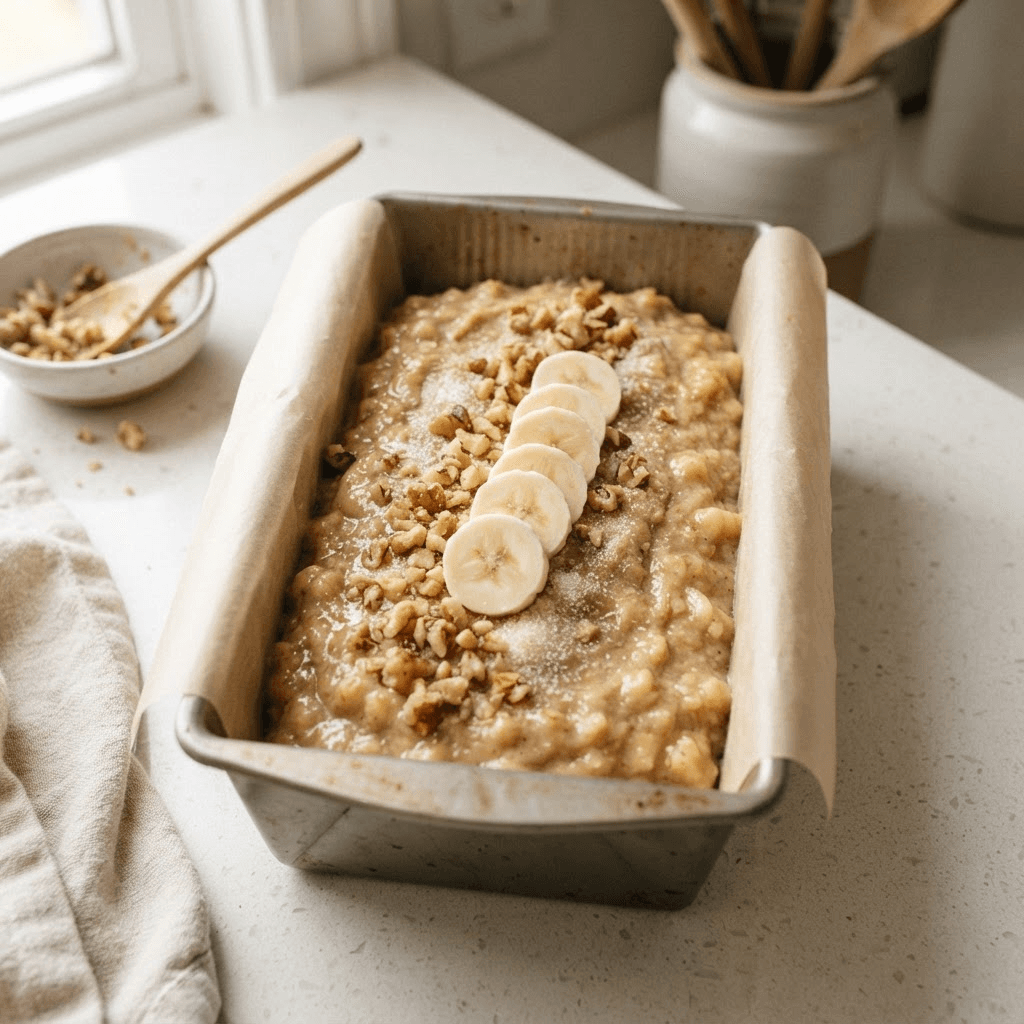
- Scrape into the pan, smooth the top, and add any toppings. Bake 50–60 minutes.
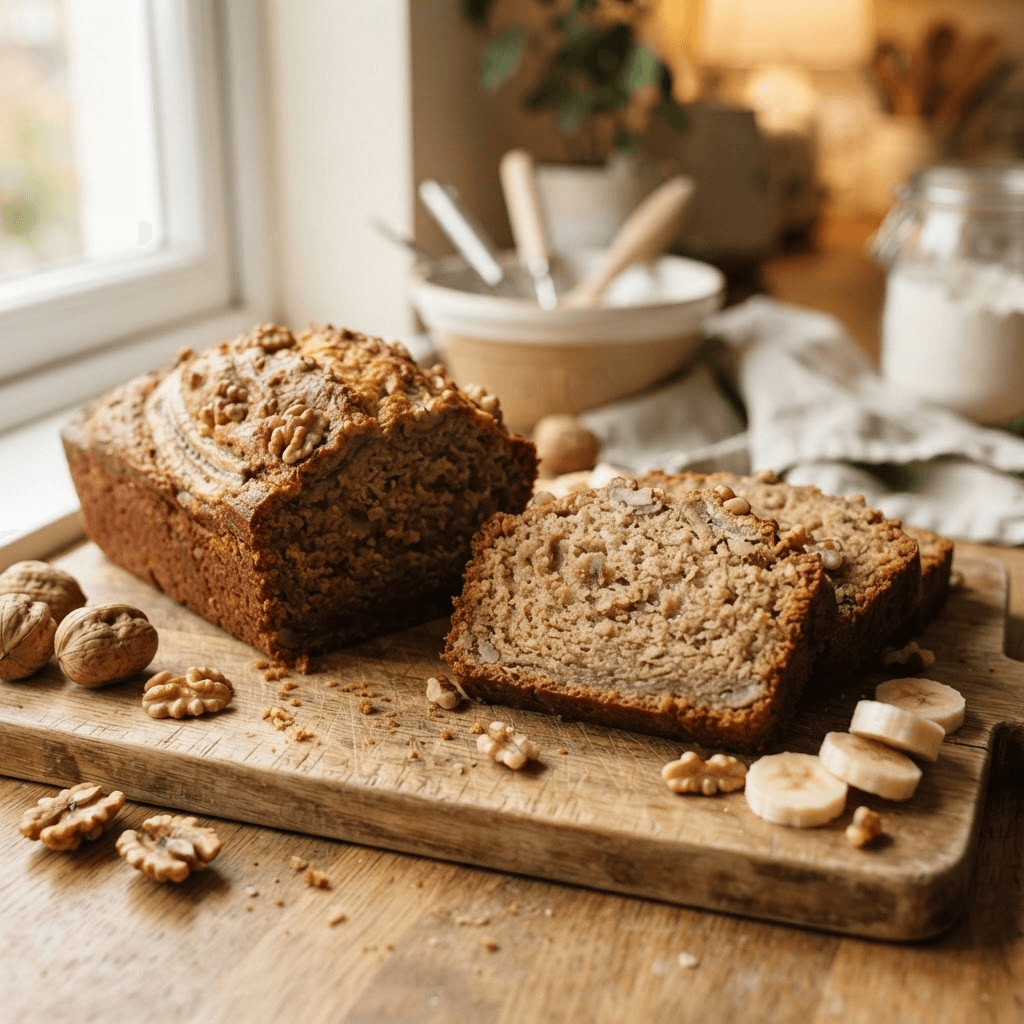
- Start checking at 50 minutes. The loaf is done at 205–210°F (96–99°C) in the center on an instant-read thermometer, or when a skewer comes out with a few moist crumbs—not wet batter, not bone dry.
- Cool in the pan 15 minutes, then lift it out and cool fully on a rack before slicing. Cutting hot bread compresses the crumb and lets steam—your moisture—escape.
The difference between moist and dry banana bread is usually the last eight minutes in the oven. Buy a $12 thermometer and stop guessing.
How to hit your protein number (with or without powder)
People arrive at high-protein banana bread from two directions. Some want food-based protein and a clean label; others just want the biggest number per slice. Both are valid. Here is what each addition actually buys you, so you can build the loaf around your own target rather than copying someone else’s.
| Add this | Protein added | Trade-off |
|---|---|---|
| 150g Greek yogurt | ~15g | None—also improves texture |
| 120g blended cottage cheese | ~14g | Must blend smooth or texture suffers |
| 2 whole eggs | ~12g | Already in the base recipe |
| 1 scoop whey (~30g) | ~24g | Needs extra moisture to avoid dryness |
| 3 tbsp oat flour vs white | ~4g + fiber | Slightly denser, nuttier crumb |
Stacked together, the food-based version lands near 110 grams of protein for the whole loaf, or roughly 13 to 14 grams a slice, with real fiber from the oat flour and banana. Add the optional scoop and you are closer to 17 grams a slice. If you want to understand where these numbers come from across your whole day, our guide to high-protein foods and how much you actually need puts a single slice in context.
Four variations that keep the balance intact
Add-ins are where good loaves go wrong, because most of them are dry (chocolate chips, nuts) or watery (fresh berries) and both throw off the equation. These four are tuned to stay balanced.
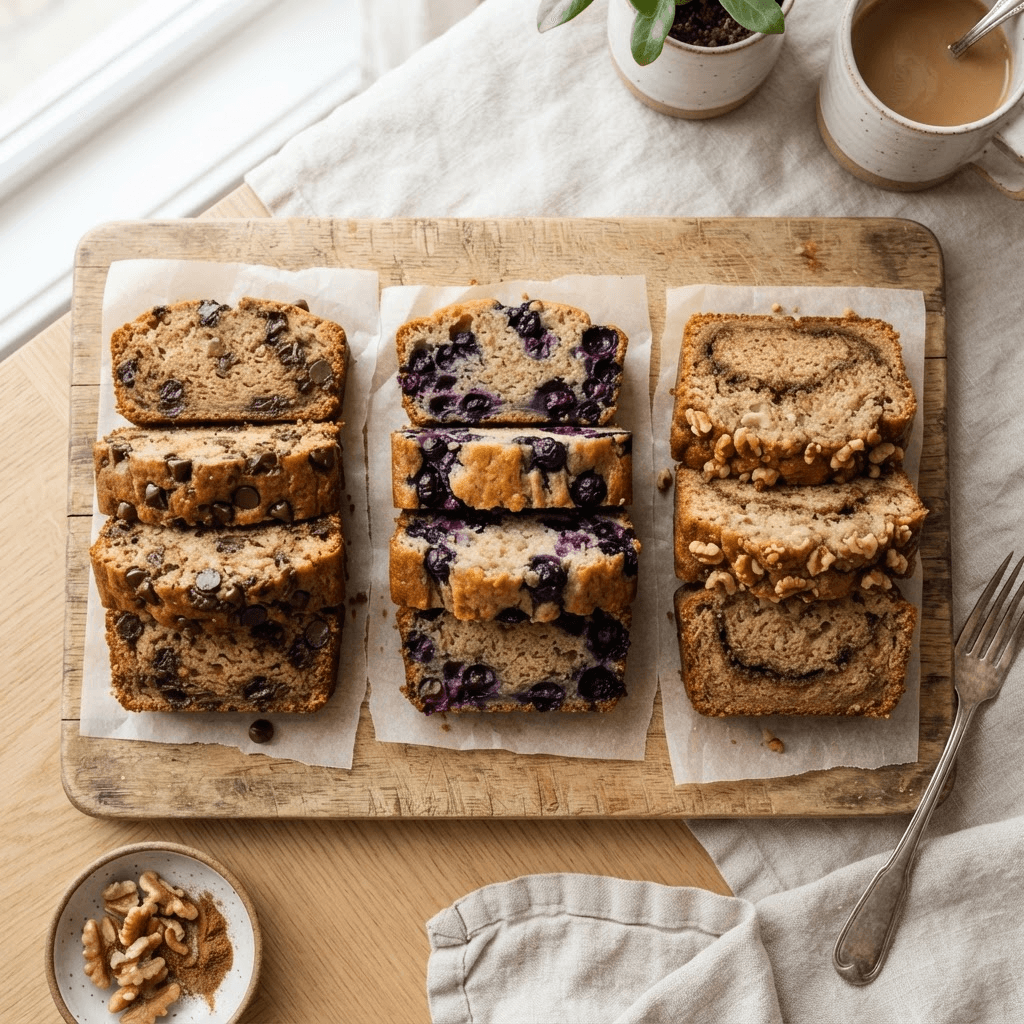
Dark chocolate chip
Fold in 60g of dark chocolate chips at the end. Chocolate is dry, so this is the one variation where an extra tablespoon of yogurt genuinely helps. It is the crowd-pleaser and the one most likely to convert a skeptic.
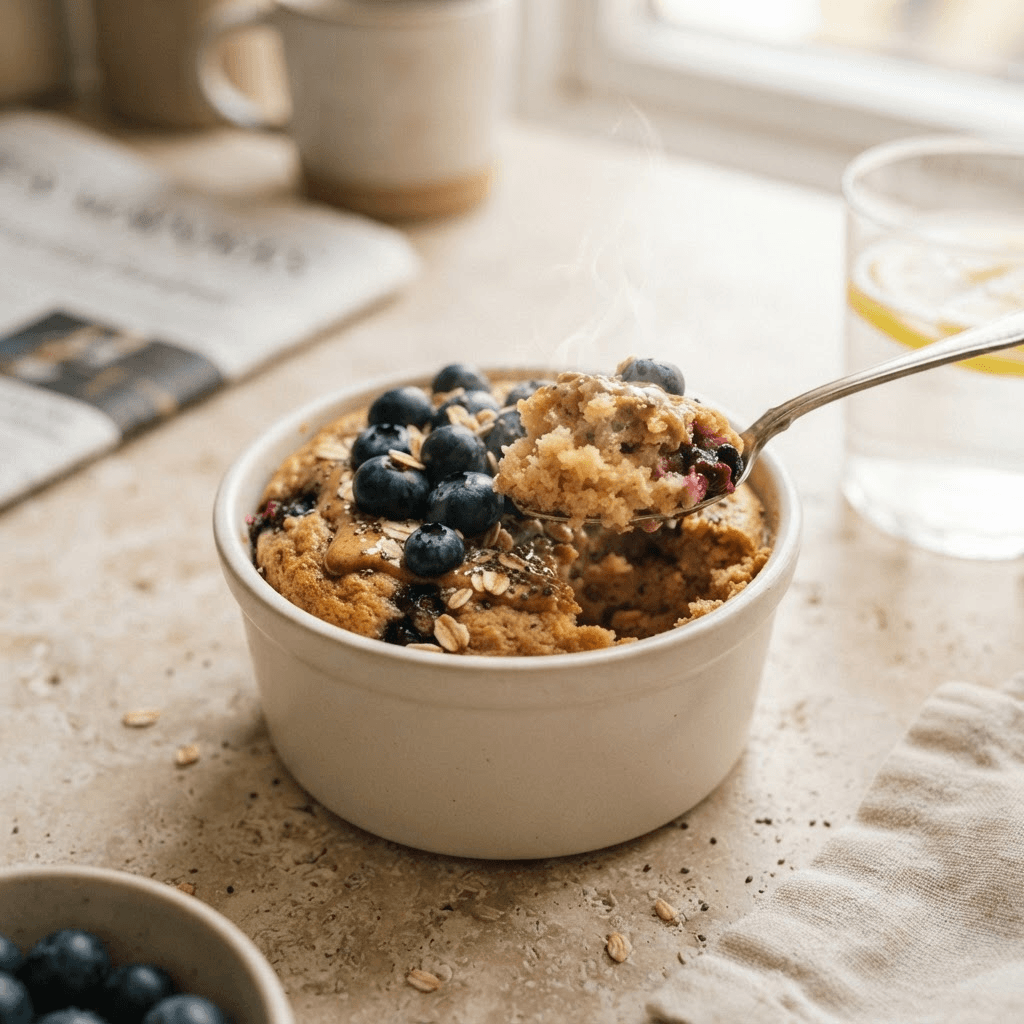
Blueberry
Use 80g of frozen (not thawed) blueberries tossed in a teaspoon of the flour so they do not sink or bleed. Frozen berries release less water into the batter than fresh, which protects your texture.
Walnut cinnamon swirl
Fold in 50g chopped walnuts and layer a cinnamon-honey swirl through the middle. This is the closest to a bakery loaf and adds healthy fats without wrecking the crumb.
Peanut butter banana
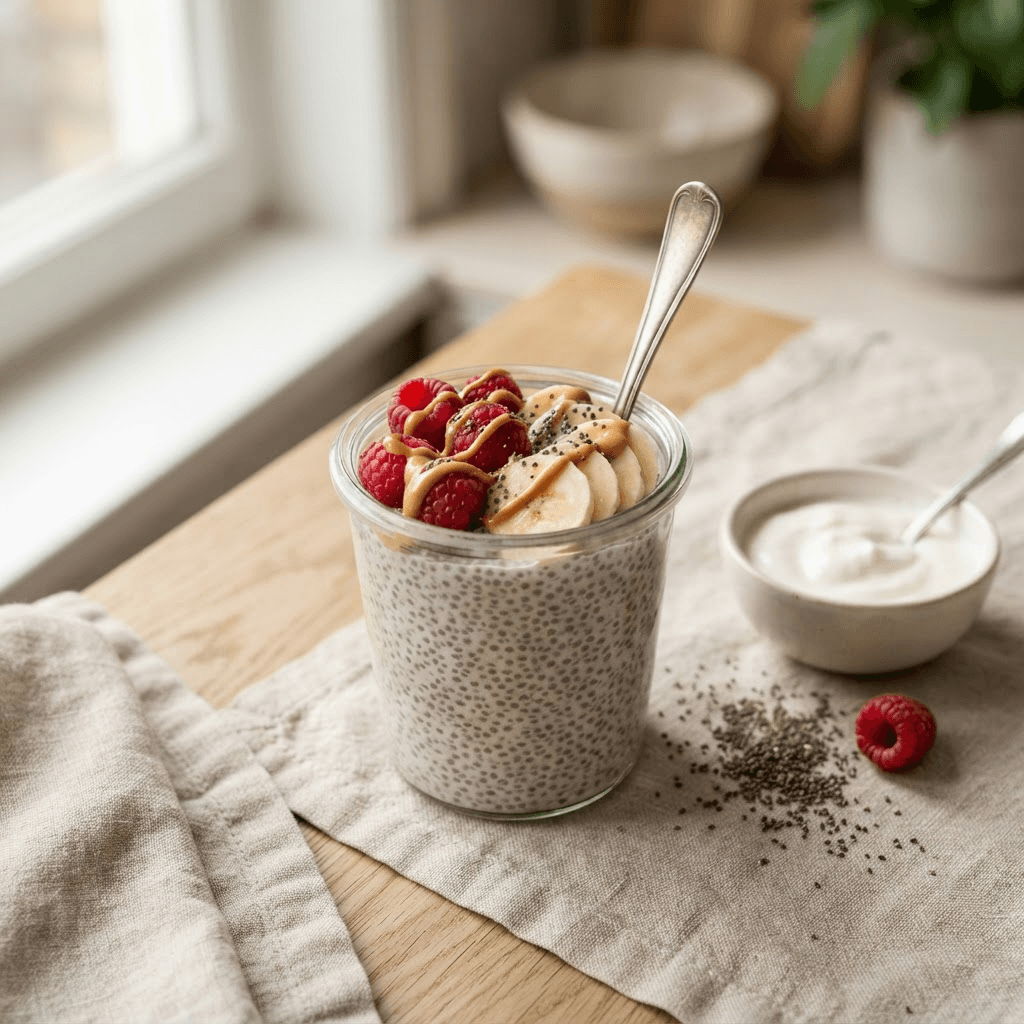
Dollop 3 tablespoons of natural peanut butter on top and swirl with a knife. It adds protein and fat and pairs naturally with banana—think of it as the baked cousin of a peanut-butter chia pudding.
Storage: how long it actually stays good
This loaf holds better than most healthy bakes because the yogurt, banana and oil keep the crumb soft. But it is a real-food bread with no preservatives, so treat it like one.
| Method | How long | The trick |
|---|---|---|
| Counter, airtight | 2 days | Cool completely first; a warm loaf steams itself soggy |
| Fridge, airtight | 5–6 days | Best for meal prep; warm a slice 10 seconds to revive it |
| Freezer, sliced | 3 months | Freeze slices with parchment between them; toast straight from frozen |
An honest word on the nutrition
High-protein banana bread is a genuinely useful food: it is portable, it satisfies, and it turns three sad bananas into a week of breakfasts. It is not a health tonic, and it does not need to be. It is bread. A slice with 13 grams of protein and a few grams of fiber is a better everyday choice than most grab-and-go pastries, and that is a reasonable bar to clear.
The exact numbers on your loaf will shift with your banana size, your yogurt and whether you add powder, so treat any figure here as an estimate rather than a lab result. If you want steadier energy from what you eat around it, pairing a slice with protein and fiber—the logic behind our high-fiber foods guide—does more for your morning than chasing the highest possible protein count in the bread itself.
Sources for the nutrition and food-safety context
These public-health and academic sources support the guidance on protein, whole grains and safe home storage.
- Protein in the dietMedlinePlus (U.S. National Library of Medicine)
- Whole grains and healthHarvard T.H. Chan School of Public Health
- Leftovers and food safetyFoodSafety.gov
Tape this to the fridge
The five-point crumb checklist
- 01Dry protein banana bread is a moisture problem, not a protein problem—every gram of protein you add needs a matching gram of moisture.
- 02Very ripe, heavily spotted bananas are the difference between a sweet, tender loaf and a bland, gummy one.
- 03Greek yogurt and blended cottage cheese add protein while keeping the crumb soft, so you can skip protein powder entirely if you want.
- 04Pull the loaf at 205–210°F (96–99°C) in the center; a few extra minutes is what turns moist into dry.
- 05One loaf gives you eight slices at roughly 12–15g of protein each—a genuine grab-and-go breakfast or snack.
From the mixing bowl
Banana bread questions, from the mixing bowl
Why is my protein banana bread always dry?
Almost always because protein powder or extra flour pulled moisture out and nothing replaced it. Add 2 extra tablespoons of Greek yogurt or milk when you add powder, use very ripe bananas, and stop baking at 205–210°F (96–99°C) in the center. Over-baking by even eight minutes is a common cause.
Can I make high-protein banana bread without protein powder?
Yes, and it is the version we recommend first. Greek yogurt, blended cottage cheese and two eggs bring the whole loaf to roughly 110 grams of protein—about 13–14 grams a slice—with no chalky aftertaste. The optional scoop is only there if you want to push the number higher.
How ripe should the bananas be?
Heavily spotted, almost black-skinned bananas are ideal. They are sweeter, softer and far more flavorful than yellow ones. If yours are not there yet, bake them (skin on) at 300°F for 15–20 minutes until the skins blacken, then cool and mash.
Can I use all oat flour instead of all-purpose?
Yes. Oat flour adds fiber and a nutty flavor and works well here. The crumb will be slightly denser and more tender. A 50/50 blend with all-purpose gives you a texture closest to classic banana bread if that is what you are after.
How do I blend cottage cheese smooth?
Add it to a small blender or food processor and run it for 30–60 seconds until no curds remain and it looks like thick cream. This is the single step that stops the loaf from tasting savory or lumpy. An immersion blender in a tall cup also works.
Is this recipe good for meal prep?
Very. Slice the whole loaf, freeze the slices flat with parchment between them, and toast straight from frozen. Each slice is a ready-made high-protein breakfast or snack for up to three months.
Can I make it gluten-free?
Use certified gluten-free oat flour and a certified gluten-free protein powder if you add one. Check that your baking powder is gluten-free too. The rest of the recipe is naturally free of gluten-containing ingredients.
How much protein is in one slice?
The food-based version is about 13–14 grams a slice across eight slices. Adding a scoop of whey brings it closer to 17 grams. Exact numbers depend on your banana size, yogurt and any add-ins, so treat these as estimates.